

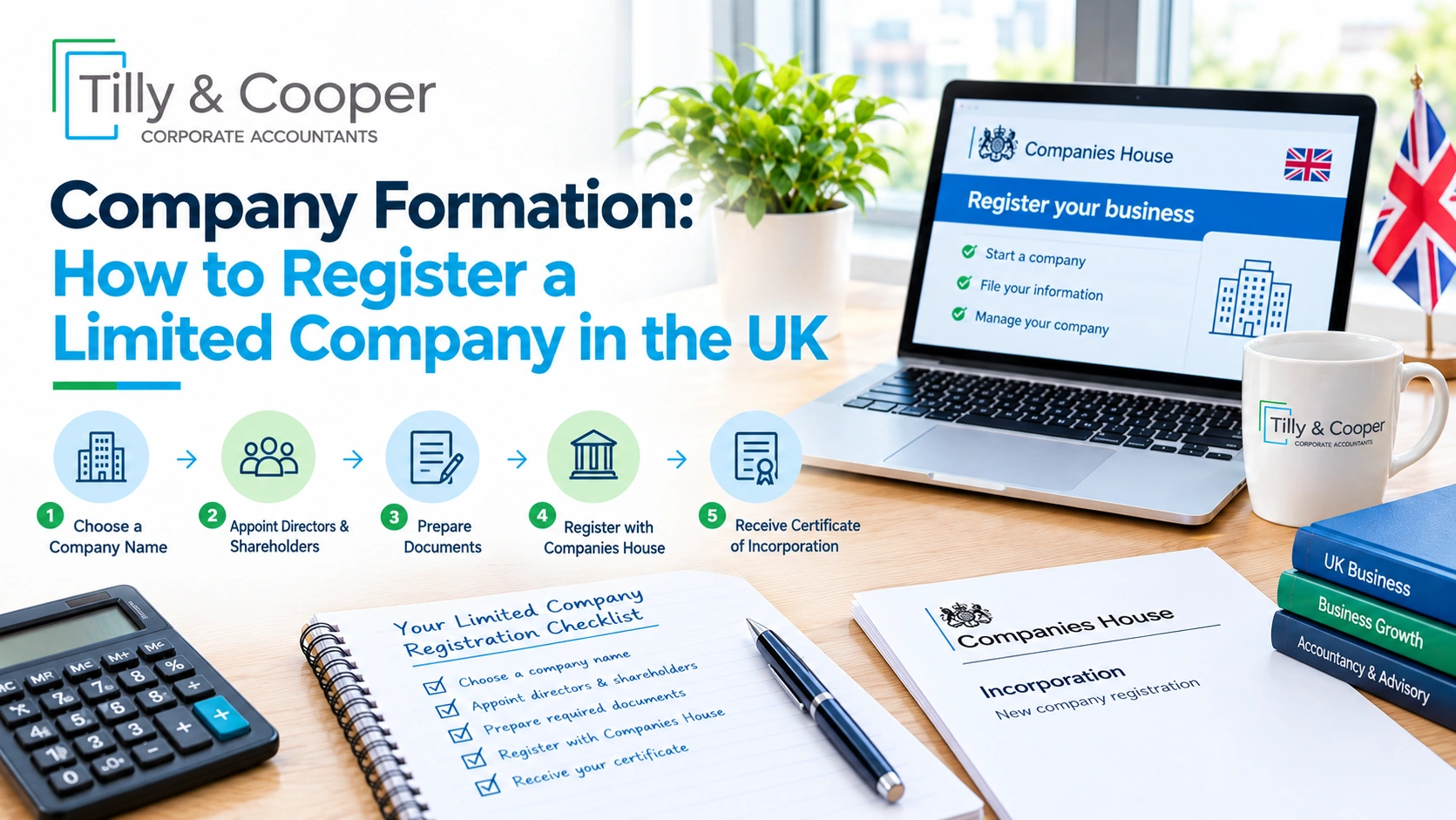
Company Formation: How to Register a Limited Company in the UK
Company formation is the legal process of creating and registering a company with Companies House. Once incorporated, a limited company becomes a separate legal entity from its owners. In the UK, forming a private limited company involves choosing an acceptable company name, appointing at least one director, deciding the ownership structure, identifying people with significant control (PSCs), providing an appropriate registered office address, and submitting an incorporation application to Companies House.
Identity verification is now an important part of UK company registration. New directors must verify their identity and provide their Companies House personal code when they are appointed during incorporation. PSCs are also subject to identity-verification requirements. Most straightforward private limited companies can be formed online.
The standard Companies House online incorporation fee is £100 in 2026, and a normal online application is usually processed within 24 hours. This guide explains what company formation means, what information you need, how to register a limited company, current Companies House costs, and what you must do after incorporation.
What Is Company Formation?
Company formation is the process of legally creating and registering a company with Companies House. Once Companies House accepts the incorporation application, it issues a Certificate of Incorporation. The certificate confirms:
- the company’s legal name
- company registration number
- date of incorporation
A private limited company has a separate legal identity from its shareholders. This means the company can:
- own assets
- enter contracts
- employ staff
- borrow money
- receive income
- incur liabilities
- continue operating when ownership changes
Most profit-making UK limited companies are formed as private companies limited by shares. Businesses may choose incorporation for limited liability, separate legal identity, commercial credibility, investment opportunities and business continuity.
What Types of Limited Companies Can You Form in the UK?
The main types of UK limited companies are companies limited by shares, companies limited by guarantee, public limited companies and Community Interest Companies.
Common structures include:
- Private company limited by shares (Ltd) – normally used by commercial businesses with shareholders.
- Private company limited by guarantee – commonly used by membership organisations and not-for-profit bodies.
- Public limited company (PLC) – designed for larger businesses that may offer shares to the public.
- Community Interest Company (CIC) – a limited company designed to carry out activities for community benefit.
A Limited Liability Partnership (LLP) is another incorporated UK business structure, but it is not a limited company. It combines partnership features with separate legal personality and normally requires at least 2 designated members.
How Many People Are Required to Form a Limited Company?
One person can form a private limited company in the UK. A company limited by shares must normally have:
- at least one director
- at least one shareholder
The same individual can act as both the sole director and sole shareholder. At least one company director must be an individual, and an individual director must normally be at least 16 years old. Private limited companies do not normally need to appoint a company secretary. A company limited by guarantee needs at least one guarantor instead of a shareholder.
What Information and Documents Do You Need to Form a Company?
Company formation requires you to prepare key information before registering a company. This includes a company name, registered office, registered email address, director details, ownership information, PSC details, SIC code, and constitutional documents. Preparing these details before submitting the application can reduce delays and help ensure the company’s legal structure is set up correctly.
What Company Name Do You Need?
Choose a company name that complies with Companies House rules and does not conflict with an existing registered name. A private limited company name normally ends with:
- Limited
- Ltd
Company formation in the UK starts with choosing a company name that follows Companies House naming rules. Welsh equivalents may apply to qualifying Welsh companies. Companies House will not normally register a name that is legally considered the same as an existing registered company name. A business may also have to change its name if it is judged to be too like another registered name after a valid complaint. Certain sensitive words and expressions require approval before they can be included in a company name. Checking these requirements before registration can help make the company formation process smoother and reduce the risk of delays or rejected applications.
You should also check:
- existing UK trade marks
- domain-name availability
- relevant social-media names
A Companies House name check does not establish that the proposed brand is free from intellectual-property risks.
What Registered Office Address Do You Need?
Every limited company must maintain an appropriate registered office address in the UK jurisdiction where it is incorporated. For example, a company registered in Scotland must maintain its registered office in Scotland. The registered office must be a physical and appropriate address where:
- documents sent to the company can reasonably be expected to reach someone acting on its behalf
- delivery can be acknowledged
A PO Box alone cannot normally be used. The registered office appears on the public Companies House register. Business owners who want to keep their home address private should consider whether a suitable professional registered office service is appropriate.
Do You Need a Registered Email Address?
Yes. A new company must provide Companies House with an appropriate registered email address. Companies House uses this email address for official communications. The registered email address is not displayed on the public register. The company should:
- maintain access to the email address
- monitor messages received through it
- update Companies House if the email address changes
What Director Information Is Required?
A private limited company must appoint at least one director and provide the required director information to Companies House. Information can include:
- full legal name
- date of birth
- nationality
- occupation
- service address
- usual residential address
Some director information appears on the public register. The director’s usual residential address is normally protected from general public access. Directors do not have to live in the UK.
Do Directors Need to Verify Their Identity?
Yes. New directors are subject to Companies House identity-verification requirements. A new director normally needs to:
- complete the required identity verification
- receive a Companies House personal code
- provide that personal code when being appointed
Identity can be verified through the available Companies House route or through an Authorised Corporate Service Provider (ACSP) that provides identity-verification services. The personal code connects the verified individual with their Companies House appointments.
What Shareholder and Share Information Is Required?
A company limited by shares must have at least one shareholder and a defined share structure. You should determine:
- shareholder names
- number of shares
- nominal value of each share
- share classes
- voting rights
- dividend rights
- other rights attached to the shares
For example:
100 ordinary shares at £1 each creates nominal share capital of £100. The nominal value of the shares should not be confused with the commercial value of the business. The company’s share information forms part of its statement of capital.
What Is a Person With Significant Control?
A Person with Significant Control is an individual or relevant legal entity that owns or exercises significant control over the company. A person may be a PSC where they:
- hold more than 25% of the company’s shares
- hold more than 25% of its voting rights
- have the right to appoint or remove a majority of directors
- otherwise exercise significant influence or control
PSC information must be identified and reported correctly. PSCs are also subject to identity-verification requirements. Where an individual PSC is required to provide their verified identity information, they must give Companies House their personal code during the applicable 14-day period. PSC identity verification is therefore related to, but separate from, the director appointment process.
What SIC Code Do You Need?
A Standard Industrial Classification code identifies the business activities carried out by the company.
Different SIC codes apply to activities such as:
- accounting
- consultancy
- software development
- construction
- retail
- property letting
- e-commerce
- marketing
Choose the code or codes that accurately describe the company’s intended activities. Do not select unrelated codes simply to cover every possible future activity.
What Are the Memorandum and Articles of Association?
The memorandum and articles of association are key constitutional documents used when forming a company. The memorandum of association records the initial subscribers who agree to form the company. The articles of association set out rules governing how the company operates. A straightforward company can normally adopt the standard model articles.
A company with:
- several founders
- different share classes
- special voting rights
- investor protections
- bespoke dividend rights
may require customised articles and professional legal advice.
Who Can Form a Company in the UK?
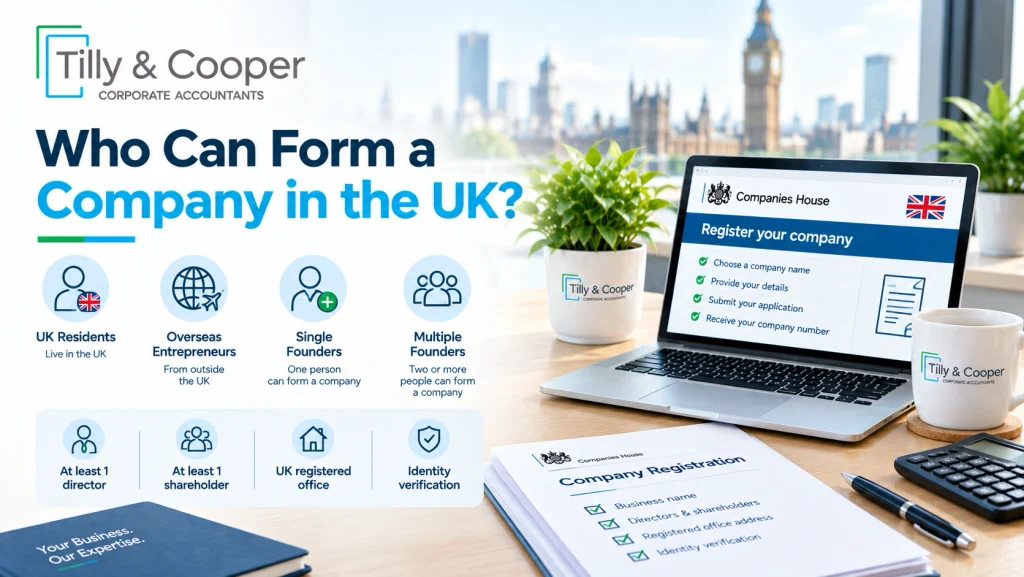
Both UK residents and non-UK residents can form a UK limited company if the incorporation requirements are satisfied. A company can be formed by:
- UK entrepreneurs
- overseas entrepreneurs
- contractors
- consultants
- e-commerce businesses
- property investors
- sole traders incorporating an existing business
- several founders starting a new business
Directors are not generally required to live in the UK. However, the company still needs an appropriate registered office address in the relevant UK jurisdiction. An individual director must normally be at least 16 and must not be prevented from acting because of a director disqualification or another applicable legal restriction.
Forming a UK company does not automatically provide UK immigration rights, a visa or UK tax residence. Non-UK resident founders should consider their personal and business tax positions separately.
How Do You Form a Limited Company in the UK?
You form a limited company by deciding the company structure, completing the required identity verification, preparing incorporation information and submitting the application to Companies House.
A practical formation process follows 8 steps.
Step 1: Decide the Company Structure
Choose the legal structure that suits the organisation. Most commercial businesses use a: private company limited by shares
You should also decide:
- who will own the company
- who will act as directors
- how many shares will be issued
- whether different share classes are needed
These decisions should be made before the incorporation application is submitted.
Step 2: Check the Company Name
Search the Companies House register to check whether the proposed name can be registered.
Also consider:
- similar registered names
- sensitive words
- restricted expressions
- UK trade marks
- domain availability
A company being available at Companies House does not mean the same name is safe to use as a trade mark.
Step 3: Verify the Directors’ Identities
New directors should complete the required Companies House identity-verification process before or as part of the relevant appointment process. Each verified individual receives a Companies House personal code.
The code is then used to connect the verified identity to the director appointment. Identity verification can be completed through the available Companies House process or through an appropriate ACSP.
Step 4: Prepare the Registered Office and Email Address
Set up:
- an appropriate UK registered office address
- a registered company email address
Both should be ready before the application is submitted. The registered office is publicly visible. The registered email address is not.
Step 5: Set the Ownership and Control Structure
Determine:
- directors
- shareholders or guarantors
- share quantities
- share classes
- nominal values
- voting rights
- PSCs
This information should be correct from incorporation. Poorly designed share structures can create legal, tax and administrative complications later.
Step 6: Choose the SIC Code and Company Documents
Select the SIC code or codes that accurately describe the company’s activities. Then decide whether the company will use:
- standard model articles
- bespoke articles of association
Companies limited by shares must also provide the required statement of capital.
Step 7: Submit the Companies House Application
Submit the incorporation application to Companies House using the appropriate online, software or paper filing route.
The application can include:
- company name
- registered office
- registered email
- director details
- identity-verification information
- shareholder or guarantor information
- share capital
- PSC information
- SIC code
- constitutional information
Subscribers must also confirm that the company is being formed for a lawful purpose.
Step 8: Receive the Certificate of Incorporation
The company legally exists once Companies House accepts the application and issues the Certificate of Incorporation.
The certificate confirms:
- legal company name
- company registration number
- date of incorporation
The company can then begin operating subject to its tax, regulatory and commercial requirements.
How Much Does Company Formation Cost?
Standard online limited company incorporation costs £100 through Companies House in 2026.
The main Companies House incorporation fees are:
| Registration method | Companies House fee |
| Online incorporation | £100 |
| Software incorporation | £100 |
| Paper incorporation | £124 |
| Software same-day incorporation | £156 |
These fees have applied since 1 February 2026.
A Community Interest Company has different filing fees. The standard online CIC incorporation fee is £115. Professional company formation services cost extra. Depending on the provider, these services may include:
- application preparation
- company name checks
- share-structure support
- registered office services
- identity-verification assistance
- company documents
- tax registration support
- ongoing company secretarial services
Compare what is included in the service rather than relying only on the headline price.
How Long Does Company Formation Take?
Companies House normally registers a straightforward online company within 24 hours, although some applications can take longer.
Standard online incorporation does not guarantee same-day approval.
A typical process may look like this:
| Stage | Typical position |
| Prepare company information | Same day |
| Complete identity verification | Depends on verification method |
| Submit online application | Usually completed quickly |
| Companies House review | Normally within 24 hours |
| Certificate of Incorporation | Issued after approval |
| Bank-account setup | Depends on the provider |
Paper incorporation takes longer because the application requires manual processing. Paper filings sent by post can take a week or more. Applications can also be delayed where Companies House:
- identifies inconsistent information
- requests additional evidence
- queries an address
- queries a company name
- cannot verify required information
Accurate preparation helps reduce avoidable delays.
What Happens After Company Formation?
After incorporation, the company must establish its banking, tax, accounting and ongoing Companies House compliance arrangements.
Receiving a Certificate of Incorporation is the beginning of the company’s legal life rather than the end of its responsibilities.
Open a Business Bank Account
A dedicated business bank account helps separate company money from the personal finances of directors and shareholders.
Banks may request:
- Certificate of Incorporation
- company registration number
- director identification
- business activity details
- shareholder information
- PSC information
Requirements vary between banks and payment providers. A limited company has a separate legal identity, so keeping its money separate from personal finances supports accurate bookkeeping and financial control.
Do You Need to Register for Corporation Tax?
Companies incorporated through the standard online service are usually set up for Corporation Tax at the same time unless they are dormant. However, incorporation does not remove the company’s responsibility to ensure HMRC has the correct information when it becomes active.
Where separate notification is required, an active company within the charge to Corporation Tax generally needs to notify HMRC within 3 months of starting the relevant tax accounting period.Dormant companies have different Corporation Tax requirements.
Register for VAT Where Required
A company must register for VAT when the applicable statutory registration conditions are met. Voluntary VAT registration may also be available before registration becomes compulsory. VAT registration depends on the company’s taxable activities and turnover rather than simply on being incorporated.
Register for PAYE Where Required
A company should consider PAYE registration if it employs staff or pays directors through payroll in circumstances requiring PAYE.
PAYE responsibilities can include:
- calculating salaries
- deducting Income Tax
- calculating National Insurance
- reporting payroll information to HMRC
- issuing payslips
PAYE registration is separate from ordinary Companies House compliance.
Consider the Construction Industry Scheme
Construction businesses should check whether they need to register under the Construction Industry Scheme. A company may need CIS registration as:
- a contractor
- a subcontractor
- both
CIS registration depends on the company’s construction activities.
Maintain Company and Accounting Records
Directors must ensure that adequate company and accounting records are maintained.
Relevant records can include:
- sales invoices
- supplier invoices
- receipts
- bank statements
- expense records
- payroll information
- asset records
- director information
- shareholder information
- supporting tax documents
Accurate records support annual accounts, Corporation Tax calculations and other compliance duties.
File Annual Accounts
Most companies must file annual accounts with Companies House, including companies that are dormant. For a private company, first accounts covering more than 12 months are normally due 21 months after incorporation. Where the first accounting period is 12 months or less, the deadline is normally 9 months after the accounting reference date. Subsequent private-company accounts are generally due 9 months after the end of the financial year. Late accounts can result in automatic financial penalties.
From 1 April 2028, UK companies will be required to file annual accounts with Companies House using commercial software. Web and paper accounts filing will no longer be available. Businesses should therefore ensure their accounting systems are capable of supporting digital filing before the new requirement takes effect.
File a Confirmation Statement
Every company must file a confirmation statement with Companies House at least once every 12 months. The confirmation statement checks whether information held on the register remains correct. The company normally has 14 days after the review period ends to file it.
The standard digital confirmation statement fee is £50 in 2026. The company must also provide the required lawful-purpose confirmation. A confirmation statement is required even where no company information has changed.
What Are the Benefits of Forming a Limited Company?
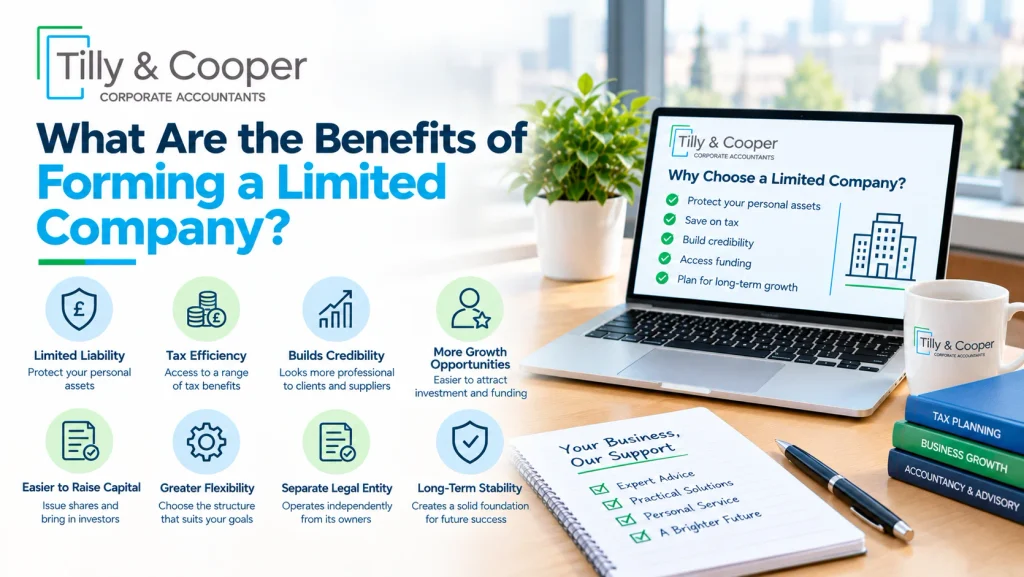
A limited company can provide limited liability, separate legal identity, ownership flexibility and greater opportunities for business continuity and investment.
Limited Liability
Shareholders of a company limited by shares normally have liability limited to the amount unpaid on their shares. This separates ordinary company debts from shareholders’ personal finances. However, limited liability does not protect directors or shareholders in every situation.
Personal liability can still arise through matters such as:
- personal guarantees
- fraud
- director misconduct
- certain legal breaches
Separate Legal Identity
The company exists separately from its shareholders and directors. It can:
- own property
- hold money
- enter contracts
- borrow
- employ staff
- incur liabilities
in its own name.
Business Continuity
A company can continue to exist when directors or shareholders change. This can make ownership transfers and succession easier to manage.
Investment Opportunities
A company limited by shares can issue shares and introduce new shareholders. This can make it easier to raise equity investment compared with operating as a sole trader.
Commercial Credibility
Some clients, lenders, suppliers and investors prefer dealing with incorporated businesses. However, incorporation alone does not prove that a business is profitable, reliable or financially secure.
Tax and Remuneration Planning
A limited company may provide different options for paying directors and shareholders, including salary and dividends where legally available. However, forming a limited company does not automatically reduce tax.
The result depends on:
- company profits
- salaries
- dividends
- other income
- Corporation Tax
- personal tax circumstances
Tax should therefore be assessed alongside commercial and legal considerations.
What Mistakes Should You Avoid When Registering a Company?
Common company registration mistakes involve company names, addresses, identity verification, share structures, PSC information and post-incorporation compliance.
Avoid:
- choosing a name without checking Companies House
- ignoring existing trade marks
- using an inappropriate registered office
- unnecessarily publishing a residential address
- failing to maintain a registered email address
- entering incorrect director details
- failing to complete identity verification
- providing the wrong Companies House personal code
- creating an unsuitable share structure
- entering incorrect shareholder information
- failing to identify PSCs correctly
- choosing unrelated SIC codes
- using unsuitable articles of association
- mixing personal and company finances
- ignoring tax-registration requirements
- missing annual accounts deadlines
- missing confirmation statement deadlines
Share structures deserve particular attention. A simple structure involving one class of ordinary shares is often easier to manage than several classes with different voting, dividend and capital rights. Seek professional advice where ownership rights are complex.
Can a Non-UK Resident Form a UK Company?
Yes. A non-UK resident can form, own and direct a UK private limited company. There is no general requirement for company directors or shareholders to live in the UK. The company still needs:
- an appropriate UK registered office
- registered email address
- at least one eligible director
- shareholders or guarantors
- PSC information
- acceptable company name
- suitable SIC code
- incorporation documents
- required identity verification
Overseas founders may face additional due-diligence requirements when opening UK bank accounts or using payment providers. They may also need to consider:
- UK Corporation Tax
- personal tax residence
- Overseas tax obligations
- double-taxation agreements
- VAT
- PAYE
- permanent-establishment rules
Forming or owning a UK company does not by itself provide a UK visa or the right to live or work in the UK.
What Happens If Companies House Rejects Your Application?
Companies House can reject or query an incorporation application where required information is missing, inconsistent, invalid, or does not satisfy legal requirements.
Common issues can include:
- unacceptable company name
- missing approval for a sensitive word
- unsuitable registered office information
- incomplete director details
- missing identity-verification information
- incorrect shareholder details
- incomplete PSC information
- missing constitutional documents
- inconsistent incorporation information
Companies House has stronger powers to query information and request supporting evidence where information appears inaccurate or inconsistent. If the application is rejected, review the explanation carefully, correct the issue and submit the application again using the appropriate process.
Checking the information before submission reduces the risk of rejection.
What Is the Difference Between a Company Limited by Shares and Guarantee?
A company limited by shares has shareholders and share capital, while a company limited by guarantee has guarantors and normally does not have share capital.
| Company Limited by Shares | Company Limited by Guarantee |
| Has shareholders | Has guarantor members |
| Has share capital | Normally has no share capital |
| Common for commercial businesses | Common for membership and non-profit organisations |
| Can normally distribute profits to shareholders | Profits are usually retained for the organisation’s purpose |
| Can issue shares | Does not normally issue shares |
| Liability relates to unpaid share value | Liability is limited to the agreed guarantee |
A company limited by shares usually suits a profit-making business. A company limited by guarantee may be more appropriate for:
- clubs
- associations
- membership organisations
- community bodies
- some charitable or non-profit activities
The correct structure depends on the organisation’s objectives.
Is a Sole Trader or Limited Company Better?
Neither structure is automatically better; the appropriate choice depends on liability, administration, profit, ownership and long-term business objectives.
| Sole Trader | Limited Company |
| Individual and business are legally connected | Company is a separate legal entity |
| Simpler administration | More statutory reporting |
| Profits generally taxed on the individual | Company profits are subject to Corporation Tax |
| Personal liability can be unlimited | Shareholder liability is generally limited |
| Cannot issue company shares | Can issue shares |
| Less public filing | Company information appears on the public register |
| Often suits straightforward businesses | Often suits growing or multi-owner businesses |
A sole trader structure may suit someone who:
- wants simple administration
- operates a small business
- has relatively low commercial risk
- does not need outside shareholders
A limited company may be more suitable where:
- limited liability is important
- there are several owners
- outside investment is expected
- the business intends to grow
- succession planning matters
Tax should not be the only factor considered when selecting the structure.
Does Registering a Company Protect Your Trade Mark?
No. Registering a company name with Companies House does not automatically provide trade mark protection. Companies House and the UK Intellectual Property Office perform different functions. Companies House registration creates the legal company and records its company name.
Company formation does not automatically protect a business name, logo or brand as a trade mark. A company name may be available for registration at Companies House but could still conflict with an existing UK trade mark.Trade mark registration can provide intellectual-property protection for qualifying business names, logos and other brand elements. Checking trade mark rights before completing company formation can therefore reduce the risk of disputes, rebranding costs or legal action later.
- Companies House company-name availability
- relevant UK trade marks
- domain-name availability where commercially important
This reduces the risk of registering a company and later discovering that the intended brand conflicts with existing rights.
What Is the Difference Between Company Formation and Incorporation?
Company formation describes the overall process of creating a company, while incorporation is the legal event that brings the company into existence. Company formation can include:
- choosing the legal structure
- selecting the company name
- deciding ownership
- appointing directors
- verifying identities
- identifying PSCs
- preparing incorporation documents
- submitting the application
Incorporation occurs when Companies House accepts the registration and issues the Certificate of Incorporation. In everyday business use, the terms are often used interchangeably.
Do You Need a Company Formation Agent?
You can register a straightforward company yourself, but a company formation agent can help where the ownership, tax position or compliance requirements are more complex. A formation agent can assist with:
- checking incorporation information
- preparing the Companies House application
- reviewing company names
- establishing a share structure
- preparing company documents
- explaining PSC requirements
- arranging registered office services
- helping with post-incorporation tax registrations
- providing ongoing company secretarial support
An Authorised Corporate Service Provider (ACSP) may also perform specified Companies House functions, including identity verification where the required conditions are met. Using an agent does not transfer the directors’ legal responsibilities to that agent. Professional support can be particularly useful where:
- there are several shareholders
- several share classes are required
- overseas founders are involved
- PSC ownership is complex
- a registered office service is required
- the company will employ staff
- VAT registration may be required
- the company operates under CIS
- the owners require tax and accounting support
How Can Tilly & Cooper Help With Company Formation?
Tilly & Cooper can help businesses establish the company correctly and understand the tax, accounting and compliance responsibilities that follow incorporation. Support can include:
- company formation assistance
- Companies House filing support
- company structure guidance
- registered office support where available
- Corporation Tax guidance
- VAT registration
- PAYE and payroll
- bookkeeping
- annual accounts
- Company Tax Returns
- confirmation statement support
- ongoing Companies House compliance
Starting with an appropriate structure and accurate incorporation information can reduce the cost of correcting ownership, tax or compliance problems later.The objective of effective company formation is clear: choose the correct structure, register accurate information, establish the company properly and understand the legal, tax and filing responsibilities that begin after incorporation.