

What Is Tax Accounting in the UK? Types & Examples
Tax accounting is the process of recording, calculating, and reporting taxes according to tax laws. It helps individuals, businesses, and organisations meet their tax obligations while keeping accurate financial records. In the UK, tax accounting follows HMRC regulations and covers taxes such as Income Tax, Corporation Tax, Capital Gains Tax, and VAT.
Unlike financial accounting, which focuses on presenting a company’s overall financial performance, tax accounting focuses on calculating the correct amount of tax due. It uses information from the income statement, balance sheet, and cash flow statement to prepare accurate tax returns and support compliance.
Businesses that maintain proper tax accounting records reduce the risk of penalties, improve financial planning, and make informed business decisions. Whether you are a sole trader, limited company, partnership, or charity, understanding tax accounting helps you manage your finances efficiently.
What Is Tax Accounting?
Tax accounting is a specialised accounting method that records financial transactions to calculate taxable income and prepare tax returns according to tax laws. It focuses on the rules issued by tax authorities rather than general financial reporting standards. In the UK, businesses and individuals prepare tax records according to HMRC requirements.
Tax accounting helps determine:
- Taxable income
- Allowable expenses
- Tax reliefs
- Capital allowances
- VAT liabilities
- Corporation Tax liabilities
- Income Tax liabilities
Unlike financial accounts, tax accounting adjusts certain income and expenses because tax legislation does not always follow accounting standards.For example, entertainment expenses may appear in business accounts but are generally not deductible for Corporation Tax purposes. Tax accounting identifies these adjustments before calculating the final tax liability.
Why Is Tax Accounting Important?
Tax accounting is important because it helps businesses and individuals calculate the correct amount of tax, comply with HMRC regulations, and avoid unnecessary penalties. Good tax accounting does much more than prepare tax returns. It provides reliable financial information that supports planning, budgeting, and business growth.
The main benefits include:
- Meeting HMRC filing deadlines.
- Calculating taxable income accurately.
- Reducing the risk of tax errors.
- Supporting financial reporting.
- Identifying available tax reliefs.
- Improving cash flow management.
- Preparing for HMRC compliance checks.
- Supporting long-term business planning.
A company with organised accounts and taxation records can prepare annual accounts more efficiently and respond quickly to HMRC enquiries. Tax accounting also improves communication between business owners, accountants, lenders, and investors because everyone works from accurate financial information.
How Does Tax Accounting Work?
Tax accounting works by recording financial transactions, adjusting them under tax legislation, and calculating the tax payable for a specific accounting period. Although every business differs, the process generally follows six stages.
1. Record Financial Transactions
Every sale, purchase, expense, payroll payment, and bank transaction is recorded throughout the accounting period. Accurate bookkeeping forms the foundation of tax accounting.
2. Prepare Financial Statements
Businesses prepare financial statements using information from their accounting records. The main financial statements are the income statement, balance sheet, and cash flow statement. Together, these reports show how the business has performed financially, what it owns and owes, and how cash has moved during the reporting period. They provide a clear picture of the company’s financial performance and financial position before any final tax adjustments are made.
3. Calculate Taxable Income
Accounting profit does not always equal taxable profit. Tax accounting adjusts the accounts by:
- Adding disallowable expenses.
- Claiming capital allowances.
- Applying tax reliefs.
- Adjusting depreciation where required.
- Considering losses brought forward.
These adjustments produce the business’s taxable income.
4. Calculate Current Year Liabilities
The taxable income is used to calculate taxes due for the current accounting period.
These may include:
- Corporation Tax
- Income Tax
- VAT
- Capital Gains Tax
- National Insurance contributions
5. Recognise Future Year Liabilities
Some transactions affect future tax periods.
Examples include:
- Deferred tax adjustments.
- Timing differences.
- Capital allowance claims.
- Pension contributions.
Recognising future year liabilities helps businesses understand upcoming tax obligations.
6. Submit Returns to HMRC
The final stage involves submitting tax returns to HMRC within the required deadlines.
Businesses may need to submit:
- Corporation Tax Return
- VAT Return
- Self Assessment Tax Return
- Employer PAYE Returns
Maintaining accurate tax accounting UK records makes each filing process simpler and more reliable.
What Are the Types of Tax Accounting?
There are four main types of tax accounting, each designed for a different taxpayer or organisation. Each type follows different tax rules and reporting requirements.
Individual Tax Accounting
Individual tax accounting applies to people who pay personal taxes.
It commonly covers:
- Employment income
- Self-employment income
- Rental income
- Investment income
- Pension income
- Capital gains
Individuals use tax accounting to prepare their Self Assessment tax returns and calculate Income Tax correctly.
Business Tax Accounting
Business tax accounting applies to sole traders, partnerships, and small businesses.
It focuses on:
- Business income
- Business expenses
- VAT
- Payroll taxes
- Capital allowances
- Taxable profits
Good business accounting and taxation records help owners understand profitability while remaining compliant with HMRC regulations.
Corporate Tax Accounting
Corporate tax accounting applies to limited companies. It involves preparing annual accounts before calculating Corporation Tax.
Corporate tax accounting includes:
- Corporation Tax calculations
- Deferred tax
- Tax provisions
- Capital allowances
- Research and Development (R&D) tax relief
- Group relief where applicable
Companies also prepare financial statements that include the income statement, balance sheet, and supporting notes before submitting their Corporation Tax Return.
Nonprofit (Tax-Exempt) Tax Accounting
Nonprofit tax accounting applies to charities, community organisations, and other tax-exempt entities. Although many nonprofits receive tax relief, they must still maintain accurate accounting records.
These organisations often prepare records covering:
- Donations
- Grants
- Restricted funds
- Charitable expenditure
- VAT where applicable
- Employment taxes
Proper tax accounting demonstrates transparency and helps organisations maintain their tax-exempt status.
What Are the Examples of Tax Accounting?
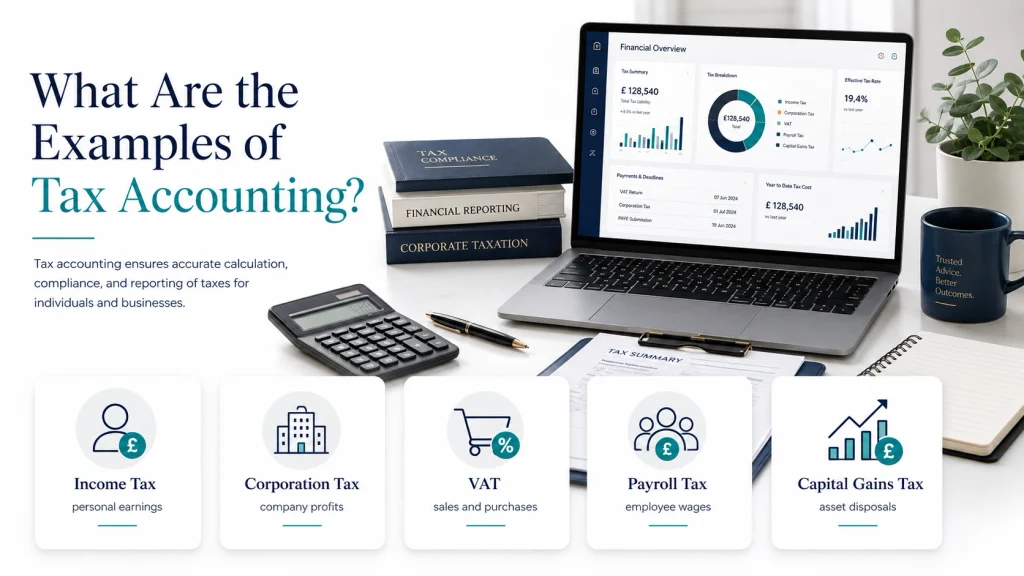
Tax accounting applies to everyday financial activities that affect an individual or business’s tax position. These examples show how tax accounting works in practice under HMRC regulations.
| Tax Accounting Activity | Practical Example |
| Corporation Tax | A limited company calculates taxable profits before submitting its Corporation Tax Return to HMRC. |
| VAT Accounting | A VAT-registered business records VAT on sales and purchases before filing quarterly VAT Returns. |
| Self Assessment | A self-employed consultant reports business income and allowable expenses to calculate Income Tax. |
| Payroll Taxes | An employer deducts PAYE Income Tax and National Insurance from employee salaries. |
| Capital Allowances | A manufacturing company claims tax relief on qualifying machinery purchases. |
| Capital Gains Tax | An investor calculates the taxable gain after selling a property or investment asset. |
| Rental Income | A landlord records rental income and allowable expenses before completing a Self Assessment return. |
Each example demonstrates how tax accounting converts financial information into accurate tax calculations.
What Is the Main Purpose of Tax Accounting?
The main purpose of tax accounting is to calculate taxable income accurately, comply with tax legislation, and ensure the correct amount of tax is paid to HMRC.
Tax accounting also helps businesses:
- Meet statutory filing deadlines.
- Reduce tax errors.
- Claim legitimate tax reliefs.
- Maintain accurate financial records.
- Support business planning.
- Avoid interest and penalties.
Without proper accounts and taxation, businesses may underpay or overpay tax. Both situations create unnecessary financial and administrative problems.
What Does a Tax Accountant Do?
A tax accountant prepares tax calculations, advises clients on tax matters, and ensures compliance with HMRC regulations.
Their responsibilities often include:
- Preparing Corporation Tax Returns.
- Completing Self Assessment tax returns.
- Preparing VAT Returns.
- Calculating taxable income.
- Advising on tax planning.
- Reviewing financial statements.
- Claiming available tax reliefs.
- Responding to HMRC enquiries.
- Supporting tax investigations.
- Helping businesses remain compliant.
Many businesses also rely on tax accountants to improve cash flow by planning tax payments throughout the year.
Who Needs a Tax Accountant?
Anyone with tax obligations can benefit from a tax accountant, but some taxpayers gain more value than others.
A tax accountant is particularly useful for:
- Sole traders.
- Limited companies.
- Partnerships.
- Property landlords.
- Company directors.
- Contractors.
- Freelancers.
- Investors.
- Charities.
- Businesses registered for VAT.
As a business grows, tax rules become more complex. Professional advice reduces compliance risks and saves valuable time.
What Does “Net of Tax” Mean?
Net of tax means the amount remaining after taxes have been deducted or accounted for. It shows the final value a person or business keeps once the relevant tax has been applied. For example: A company earns £20,000 from selling an asset. If the tax due is £4,000, the net of tax amount equals £16,000. Businesses often use this term when analysing profits, dividends, investments, and financial reporting.
What Are the Common Tax Accounting Methods?
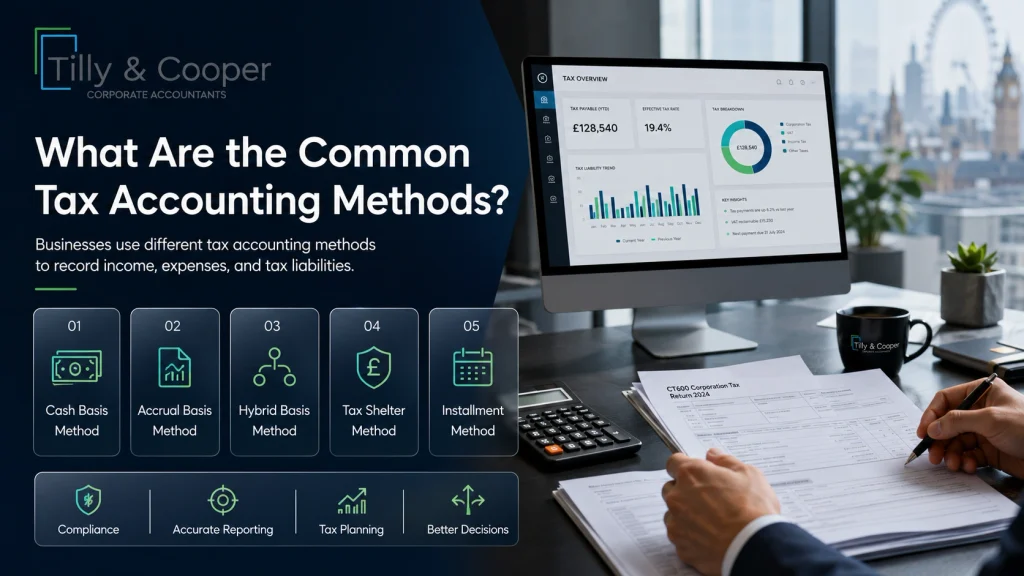
There are two common tax accounting methods: the cash basis and the accrual basis. Each method records income and expenses differently.
Cash Basis Accounting
Cash basis accounting records income when money is received and expenses when they are paid.It is commonly used by smaller businesses because it is simple to maintain.
Advantages include:
- Easier bookkeeping.
- Better cash flow visibility.
- Simpler tax calculations.
Accrual Basis Accounting
Accrual accounting records income when it is earned and expenses when they are incurred. This method provides a more accurate picture of business performance. Many larger businesses prepare their financial reporting using the accrual basis because it matches income with related expenses.
Hybrid Accounting
Some businesses use a combination of cash and accrual methods where tax legislation permits. Professional advice is important before adopting a hybrid approach because HMRC rules vary depending on the business structure.
What Are the Principles of Tax Accounting?
The principles of tax accounting are the rules and practices used to calculate taxable income, record tax-related transactions, and meet tax reporting requirements. Unlike general financial accounting, tax accounting focuses primarily on compliance with tax legislation and the correct calculation of tax liabilities.
Key principles include:
- Accuracy: Income, expenses, assets, liabilities, and tax calculations should be recorded correctly.
- Consistency: Businesses should apply their chosen accounting and tax methods consistently between accounting periods.
- Proper documentation: Transactions should be supported by invoices, receipts, bank records, payroll records, and other evidence.
- Correct recognition: Income and allowable expenses must be recognised in the appropriate accounting period.
- Tax compliance: Calculations and returns should follow current tax laws, HMRC rules, and filing requirements.
- Allowable deductions: Only expenses permitted under tax legislation should reduce taxable profits.
- Record retention: Adequate accounting and tax records must be maintained for the required period.
- Transparency: Tax calculations should provide a clear audit trail showing how taxable profit and tax liabilities were determined.
These principles help businesses produce reliable tax information, reduce reporting errors, and remain compliant with their tax obligations.
What Are the Benefits of Tax Accounting?
Tax accounting helps businesses and individuals calculate taxes accurately, comply with tax laws, maintain proper records, and plan their finances more effectively. It provides a structured way to manage tax-related income, expenses, deductions, and liabilities.
The main benefits of tax accounting include:
- Accurate tax calculations: Helps determine the correct amount of tax payable.
- Better tax compliance: Supports timely and accurate submission of tax returns.
- Reduced risk of penalties: Proper records can help prevent errors, missed deadlines, and incorrect claims.
- Tax planning: Helps identify legitimate deductions, allowances, and available tax reliefs.
- Improved record keeping: Keeps financial documents organised and ready for HMRC enquiries or reviews.
- Better cash flow management: Businesses can plan for Corporation Tax, VAT, PAYE, and other tax payments.
- Informed decision-making: Tax information helps business owners understand how financial decisions may affect their tax position.
Effective tax accounting therefore supports both tax compliance and long-term financial planning.
What Is the Difference Between Tax Accounting and Financial Accounting?
Tax accounting focuses on calculating tax liabilities under tax law, while financial accounting focuses on presenting a company’s financial performance to stakeholders.
| Feature | Tax Accounting | Financial Accounting |
| Primary Purpose | Calculate taxes | Report financial performance |
| Main Users | HMRC and taxpayers | Investors, lenders, directors, shareholders |
| Rules Followed | HMRC regulations and tax legislation | UK accounting standards (FRS 102, FRS 105 or IFRS where applicable) |
| Main Focus | Taxable income | Accounting profit |
| Reports Produced | Tax Returns | Income Statement, Balance Sheet, Cash Flow Statement |
| Filing Authority | HMRC | Companies House and stakeholders |
| Adjustments | Tax legislation | Accounting standards |
Although the two systems use much of the same financial information, they often produce different results because tax legislation treats certain income and expenses differently from accounting standards.
What Is the Difference Between Tax Avoidance and Tax Evasion?
Tax avoidance uses legal methods to reduce a tax bill, while tax evasion is the illegal act of deliberately avoiding tax. Tax avoidance involves using reliefs, allowances, and exemptions that tax legislation allows. Tax evasion involves hiding income, falsifying records, or deliberately providing incorrect information to HMRC.
| Tax Avoidance | Tax Evasion |
| Legal | Illegal |
| Uses approved tax reliefs | Hides taxable income |
| Follows HMRC regulations | Breaches tax legislation |
| Supported by proper records | Often involves false or incomplete records |
| Reduces tax lawfully | Can lead to penalties, interest, or prosecution |
Businesses should always seek professional tax advice before implementing any tax planning strategy.
What Is the Difference Between Tax Accounting and GAAP?
Tax accounting follows tax legislation, while Generally Accepted Accounting Principles (GAAP) focus on preparing financial statements that present a true and fair view of a business. The two systems often produce different figures because tax law and accounting standards treat certain transactions differently.
Examples include:
- Depreciation versus capital allowances.
- Entertainment expenses.
- Deferred tax.
- Timing differences.
- Certain provisions and reserves.
A company may report one profit in its financial statements and a different taxable profit in its Corporation Tax Return.
How Much Does a Tax Accountant Cost?

The cost of a tax accountant depends on the complexity of your tax affairs, the services required, and the size of your business. Typical UK fees may include:
| Service | Typical Price Range |
| Self Assessment Tax Return | £150–£400 |
| Sole Trader Accounts and Tax Return | £250–£700 |
| Limited Company Annual Accounts and Corporation Tax | £500–£2,000+ |
| VAT Return | £75–£300 per return |
| Payroll Services | £10–£30 per employee per month |
| Tax Planning Consultation | £100–£300 per hour |
Simple tax affairs usually cost less than complex company structures with multiple income sources. Choosing an accountant based on expertise rather than price often provides better long-term value.
When Should You Use a Corporate Tax Accountant?
You should use a corporate tax accountant when your company has more complex tax affairs, is approaching a filing deadline, or needs help reducing the risk of errors and penalties. A corporate tax accountant can help calculate taxable profits, prepare the Company Tax Return (CT600), claim available reliefs and allowances, and ensure Corporation Tax is paid correctly and on time.
Professional support is particularly useful when a company has multiple income streams, significant expenses, capital purchases, losses brought forward, associated companies, overseas transactions, or complex accounting adjustments. A corporate tax accountant can also advise on tax planning and help ensure the figures reported to HMRC are consistent with the company’s financial accounts.
How Can You Start a Career in Tax Accounting?
You can start a career in tax accounting by building a strong foundation in accounting, taxation, and financial reporting, then gaining practical experience with tax returns and compliance work. A degree in accounting, finance, or business can help, but professional qualifications are also highly valuable. In the UK, common routes include studying towards qualifications such as ACCA, ACA, ATT, or CTA. Entry-level roles may include tax assistant, trainee accountant, accounts assistant, or junior tax adviser.
You should also develop practical skills in:
- Preparing tax calculations and returns.
- Understanding Income Tax, Corporation Tax, VAT, and PAYE.
- Using accounting and tax software.
- Maintaining accurate financial records.
- Researching current tax legislation and HMRC guidance.
- Communicating clearly with clients and tax authorities.
As you gain experience, you can specialise in areas such as personal tax, corporate tax, VAT, international tax, or tax advisory services.
How Can You Check if a Company Is VAT Registered?
You can check whether a UK company is VAT registered by verifying its VAT registration number through HMRC’s online VAT number checker.
The process is straightforward:
- Obtain the company’s VAT registration number.
- Visit the official HMRC VAT number validation service.
- Enter the VAT number.
- Review the validation result.
A valid VAT number confirms that the business is registered for VAT. However, it does not provide full details about the company’s tax affairs.
How Does an Accountant Manage a Business Tax Account?
An accountant manages a business tax account by maintaining accurate records, calculating tax liabilities, filing returns, and ensuring ongoing compliance with HMRC.
The process usually includes:
Maintaining Accurate Records
Every business transaction is recorded using accounting software or bookkeeping systems.
Preparing Financial Statements
The accountant prepares the income statement, balance sheet, and cash flow statement.
Calculating Taxable Income
Accounting profit is adjusted according to tax legislation to calculate taxable income.
Filing Tax Returns
The accountant prepares and submits:
- Corporation Tax Returns.
- VAT Returns.
- Self Assessment Returns.
- PAYE submissions where applicable.
Monitoring Deadlines
Important filing dates are tracked to avoid penalties and interest.
Advising on Tax Planning
The accountant identifies legitimate tax reliefs and planning opportunities that may reduce future tax liabilities.
Frequently Asked Questions
Is tax accounting different from bookkeeping?
Yes. Bookkeeping records financial transactions, while tax accounting uses those records to calculate taxes and prepare tax returns.
Can a small business manage its own tax accounting?
Yes, but professional advice becomes valuable as the business grows or tax matters become more complex.
Does every UK business need tax accounting?
Yes. Every business must maintain financial records and comply with relevant tax legislation, even if it has little or no tax to pay.
Why is taxable income different from accounting profit?
Tax legislation does not treat every income or expense in the same way as accounting standards. Tax accounting adjusts accounting profit to calculate taxable income.
What software is commonly used for tax accounting?
Many UK businesses use cloud accounting software such as Xero, QuickBooks, Sage, and FreeAgent to manage bookkeeping and support tax compliance.