

13 Best Accounting Software for Small Businesses in the UK (2026)
The best accounting software for UK small businesses in 2026 includes Xero, QuickBooks Online, FreeAgent, Sage Accounting, Zoho Books, Pandle, Clear Books, QuickFile, FreshBooks, KashFlow, Crunch, GnuCash and Adminsoft Accounts. The right platform depends on your business structure, VAT status, transaction volume, employees, industry, reporting needs, integrations and budget.
Xero is one of the strongest all-round choices for growing businesses. QuickBooks Online provides detailed bookkeeping, reporting, inventory and project tools. FreeAgent is particularly suitable for freelancers, contractors and owner-managed businesses, while Pandle, Clear Books, QuickFile and Zoho Books provide attractive options for businesses trying to keep software costs low.UK businesses also need to consider Making Tax Digital (MTD). MTD for VAT and MTD for Income Tax are separate requirements, so software that supports VAT filing should not automatically be assumed to provide every MTD for Income Tax function.
MTD for Income Tax became mandatory from 6 April 2026 for qualifying sole traders and landlords whose qualifying income for 2024/25 was more than £50,000. The threshold falls to more than £30,000 from 6 April 2027 and more than £20,000 from 6 April 2028. Qualifying income is broadly gross income from self-employment and property before expenses. Prices and features in this guide were reviewed in August 2026. Regular prices are used where possible instead of temporary introductory discounts. Prices generally exclude VAT unless stated otherwise.
Which Accounting Software Is Best for UK Small Businesses?
Xero is one of the best overall accounting platforms for growing UK small businesses, while FreeAgent is particularly strong for freelancers and QuickBooks Online suits businesses that need detailed bookkeeping and reporting.
The strongest option changes according to the type of business.
- Best overall for growing businesses: Xero
- Best for freelancers and contractors: FreeAgent
- Best for detailed bookkeeping and reporting: QuickBooks Online
- Best for payroll, CIS and inventory requirements: Sage Accounting
- Best for startups and Zoho users: Zoho Books
- Best low-cost cloud bookkeeping software: Pandle
- Best free MTD Income Tax option: Clear Books
- Best low-cost UK bookkeeping platform: QuickFile
- Best for service and project-based businesses: FreshBooks
- Best for straightforward UK bookkeeping: KashFlow
- Best for software plus professional accounting support: Crunch
- Best free open-source desktop software: GnuCash
- Best for businesses preferring traditional Windows accounting: Adminsoft Accounts
These are editorial recommendations based on suitability rather than universal rankings. A business should compare the exact functionality it requires before selecting a platform.
How Were the Best Accounting Software Options Compared?
To make the comparison practical and relevant, each accounting software option was assessed against the day-to-day needs of UK sole traders, startups and small businesses. The review looks beyond basic bookkeeping to consider tax compliance, automation, reporting, business growth and overall value for money. Particular attention was also given to features that can reduce manual accounting work and support changing business requirements.
The main factors considered were:
- bookkeeping functions
- bank feeds
- bank reconciliation
- invoicing
- expense management
- VAT
- MTD for VAT
- MTD for Income Tax
- payroll
- CIS
- inventory
- project accounting
- time tracking
- multi-currency accounting
- cash flow tools
- financial reporting
- mobile access
- accountant access
- integrations
- automation
- scalability
- regular subscription cost
- availability of a free option
MTD functionality has been considered separately for VAT and Income Tax because they are different HMRC services.
Best Accounting Software for Small Businesses: Quick Comparison
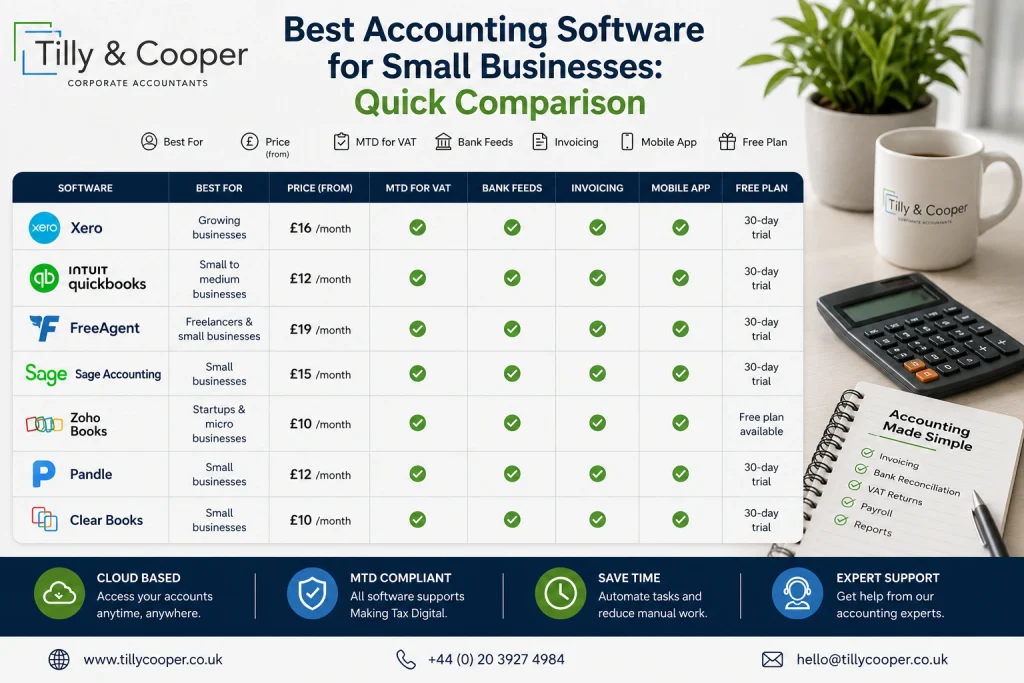
The best accounting software for a UK small business depends on its size, budget, VAT status, transaction volume, payroll requirements, and need for integrations. Xero, QuickBooks, FreeAgent, Sage, and Zoho Books are among the main options, while Pandle and QuickFile can suit businesses looking for lower-cost bookkeeping tools. Current UK products increasingly support Making Tax Digital (MTD), bank feeds, invoicing, expense tracking, and financial reporting.
| Accounting Software | Best For | Key Strength |
|---|---|---|
| Xero | Growing small businesses | Strong bank feeds, reporting and integrations |
| QuickBooks Online | Sole traders and small companies | Invoicing, expense tracking and tax features |
| FreeAgent | Freelancers and contractors | Simple bookkeeping and UK tax-focused features |
| Sage Accounting | Established small businesses | Accounting and payroll capabilities |
| Zoho Books | Start-ups and budget-conscious businesses | Free plan and strong automation |
| Pandle | Micro-businesses | Straightforward, low-cost bookkeeping |
| QuickFile | Very small businesses | Free or low-cost cloud accounting |
| FreshBooks | Service-based businesses | Invoicing, time tracking and expenses |
| Crunch | Freelancers and small companies | Accounting software combined with accounting services |
| ANNA Money | Sole traders and micro-businesses | Banking and accounting tools in one platform |
Zoho Books currently offers a £0 plan, while Xero’s UK plans include options starting from £7 per month for simpler non-VAT businesses and £16 per month for Ignite before Xero’s announced 1 September 2026 price changes. QuickBooks also offers different plans according to business type and accounting requirements.
For most businesses, the decision should not be based on price alone. MTD compatibility, bank integration, payroll, VAT functionality, reporting, user access, accountant collaboration, and scalability should all be considered before choosing accounting software.
What Does Xero Offer UK Small Businesses?
Xero is cloud accounting software for sole traders and growing businesses that need invoicing, bank reconciliation, VAT, reporting, payroll options and integrations with other business applications.
Best for: Growing limited companies, ecommerce businesses, professional services, VAT-registered businesses and companies working closely with an accountant.
Key features: Xero provides bank feeds, reconciliation, invoicing, bills, document capture, reports, VAT Returns, CIS, cash flow tools, projects, expenses and multi-currency accounting depending on the plan.
Xero’s Simple plan costs £7 per month but is specifically designed for non-VAT businesses. Its Ignite plan currently costs £16 per month and includes VAT submission functionality. Grow costs £37, Comprehensive £50 and Ultimate £65.
From 1 September 2026, Ignite rises to £18, Grow to £39, Comprehensive to £55 and Ultimate to £70. Simple remains £7.
Pros:
- strong bank reconciliation
- broad integration ecosystem
- good accountant collaboration
- scalable plans
- strong reporting
- MTD for VAT
- MTD for Income Tax-ready functionality
- payroll options
- multi-currency support on suitable plans
Cons:
- £7 Simple is not suitable for VAT-registered businesses
- Higher plans can become expensive
- Some features require higher subscriptions or additional charges
Verdict: Choose Xero when scalability, accountant collaboration and integrations matter more than finding the lowest possible monthly price.
Is QuickBooks Online Good for Small Businesses?
QuickBooks Online is a comprehensive cloud accounting system for sole traders and small or medium-sized businesses that need bookkeeping, invoicing, VAT, reporting and management tools.
Best for: Businesses requiring detailed bookkeeping, management reports, inventory, budgeting or project profitability.QuickBooks provides bank feeds, receipt capture, invoices, expenses, Self Assessment tools, VAT, CIS, reporting, multi-currency accounting, budgets, inventory, project profitability and automation depending on the plan.
Current regular monthly prices are:
- Sole Trader Plus: £10
- Simple Start: £16
- Essentials: £38
- Plus: £56
- Advanced: £123
Sole Trader Plus is designed primarily around Income Tax requirements. Simple Start and higher plans provide MTD for VAT functionality. Payroll is available as a paid add-on rather than being included in the standard accounting subscription.
Pros:
- detailed bookkeeping
- strong reporting
- MTD for VAT
- MTD for Income Tax-ready tools
- inventory on Plus
- project profitability
- mobile access
- broad feature set
Cons:
- payroll costs extra
- advanced plans are expensive
- very small businesses may not need its full functionality
Verdict: Choose QuickBooks when detailed bookkeeping, management information, projects or inventory are more important than keeping the software simple.
Why Is FreeAgent Good for Freelancers and Contractors?
FreeAgent is UK-focused accounting software designed around freelancers, contractors, landlords, sole traders and owner-managed businesses.
Best for: Freelancers, contractors, consultants, landlords and small owner-managed companies.FreeAgent includes invoicing, expenses, bank feeds, reconciliation, projects, time tracking, payroll, Self Assessment, VAT, cash flow forecasting and MTD for Income Tax functions. Regular monthly prices include approximately £19 for sole traders and £33 for limited companies, excluding VAT. Eligible customers with NatWest, Royal Bank of Scotland, Ulster Bank or qualifying Mettle business accounts may receive FreeAgent without its normal subscription charge, subject to conditions.FreeAgent’s MTD for Income Tax functionality supports sole traders and unincorporated landlords, although users with multiple businesses or both self-employment and property income may need separate FreeAgent accounts for different income streams.
Pros:
- designed around UK tax
- strong Self Assessment tools
- MTD for Income Tax
- payroll
- project and time tracking
- good tax visibility
- potentially free through eligible bank accounts
Cons:
- less suited to larger organisations
- direct subscriptions can be expensive for microbusinesses
- multiple income streams can require separate accounts
Verdict: FreeAgent is particularly strong where business bookkeeping and personal tax reporting are closely connected.
Is Sage Accounting Suitable for Growing Businesses?
Sage Accounting is cloud accounting software for UK businesses that need bookkeeping, VAT, payroll and stronger financial controls as they grow.
Best for: Employers, growing companies, construction businesses, companies managing suppliers and businesses needing stock or multi-currency functions.
Current regular customer pricing is:
- Start: £20 per month
- Standard: £43 per month
- Plus: £59 per month
Start is designed for businesses beginning with VAT and basic accounting. Standard adds functionality for suppliers, CIS and more advanced reporting. Plus adds inventory, budgets and multi-currency tools. Payroll is included subject to employee allowances and additional employee charges.
Sage also provides separate sole-trader and MTD products aimed at businesses and landlords within MTD for Income Tax, so businesses should select the Sage product appropriate to the tax obligation rather than assume every Sage Accounting subscription provides identical Income Tax functionality.
Pros:
- strong UK accounting platform
- payroll functionality
- MTD VAT
- CIS
- supplier management
- cash flow forecasting
- inventory on Plus
- multi-currency accounting
Cons:
- more expensive than basic bookkeeping software
- many advanced functions require Standard or Plus
- MTD Income Tax functionality depends on selecting the relevant product
Verdict: Sage is a strong choice where payroll, CIS, suppliers, inventory or more advanced financial controls are becoming important.
Is Zoho Books Good for Startups?
Zoho Books is affordable cloud accounting software that combines bookkeeping, tax functions and automation with the wider Zoho business software ecosystem.
Best for: Startups, sole traders, ecommerce businesses and organisations already using Zoho applications.
Zoho Books provides invoicing, expenses, bank reconciliation, VAT, reports, projects and automation. Higher plans add inventory, multi-currency transactions, workflows, budgets and advanced analytics.
Current monthly pricing is:
- Free: £0
- Standard: £12
- Professional: £24
- Premium: £30
- Elite: £99
- Ultimate: £199
Annual billing lowers the equivalent monthly price. Zoho’s Free plan includes invoices, expenses, bank reconciliation and MTD VAT filing.
Pros:
- useful free plan
- MTD VAT
- strong automation
- API access
- good value
- scalable subscriptions
- strong integration with other Zoho applications
Cons:
- advanced functions require higher plans
- usage limits vary between subscriptions
- the wider Zoho ecosystem is less useful if you use unrelated applications
Verdict: Zoho Books is one of the better choices when a business wants low initial cost with room to add automation and more advanced functionality later.
Is Pandle Good for Cheap Accounting and Bookkeeping?
Pandle is low-cost UK cloud bookkeeping software designed for sole traders, freelancers, startups and microbusinesses.
Best for: Businesses that need straightforward digital bookkeeping without paying for a large accounting suite.
Pandle’s standard plan is free. Pandle Pro costs £5 plus VAT per month and adds bank feeds, cash flow forecasting, receipt uploads, mileage tracking, projects and user permissions.
The free plan includes invoicing, reports, VAT submissions, multi-currency records and MTD Income Tax submissions. Pandle states that it is HMRC-recognised for MTD Income Tax and MTD VAT.
Pros:
- free version
- Pro costs only £5 plus VAT
- MTD VAT
- MTD Income Tax
- simple bookkeeping
- unlimited usage on core functions
Cons:
- fewer advanced management tools than Xero or Sage
- bank feeds require Pro
- less suitable for complicated organisations
Verdict: Pandle is one of the strongest budget choices for microbusinesses that need UK-focused bookkeeping and MTD functionality.
Is Clear Books Good for Sole Traders and Landlords?
Clear Books is UK accounting software with particularly strong low-cost options for sole traders and landlords affected by MTD for Income Tax.
Best for: Sole traders, landlords and small businesses wanting affordable UK-focused MTD tools.
Current monthly plans include:
- Sole Trader Free: £0
- Sole Trader: £5
- Sole Trader Plus: £15
Clear Books also provides wider organisational plans. The free Sole Trader plan is HMRC-recognised and includes MTD Income Tax quarterly updates, year-end tax return filing, income and expense recording, and basic reports. Sole Trader Plus adds MTD VAT functionality for VAT-registered sole traders.
Pros:
- permanently free MTD Income Tax plan
- UK-focused
- no transaction limits on the free sole-trader plan
- bank feeds on paid plans
- VAT option
- accountant access
Cons:
- VAT requires the appropriate plan
- smaller ecosystem than Xero
- more complex companies may outgrow the lower plans
Verdict: Clear Books is particularly attractive to sole traders and landlords whose main priority is meeting MTD requirements at a low cost.
Is QuickFile Good for UK Small Businesses?
QuickFile is UK cloud accounting software that offers bookkeeping, invoicing, VAT, reporting and MTD tools with free access for qualifying smaller accounts.
Best for: Sole traders, startups, microbusinesses and small companies comfortable with a usage-based pricing model.
QuickFile includes invoicing, purchases, bank tools, VAT Returns, quotations, reports, multi-currency accounting, API access and unlimited users. Smaller accounts can use the basic software without a standard subscription. Larger accounts may require the Power User subscription, currently £60 plus VAT per year. Automated bank feeds cost £15 plus VAT per year. A key qualification is MTD for Income Tax. QuickFile identifies MTD ITSA as a Power User feature, and its official support team has confirmed that MTD Income Tax submissions require a Power User subscription for relevant individual accounts.
Pros:
- basic software can be free
- low annual paid cost
- unlimited users
- MTD VAT
- API access
- multi-currency accounting
Cons:
- MTD Income Tax filing is not automatically free
- Pricing depends partly on usage
- some features require subscriptions or add-ons
Verdict: QuickFile provides strong value, but businesses choosing it specifically for MTD Income Tax should budget for the required paid access rather than assuming the filing function is free.
Is FreshBooks Good for Freelancers and Service Businesses?
FreshBooks is cloud accounting and invoicing software particularly suited to businesses that manage clients, projects and billable time.
Best for: Freelancers, consultants, agencies, creative businesses and other service providers.
FreshBooks includes invoicing, expense tracking, quotes, time tracking, projects, bank tools, reports, payments and client management. Its current regular monthly prices are:
- Lite: £16
- Plus: £30
- Premium: £42
Temporary discounts frequently reduce these prices for new customers.
FreshBooks confirms that its UK plans can submit MTD-compliant VAT Returns directly to HMRC.
Pros:
- strong invoicing
- good time tracking
- client management
- project tools
- expense capture
- MTD VAT functionality
Cons:
- lower plans limit active clients
- additional team members cost extra
- not as strong for stock-heavy businesses
- businesses needing MTD Income Tax should confirm the current supported filing scope before choosing it for that purpose
Verdict: FreshBooks makes the most sense for service businesses where client billing and project management are more important than complex inventory.
Is KashFlow Good for UK Bookkeeping and VAT?
KashFlow is UK cloud accounting software focused on straightforward bookkeeping, invoicing, banking, VAT and reporting.
Best for: Sole traders, contractors, VAT-registered businesses and small limited companies.
Current monthly prices are:
- Starter: £13.50
- Business: £27.50
Starter includes bank feeds, VAT submission, mobile access, reports, expense management and payroll for up to five employees, but limits invoices and reconciled bank transactions. Business removes many of those limits and adds multi-user functionality.
Pros:
- UK-focused
- MTD VAT
- bank feeds
- mobile app
- reporting
- payroll functionality
- straightforward interface
Cons:
- Starter has transaction and invoice limits
- smaller integration ecosystem than Xero
- Businesses choosing software specifically for MTD Income Tax should verify the current supported workflow
Verdict: KashFlow is practical for businesses that need traditional bookkeeping, VAT and payroll functions without the complexity of a larger platform.
Is Crunch Good for Small Business Accounting?
Crunch combines accounting software with optional professional accountancy services, making it different from software-only platforms such as Xero and QuickBooks.
Best for: Business owners who want bookkeeping software but also value access to accountants and tax support.
Crunch provides tools for invoicing, expenses, bookkeeping and financial records. It also offers professional accounting packages.Crunch currently advertises:
- Sole Trader accounting: from £27 plus VAT per month
- Limited Company accounting: from £94 plus VAT per month
Crunch also offers free software options for businesses that do not yet need a full professional service package.
Pros:
- free software option
- professional accountants available
- UK-focused
- bookkeeping and accountancy can sit together
- suitable for owners wanting human support
Cons:
- professional packages cost much more than software alone
- less compelling if you already have an accountant
- tax filing features depend on the package selected
Verdict: Crunch should be viewed as a hybrid accounting solution rather than directly equivalent to standalone bookkeeping software.
Is GnuCash Good for Small Business Accounting?
GnuCash is free open-source desktop accounting software that provides double-entry bookkeeping without a monthly subscription.
Best for: Technically confident users who prefer desktop software and local control over cloud collaboration.
GnuCash supports:
- double-entry bookkeeping
- accounts receivable
- accounts payable
- invoicing
- scheduled transactions
- financial reports
- multiple operating systems
The latest stable version in August 2026 is GnuCash 5.16, released on 28 June 2026.
Pros:
- completely free
- open source
- no subscription
- double-entry accounting
- works across major desktop operating systems
Cons:
- no cloud-first collaboration
- no comparable native HMRC MTD filing workflow
- less convenient for accountant access
- interface is less modern than cloud competitors
Verdict: GnuCash is suitable when free desktop accounting is more important than automation, mobile access or direct UK tax filing.
Is Adminsoft Accounts Suitable for UK Small Businesses?
Adminsoft Accounts is Windows-based desktop accounting software designed for businesses that prefer traditional accounting, stock, payroll and operational functions on a local computer.
Best for: Businesses using Windows that want desktop bookkeeping, stock management and payroll.
Its features include:
- double-entry accounting
- invoicing
- sales and purchase ledgers
- bank reconciliation
- stock
- purchase orders
- payroll
- fixed assets
- budgeting
- reports
- CIS
- MTD VAT submissions
Adminsoft confirms that its software can submit MTD VAT Returns directly to HMRC.
Adminsoft’s public information about MTD for Income Tax is less current than its VAT information. Businesses choosing it specifically for MTD Income Tax should therefore confirm the latest support with the provider and HMRC before relying on it for the full filing process.
Pros:
- free edition available
- desktop operation
- broad accounting functions
- inventory
- payroll
- MTD VAT
- CIS
- multi-company functionality
Cons:
- Windows-focused
- less convenient for remote collaboration
- traditional interface
- current end-to-end MTD Income Tax support should be confirmed before selection
Verdict: Adminsoft is better suited to businesses that want a traditional desktop accounting system than businesses prioritising cloud collaboration.
What Is Accounting Software?
Accounting software is a digital system used to record, organise, process and report financial transactions.It can replace many bookkeeping tasks previously carried out through paper records and spreadsheets.
Accounting software can record:
- sales
- purchases
- expenses
- customer payments
- supplier payments
- bank transactions
- VAT
- payroll entries
- assets
- liabilities
Modern software can also automate bank imports, receipt capture, invoice matching and transaction categorisation.
Financial reporting functions commonly include:
- profit and loss accounts
- balance sheets
- aged debtor reports
- aged creditor reports
- cash flow information
Accounting software can improve efficiency, but it does not guarantee that the underlying records or tax treatment are correct. Transactions, VAT codes, payroll entries and year-end adjustments still need appropriate review.
What Are the Main Types of Accounting Software?
Accounting software can be classified according to how it is delivered, the size of business it serves and the functions it provides.
Cloud Accounting Software
Cloud software is accessed online and makes remote collaboration easier.Examples include Xero, QuickBooks, FreeAgent, Sage Accounting, Zoho Books, Pandle and Clear Books.
Desktop Accounting Software
Desktop accounting software primarily runs on a computer rather than through a browser.Examples include GnuCash and Adminsoft Accounts.
Free Accounting Software
Free options can work well for businesses with straightforward requirements.
Examples include:
- Pandle
- Clear Books
- Zoho Books
- QuickFile for qualifying accounts
- Crunch Free
- GnuCash
- Adminsoft Accounts
Free software does not necessarily mean that every function is free. Bank feeds, MTD submissions, additional users, storage or support may carry separate charges.
Enterprise and ERP Software
Enterprise Resource Planning software goes beyond accounting and can combine finance with inventory, manufacturing, procurement, customer management, supply chains and human resources.
Most sole traders and small limited companies do not need a complete ERP system.
Which Accounting Software Is Best for Different Types of Business?
The best software depends on how a business operates rather than which provider has the longest feature list.
Best Accounting Software for Freelancers
FreeAgent is a strong choice because it combines invoices, expenses, projects, time tracking and UK tax functions.
FreshBooks is particularly useful for freelancers billing by client, project or time.
Pandle and Zoho Books provide lower-cost alternatives.
Best Accounting Software for Sole Traders
Strong options include:
- FreeAgent
- Clear Books
- Pandle
- Zoho Books
- QuickFile
- QuickBooks Sole Trader Plus
Sole traders affected by MTD for Income Tax should place particular importance on whether their chosen product supports the full workflow they need.
Best Accounting Software for Limited Companies
Xero, QuickBooks, Sage and FreeAgent are among the strongest options for small limited companies. Xero works particularly well when accountant collaboration and integrations matter.QuickBooks is attractive for businesses requiring management reporting or inventory. Sage is strong where payroll, suppliers, CIS and stock are important.
Best Free Accounting Software
Strong free options include Pandle, Clear Books, Zoho Books, QuickFile, Crunch, GnuCash and Adminsoft Accounts.The most appropriate free option depends on whether you need:
- MTD Income Tax
- VAT
- bank feeds
- cloud access
- desktop software
- invoices
- accountant collaboration
Best Accounting Software for Ecommerce
Xero, QuickBooks and Zoho Books are good platforms to compare for ecommerce.An ecommerce business should consider integrations with systems such as:
- Amazon
- Shopify
- eBay
- Etsy
- Stripe
- PayPal
High-volume sellers also need to consider settlement reports, payment fees, refunds, stock and VAT.
Xero vs QuickBooks: Which Is Better?
Xero and QuickBooks are both strong accounting platforms, but Xero is particularly attractive for collaboration and integrations while QuickBooks provides extensive management, inventory and project functionality.
Choose Xero if your priorities are:
- accountant collaboration
- bank reconciliation
- third-party integrations
- scalability
- straightforward cloud accounting
Choose QuickBooks if your priorities are:
- detailed reporting
- inventory
- project profitability
- budgets
- management information
Both provide MTD for VAT on suitable UK plans and have MTD for Income Tax functionality. Xero’s £7 Simple plan, however, is specifically aimed at non-VAT businesses, while QuickBooks requires Simple Start or above for its MTD VAT functionality.
How Much Does Accounting Software Cost in the UK?
Accounting software for a UK small business can cost from £0 to more than £100 per month.
The price depends on:
- plan
- users
- transaction volume
- payroll
- bank feeds
- inventory
- multi-currency requirements
- projects
- advanced reporting
- tax filing
- professional support
A straightforward sole trader may be able to use free software. Low-cost platforms often cost between approximately £5 and £15 per month. Mainstream cloud accounting subscriptions commonly range from approximately £15 to £60 per month. Advanced plans and software combined with professional accountancy services can cost substantially more. Businesses should compare regular prices rather than temporary introductory discounts.
What Are the Benefits of Accounting Software?
Accounting software can reduce repetitive bookkeeping work, improve financial visibility and make business records easier to manage.
Benefits include:
- faster bookkeeping
- easier bank reconciliation
- organised digital records
- expense tracking
- invoicing
- payment monitoring
- VAT records
- financial reports
- cash flow visibility
- accountant collaboration
- tax software integration
- fewer duplicate entries
- automation of recurring tasks
Software does not replace professional judgement. Incorrect VAT treatment or transaction classification can still produce incorrect reports even when the calculations are automated.
How Should You Choose Accounting Software?
Choose accounting software by defining what your business needs before comparing software providers.
First consider your business structure:
- sole trader
- landlord
- partnership
- LLP
- limited company
Then identify the functions you need:
- VAT
- MTD for Income Tax
- payroll
- CIS
- stock
- projects
- time tracking
- multi-currency accounting
- ecommerce integrations
- multiple users
- accountant access
Check whether your bank supports automatic feeds into the software.
Also consider how your business may change. Migrating bookkeeping records between platforms later can create additional work, particularly where VAT Returns, opening balances or historical transactions need to be transferred.
What Is MTD-Compatible Accounting Software?
MTD-compatible software is software that can perform the digital record-keeping and HMRC submission functions required for a particular Making Tax Digital service.
MTD for VAT and MTD for Income Tax are separate.
Businesses should therefore ask two different questions:
- Does the software work with MTD for VAT?
- Does it support the required MTD for Income Tax workflow?
MTD for Income Tax requires affected sole traders and landlords to use compatible software to maintain digital records, send quarterly updates and ultimately submit their tax return through their software.
When Does MTD for Income Tax Apply?
MTD for Income Tax began on 6 April 2026 for qualifying sole traders and landlords with qualifying income above £50,000.
The staged thresholds are:
| Qualifying Income | MTD Start Date |
| More than £50,000 | 6 April 2026 |
| More than £30,000 | 6 April 2027 |
| More than £20,000 | 6 April 2028 |
HMRC defines qualifying income broadly as total turnover from self-employment and property before expenses.
When Must a Small Business Register for VAT?
A small business in the UK must register for VAT if its VAT-taxable turnover exceeds £90,000 in any rolling 12-month period. Registration is also required if the business expects its taxable turnover to exceed £90,000 within the next 30 days. VAT-taxable turnover includes the value of goods and services that are standard-rated, reduced-rated, or zero-rated for VAT. VAT-exempt and out-of-scope supplies generally do not count towards the registration threshold.
A business with taxable turnover below £90,000 can also choose voluntary VAT registration. This may be beneficial where the business pays significant VAT on its purchases or mainly sells to other VAT-registered businesses. Businesses based outside the UK may have different registration rules and can be required to register regardless of turnover when making taxable supplies in the UK.
Is Xero HMRC-Approved?
It is more accurate to describe Xero as providing HMRC-compatible or HMRC-recognised MTD functionality than to say HMRC generally approves Xero as an accounting platform.HMRC recognition relates to specific digital tax services rather than a general endorsement of one accounting provider over another. Businesses should therefore confirm that the particular Xero plan or feature they intend to use supports their tax requirement.
Is Wave Accounting Suitable for UK Small Businesses?
Wave is not one of the strongest choices for a new UK small business in 2026. Although Wave is widely associated with free accounting software, UK businesses now have more suitable options designed around UK bookkeeping and tax requirements.Businesses looking for free or inexpensive alternatives should compare:
- Pandle
- Clear Books
- Zoho Books
- QuickFile
- Crunch
For that reason, Wave is not included in the main 13 software platforms in this guide.
Is Accounting Software the Same as ERP Software?
No. Accounting software primarily manages financial records, while ERP software combines finance with wider business operations.Accounting software commonly manages:
- bookkeeping
- invoices
- expenses
- bank transactions
- VAT
- reports
- payroll integrations
ERP software can additionally manage:
- purchasing
- inventory
- manufacturing
- supply chains
- customer relationships
- human resources
- operational workflows
Most small UK businesses will not need a full ERP system.
Which Accounting Software Should a UK Small Business Choose?
Choose Xero or QuickBooks when scalability and detailed accounting functionality are priorities, FreeAgent for freelancers and owner-managed businesses, Sage for growing companies with payroll or inventory requirements, and Pandle, Clear Books, QuickFile or Zoho Books when keeping costs low is particularly important.
For MTD for Income Tax, do not choose software solely because it uses the words “MTD-ready”. Check whether the exact plan supports the digital records, quarterly updates and tax-return process your circumstances require. For VAT-registered businesses, confirm that the chosen plan supports your VAT scheme and direct HMRC submissions. For ecommerce businesses, prioritise payment, marketplace and stock integrations.
For employers, compare payroll limits and additional employee charges. The best accounting software is therefore not simply the system with the most features. It is the platform that matches your business structure, tax obligations, workflow and expected growth without making bookkeeping unnecessarily complicated or expensive.