


HMRC Complaints: How to Make and Escalate a Complaint
You can make an HMRC complaint when you are unhappy with the service provided by HM Revenue and Customs, such as unreasonable delays, poor communication, administrative mistakes or inappropriate behaviour. An HMRC complaint deals with the quality of HMRC’s service. It is different from challenging a tax assessment, penalty or other formal tax decision.HMRC operates a two-tier internal complaints process. A complaint that cannot be resolved initially may receive a first-tier review. If you remain dissatisfied, you can request a second-tier review by a different complaint handler. After completing HMRC’s internal process, eligible complaints can be taken to the independent Adjudicator’s Office and potentially the Parliamentary and Health Service Ombudsman.
What Is an HMRC Complaint?
An HMRC complaint is a formal way to raise dissatisfaction about how HMRC has handled your tax affairs or provided a service. Complaints normally concern HMRC’s administration rather than whether its interpretation of tax law or a formal tax decision is correct.HMRC gives the following examples of circumstances that can justify a complaint:
- unreasonable delays in processing
- poor communication
- inappropriate behaviour
- mistakes in handling your case
A complaint may therefore be appropriate if HMRC loses information you supplied, repeatedly requests the same documents, fails to respond within a reasonable period, delays a repayment or does not correct an administrative mistake. The complaints procedure allows HMRC to examine what happened, determine what should have happened and decide what action is needed to put the matter right.
When Should You Make an HMRC Complaint?
You should complain to HMRC when the main problem concerns the quality of its service or the way your tax affairs have been administered. This may include unreasonable delays in processing your tax matters, repeated failures to respond to correspondence, failure to process documents you have already supplied, incorrect administrative information, or poor and confusing communication.
A complaint may also be appropriate if HMRC repeatedly asks you for information you have already provided, fails to correct a known error, takes an unreasonable amount of time to issue a tax repayment, or if you believe an HMRC member of staff has behaved inappropriately. You can also complain if HMRC has handled an earlier complaint poorly or has failed to address the issues you originally raised.
However, you do not always need to make a formal HMRC complaint immediately. If the problem is relatively straightforward and can be corrected through HMRC’s normal enquiry service, resolving it through that route may be quicker and more practical. For individuals dealing with PAYE or Self Assessment issues, HMRC may also provide webchat support in some circumstances. This can sometimes help resolve an administrative problem before you decide to submit a formal complaint.
What Is the Difference Between an HMRC Complaint and a Tax Appeal?
An HMRC complaint challenges poor service, while an appeal or statutory review challenges an HMRC tax decision. This distinction is important because the complaints procedure is not a substitute for your legal right to appeal.
For example:
| Situation | Usually appropriate route |
|---|---|
| HMRC takes an unreasonable time to answer | Complaint |
| HMRC loses documents you submitted | Complaint |
| HMRC repeatedly provides conflicting information | Complaint |
| You believe a Self Assessment penalty is wrong | Appeal |
| You disagree with a tax assessment | Appeal or statutory review |
| You disagree with a decision about tax relief | Appeal or review |
| HMRC handles your penalty appeal badly | Service complaint about the handling |
HMRC specifically states that complaints should concern dissatisfaction with its service. Matters involving bills, penalties and decisions about tax relief may instead require an appeal or review.
Can You Complain and Appeal at the Same Time?
Yes, a complaint and an appeal can concern different aspects of the same case. For example, you may appeal a penalty because you believe HMRC imposed it incorrectly, while separately complaining because HMRC lost your correspondence or took an unreasonable time to process the appeal. Do not assume that submitting a complaint protects or extends an appeal deadline. If you have a statutory right of appeal, protect that right separately.
How Do You Make a Complaint to HMRC?
You can make a complaint to HMRC online, by telephone or by post. The most suitable method depends on the tax or service your complaint relates to and how you normally communicate with HMRC.HMRC provides an official online complaints service, which is often the quickest way to submit a complaint. You will normally need to sign in using your Government Gateway details before you can access the service and provide information about the issue.
You can also make a complaint by telephone using the contact number for the relevant HMRC tax or service. If you prefer to complain in writing, you can send a letter to the appropriate HMRC complaints address for the department dealing with your case. When contacting HMRC, clearly state that you are making a formal complaint, not a general enquiry. Explain what went wrong, when the problem occurred, how it has affected you and what you would like HMRC to do to resolve the matter.
What Information Should You Include in an HMRC Complaint?
Give HMRC enough information to identify your case, understand the service failure and determine how you want the problem resolved. A clear and well-organised complaint can make it easier for HMRC to investigate the issue and respond appropriately.
Your complaint should normally include your full name or business name, postal address, telephone number or other suitable contact details, and the relevant tax reference. You should also provide the dates of important events, details of previous telephone calls or correspondence, any HMRC reference numbers and a clear explanation of what went wrong.
Where relevant, include copies of supporting evidence, such as letters, emails, notices or other documents connected with the complaint. You should also explain how HMRC’s actions or delays affected you and clearly state the outcome you would like, such as an explanation, correction, repayment, apology or reimbursement of eligible costs.
The tax reference you provide will depend on the type of tax involved. This may include your Unique Taxpayer Reference (UTR), National Insurance number, PAYE reference, VAT registration number or Corporation Tax reference. Present the events in chronological order wherever possible. This helps the HMRC complaint handler understand what happened, when it happened and what steps have already been taken without having to reconstruct the case from disconnected information.
What Evidence Should You Keep?
Supporting your complaint with clear evidence can help HMRC understand what happened and assess whether its service caused a financial loss, delay or other problem. Include documents that confirm important dates, previous communication, actions you took and any additional costs you incurred. Organising the evidence in chronological order can also make the complaint easier for HMRC to review.
Useful evidence can include:
- HMRC letters
- screenshots
- copies of forms submitted
- proof of postage
- delivery confirmations
- records of telephone calls
- previous complaint responses
- calculations
- professional invoices
- receipts for additional expenses
Keep copies of everything sent to HMRC.
If you later request reimbursement of costs caused by HMRC’s mistake, HMRC may ask for evidence showing that those costs were actually incurred.
What Happens After You Submit an HMRC Complaint?
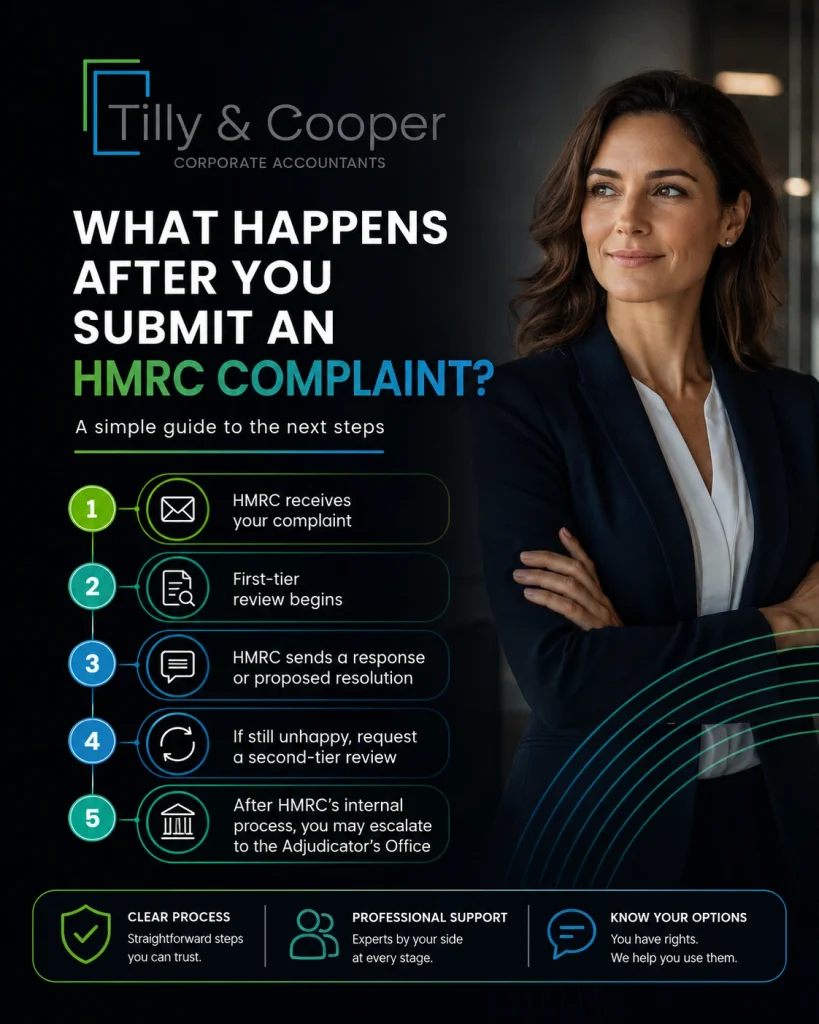
After you submit an HMRC complaint, HMRC will review the issue and the evidence you provided. A complaint handler may contact you if further information is needed. HMRC will then explain its findings and any action it intends to take. If you are unhappy with the response, you can usually ask for a second-tier review.
HMRC operates two formal internal complaint stages.
What Happens During the First-Tier Review?
Tier 1 is HMRC’s first formal review of a complaint that was not resolved at the initial point of contact.HMRC aims to resolve as many complaints as possible at this stage. The complaint handler may review correspondence, HMRC records, previous telephone contacts, documents submitted and actions taken by the relevant HMRC team.
HMRC may:
- uphold the complaint
- partially uphold the complaint
- not uphold the complaint
Where HMRC accepts that something went wrong, it may correct its records, process outstanding work, provide an explanation, apologise or consider financial redress.HMRC’s published performance figures confirm that it continues to classify Tier 1 complaints as fully upheld, partially upheld or not upheld.
What Happens During the Second-Tier Review?
If you disagree with the first-tier response, you can ask HMRC to review your complaint again at Tier 2. A different complaint handler should conduct the second review so that the case receives a fresh examination. Instead of simply repeating the original complaint, explain why the first review did not resolve the problem.
Identify:
- facts HMRC misunderstood
- questions HMRC did not answer
- evidence that was overlooked
- conclusions you believe are unsupported
- remedies that remain outstanding
Tier 2 is HMRC’s second and final internal review. You cannot request a third HMRC review simply because you disagree with the outcome.
How Long Does HMRC Take to Resolve a Complaint?
HMRC does not publish one fixed number of working days that applies to every complaint. Its internal guidance says complaint handlers should acknowledge complaints within the timeframe set by the relevant HMRC business area and aim to resolve them at the earliest opportunity. If a full response cannot be provided within a reasonable period because a case is complex or additional information is required, HMRC says an interim response should explain progress and outstanding actions.
Further updates should be provided where necessary. Be cautious about websites claiming that every HMRC complaint must be completed within 15, 20 or another fixed number of working days. There is no single universal HMRC complaint deadline of that type.
How Can You Follow Up a Delayed Complaint?
Keep your complaint reference number and use the contact details HMRC provides when following up. There is no general public dashboard showing the live status of every HMRC complaint.HMRC’s online complaint form can issue an emailed receipt where a customer chooses email communication and provides an email address.
If the case is taking an unreasonable amount of time, ask HMRC:
- what action has already been completed
- what remains outstanding
- whether further information is required
- when you can expect the next update
How Do You Escalate an HMRC Complaint?
If HMRC’s two internal reviews do not resolve your complaint, you may be able to request an independent review from the Adjudicator’s Office.
The normal escalation route is:
Initial HMRC contact → Tier 1 → Tier 2 → Adjudicator’s Office → Parliamentary and Health Service Ombudsman
Each stage has a different function. The Adjudicator reviews eligible complaints independently of HMRC, while the Parliamentary and Health Service Ombudsman provides a later independent route for qualifying complaints about government departments.
When Can You Contact the Adjudicator’s Office?
You normally need to complete both HMRC complaint reviews before the Adjudicator’s Office will investigate your case. The Adjudicator may investigate eligible complaints involving matters such as:
- unreasonable delays
- administrative mistakes
- poor or misleading advice
- how HMRC exercised discretion
- poor customer service
- staff conduct within its remit
It cannot replace a court, tax tribunal or statutory appeal procedure. It also generally cannot investigate a complaint about an ongoing HMRC investigation or enquiry.
Is There a Deadline for the Adjudicator?
The Adjudicator’s Office can normally accept a complaint up to six months after you receive HMRC’s second review. If more than six months have passed, it may consider a late complaint in exceptional circumstances if you explain why the complaint was delayed. The Adjudicator’s current service standard is to resolve cases within four months of receipt. Its published figures show that 75% of cases resolved between April and June 2026 met that standard. This is a service target rather than a guarantee for every case.
When Can You Take an HMRC Complaint to the Ombudsman?
The Parliamentary and Health Service Ombudsman is a later stage for eligible complaints that remain unresolved. For complaints concerning UK government departments such as HMRC, a Member of Parliament normally needs to refer the complaint to the Ombudsman. The PHSO states that you normally need to make the complaint to an MP within one year of becoming aware of the problem. The MP then passes the complaint to the Ombudsman. The Ombudsman should therefore not normally be treated as the first external complaint route for an HMRC service complaint.
Can You Claim Compensation or Costs From HMRC?
HMRC may reimburse reasonable costs that arise directly because of its mistake or poor service. These payments are not automatic, so you should explain clearly why the expense was necessary and how it resulted from HMRC’s actions. Providing supporting evidence can strengthen your request and help HMRC assess whether the amount claimed is appropriate and directly connected to the complaint.
HMRC’s public guidance specifically says it may consider refunding costs such as:
- postage
- telephone charges
- professional fees
Keep receipts and invoices if you intend to claim reimbursement.
Can HMRC Reimburse Accountant or Professional Fees?
Additional professional fees can potentially be reimbursed where they resulted directly from HMRC’s mistake or unreasonable delay.HMRC distinguishes these from normal professional fees you would have incurred anyway. For example, the normal cost of preparing an annual tax return would not usually become reimbursable merely because you later complained. However, additional work performed by an accountant solely to resolve an HMRC error may qualify for consideration.HMRC assesses whether the fees are reasonable and proportionate and may request invoices, timesheets or evidence of payment. It is not required to reimburse every pound claimed simply because the complaint is upheld.
Can HMRC Pay for Worry or Distress?
Yes. HMRC may make a payment to an individual where its mistakes, unreasonable delays or poor service have caused significant worry or distress. These payments are intended to acknowledge the impact of HMRC’s actions rather than compensate the person in the same way as damages awarded by a court.
HMRC considers each case individually. It may look at the seriousness of the mistake, how the problem affected the person and how long the issue remained unresolved. An inconvenience alone may not be enough; HMRC generally looks for evidence that its error or unreasonable delay caused genuine worry or distress.
HMRC’s internal guidance states that worry and distress payments will usually range from £25 to £500, with most awards at the lower end. Payments outside this range are possible in exceptional circumstances where the impact has been particularly serious. These payments are generally made to individuals rather than companies, although HMRC may consider a payment where its actions have directly affected a particular director, partner or employee personally.
What Address Should You Use for an HMRC Complaint?
The correct HMRC complaint address depends on the tax or service your complaint relates to. HMRC uses different postal addresses for Income Tax, Self Assessment, National Insurance, employer matters, Debt Management, compliance checks and online services. You should write “Complaint” clearly on the front of your letter and include your HMRC reference number where available. HMRC states that you normally do not need to include a street name, city or PO box when using these postal addresses.
Common HMRC complaint addresses include:
| Complaint | Postal address |
| Income Tax or Self Assessment | PAYE and Self Assessment Complaints, HM Revenue and Customs, BX9 1AB, United Kingdom |
| National Insurance or employer services | NIC and EO Complaints, HM Revenue and Customs, BX9 1AA, United Kingdom |
| Debt Management | Debt Management Complaints, HM Revenue and Customs, BX9 1JT, United Kingdom |
| Compliance checks or HMRC enquiries | Customer Compliance Complaints, HM Revenue and Customs, BX9 2AB, United Kingdom |
| HMRC online services | HMRC Digital Services, Complaints Unit, S1755, Newcastle, NE98 1ZZ, United Kingdom |
If HMRC has already completed a first-tier review and you want a second-tier review, use the postal address provided in HMRC’s first-tier complaint response rather than automatically using one of the general addresses above.
HMRC says you do not need to include a street name, city or PO box for its BX addresses. Write “Complaint” on the front of the letter and include your HMRC reference number where available. Always check GOV.UK before sending important original documents because contact details can change.
Does HMRC Have a Complaints Email Address?
HMRC does not publish one general public email address for every HMRC complaint.HMRC’s general policy is not normally to communicate about confidential tax affairs through ordinary email because of security risks. Its official online complaint service, telephone channels and postal routes should normally be used instead. Do not send confidential tax information to an email address found on an unofficial website.
What Are Common HMRC Complaint Scenarios?
Different HMRC problems require different routes. The following examples show when a service complaint may become appropriate.
Can You Complain About an Incorrect Tax Code?
A wrong tax code does not automatically require a formal HMRC complaint. Start by contacting HMRC’s Income Tax service and asking for the tax code to be checked or corrected. The general Income Tax number is currently 0300 200 3300.
A complaint may become appropriate if HMRC:
- fails to act on information you supplied
- repeatedly applies the wrong information
- takes an unreasonable time to make a correction
- handles the matter poorly
The complaint would concern the service failure, not merely the existence of an incorrect code.
Can You Complain About a Delayed Tax Refund?
Yes. An unreasonable delay in processing a tax repayment can justify an HMRC complaint. First check whether HMRC’s normal processing period has passed. If it has, contact the relevant tax department and request an update.
Keep evidence showing:
- when the repayment was claimed
- when supporting information was submitted
- previous HMRC contacts
- reference numbers
- financial consequences of the delay
If HMRC repeatedly fails to deal with the repayment or the delay becomes unreasonable, a formal service complaint may be appropriate.
Should You Complain About an HMRC Penalty?
If you believe a penalty itself is wrong, you should normally appeal it rather than use the complaints procedure.HMRC specifically identifies incorrect Self Assessment penalties as matters for the appeal process. A separate complaint may be appropriate if HMRC then provides poor service while handling the appeal.
For example:
Penalty is wrong → appeal
HMRC loses your penalty appeal and fails to respond → complaint
Keeping those two issues separate protects your legal appeal rights.
When Should You Use a Different HMRC Procedure?
Not every dispute involving HMRC belongs in the ordinary complaints process. Different procedures apply to tax appeals, serious staff misconduct and reports of suspected tax fraud.
How Do You Report Serious Misconduct by HMRC Staff?
HMRC has a separate process for serious staff misconduct. Serious misconduct can include behaviour such as:
- assault
- corruption
- fraud
- unauthorised disclosure of taxpayer information
Certain complaints can be referred to independent oversight bodies depending on where the incident occurred and the nature of the allegation. Do not treat serious criminal or disciplinary allegations as an ordinary customer-service complaint without checking the correct HMRC procedure.
How Do You Report Suspected Tax Fraud?
Reporting another person or business for suspected tax fraud is not an HMRC service complaint.HMRC provides a separate online tax fraud reporting service. If you cannot use the online service, HMRC currently provides its fraud hotline on:
0800 788 887
From outside the UK:
+44 203 080 0871
The hotline currently operates Monday to Friday from 9 am to 5 pm, excluding bank holidays.HMRC advises people not to investigate suspected fraud themselves.
Can an Accountant Make an HMRC Complaint for You?
Yes. An authorised accountant, tax adviser or other representative can complain to HMRC on your behalf. You need to give the representative appropriate authority before HMRC can discuss confidential tax matters with them.HMRC’s public complaints guidance confirms that someone else can complain for you once they have been authorised to deal with HMRC on your behalf.
Professional representation can be useful where the complaint involves:
- several tax years
- complex tax calculations
- long correspondence histories
- repeated administrative errors
- compliance checks
- overlapping appeals and complaints
- claims for additional professional costs
A tax accountant can also help identify whether a matter belongs in the complaints procedure or should instead be dealt with through an appeal, statutory review or tribunal process.
What Rights Do You Have Under the HMRC Charter?
The HMRC Charter sets out the standards taxpayers should expect when dealing with HM Revenue and Customs. Among other commitments, HMRC says it will provide accurate, consistent and clear information and aim to resolve matters first time or as quickly as possible. It also says that when HMRC makes a mistake, it will put it right as soon as possible.
Relevant Charter principles include:
- getting things right
- making things easy
- being responsive
- treating customers fairly
- recognising personal circumstances
- keeping information secure
You can refer to the Charter in a complaint if HMRC’s service fell below those standards. However, avoid simply stating that HMRC “breached the Charter”.Explain which service standard was relevant, what HMRC did and how that affected your case.
Do You Still Have to Pay Tax During an HMRC Complaint?
Yes. Opening an HMRC complaint does not normally suspend your tax obligations.HMRC states that you should continue paying tax while your complaint is being considered. Stopping or delaying required payments can lead to interest or penalties. If the amount due is itself disputed, deal with the relevant appeal, payment or Time to Pay procedure separately.
Is There a Deadline for Complaining to HMRC?
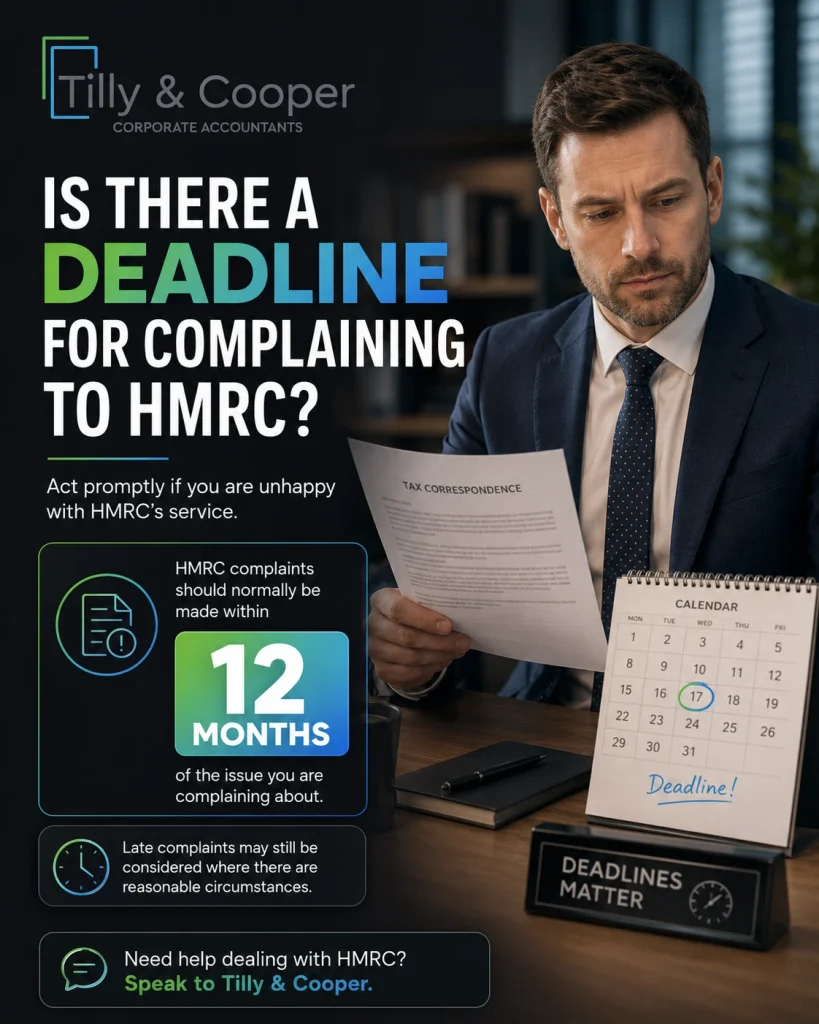
HMRC asks taxpayers to complain as soon as possible but does not impose one strict general deadline for ordinary service complaints.HMRC’s internal guidance states that rejecting a complaint solely because it was made a long time after the event should be the exception rather than the rule.
However, other deadlines can apply later:
- HMRC service complaint: no single strict general deadline, but complain as soon as possible
- Adjudicator’s Office: normally within six months of HMRC’s second review
- PHSO: normally make the complaint to an MP within one year of becoming aware of the problem
- Tax appeals: separate statutory deadlines apply
Do not allow an ongoing service complaint to cause you to miss an appeal deadline.
What Does an Effective HMRC Complaint Look Like?
An effective HMRC complaint is specific, chronological, evidence-based and clear about what HMRC needs to do to resolve the problem. Avoid sending a long narrative without identifying the actual service failures.
A stronger structure is:
1. Identify the problem
Explain the specific HMRC action or failure you are complaining about.
2. Give the chronology
List the important events and dates in order.
3. Explain what should have happened
State what HMRC should reasonably have done.
4. Provide evidence
Refer to correspondence, call records, documents or proof of postage.
5. Explain the impact
Describe additional costs, delays or practical consequences.
6. State the remedy
Tell HMRC what you want it to do.
That could include:
- correcting a record
- processing outstanding work
- issuing a repayment
- providing an explanation
- apologising
- refunding eligible additional costs
Example of an HMRC Service Complaint
Imagine a taxpayer submits documents requested by HMRC on 10 February. Tracked delivery confirms HMRC received them on 12 February. Two months later, HMRC says the documents were never received and asks for them again. The taxpayer resubmits the documents and contacts HMRC several times, but no action is taken for another three months. The accountant then has to spend additional time corresponding with HMRC to correct the position.
The complaint could identify:
failure to process received documents → repeated administrative error → unreasonable delay → additional professional costs
The taxpayer should attach or refer to the delivery evidence, copies of the documents, dates of follow-up calls and the additional accountant’s invoice. This gives HMRC a clear factual chain to investigate.
HMRC Complaint Checklist
Before submitting your complaint, check that you have:
- confirmed that the issue is a service complaint rather than an appeal
- identified the correct HMRC department
- included your relevant tax reference
- explained events in date order
- identified the specific HMRC service failure
- included relevant correspondence and evidence
- recorded previous telephone calls or contact attempts
- explained the effect of HMRC’s mistake or delay
- stated what you want HMRC to do
- kept copies of everything submitted
- retained invoices and receipts for additional costs
- protected any separate tax appeal deadline
How Can You Resolve an HMRC Complaint Successfully?
The best approach is to use the correct procedure, provide clear evidence and move through the complaint stages in the correct order. Use the HMRC complaints process for problems involving service, administration, delays, communication or case handling. Use an appeal or statutory review where you dispute a tax assessment, penalty or formal tax decision. When making a complaint, identify exactly what went wrong and provide a chronological record supported by evidence. Explain what HMRC needs to do to put the matter right and retain proof of any additional costs caused by its mistake.
If the first-tier response does not resolve the complaint, request a second-tier review and identify the points that remain unanswered. After HMRC’s final internal review, eligible cases may be taken to the Adjudicator’s Office. The Parliamentary and Health Service Ombudsman can provide a later route for qualifying unresolved complaints. Using the correct procedure from the beginning helps HMRC understand the issue, protects separate appeal rights and gives you a clearer route to escalation if the problem remains unresolved.

