
What Is a Company Tax Return? How to Prepare and File One
A Company Tax Return reports a company’s taxable profits, Corporation Tax calculation, and tax liability to HMRC. Most active UK limited companies receive a notice from HMRC requiring a Company Tax Return for each relevant Corporation Tax accounting period. A complete return usually contains Form CT600, company accounts, tax computations and any required supplementary pages.
These documents show how accounting profit becomes taxable profit. Company tax filing rules changed on 1 April 2026. HMRC closed its former joint online filing service on 31 March 2026. Companies now normally need compatible commercial software to file their Company Tax Return electronically.
Filing a Company Tax Return forms part of wider company tax compliance. Directors also need accurate bookkeeping, annual accounts and supporting tax records. This explains who needs to file, what information HMRC requires and how the filing process works.
What Is a Company Tax Return?
A Company Tax Return is the formal return used to report a company’s Corporation Tax position to HMRC.HMRC normally requires a return after issuing a notice to deliver one. A company must still file after receiving that notice if it made a loss. The same rule applies when no Corporation Tax is payable. The return covers a specific Corporation Tax accounting period. It reports taxable profits, losses, reliefs, adjustments and Corporation Tax due.
A Company Tax Return contains more than a single tax form. HMRC describes the complete return as Form CT600, supplementary pages, accounts and tax computations. The accounts provide the financial starting point. The tax computation then adjusts the accounting result under Corporation Tax rules.
For example, company accounts may include accounting depreciation. Corporation Tax calculations normally adjust that depreciation. Capital allowances may instead provide tax relief on qualifying expenditure. This means accounting profit and taxable profit can differ. A simple sequence is:
Company accounts → tax adjustments → taxable profit → CT600 → Corporation Tax liability.
Understanding that relationship makes the Company Tax Return easier to prepare.
What Documents Make Up a Company Tax Return?
A complete Company Tax Return normally contains Form CT600, company accounts, tax computations and relevant supplementary pages. Form CT600 reports the company’s main Corporation Tax figures. The company accounts show its financial performance and financial position. The tax computation explains how figures from the accounts become the taxable amounts reported to HMRC.
Supplementary CT600 pages apply when the company has particular transactions, claims or tax circumstances.HMRC requires online computations to explain how figures in the return derive from the company accounts. These documents together create the full Corporation Tax filing package.
What Is Form CT600?
Form CT600 is the main tax form used within a UK Company Tax Return.It records details about the company, accounting period, taxable profits, and Corporation Tax calculation. The CT600 also contains information about relevant claims and reliefs. Some companies need supplementary CT600 pages.The required pages depend on their activities and tax position. The tax computation supports the figures shown on CT600. Form CT600 therefore forms one part of the complete return rather than replacing the supporting accounts and computations.
Is CT600 the Same as a Company Tax Return?
No. CT600 forms part of a Company Tax Return, but it is not the complete filing package. People often use “CT600” and “Company Tax Return” to describe the same filing. Technically, the complete return normally includes the CT600, company accounts, and Corporation Tax computations.It can also contain supplementary pages. The CT600 reports the main tax figures. The accounts provide the financial results. The computation connects the two by explaining the tax adjustments.
Who Needs to File a Company Tax Return?
A company or organisation must file a Company Tax Return when HMRC issues a notice requiring one. This commonly applies to active UK limited companies within the Corporation Tax system. HMRC can also require returns from certain associations, societies, clubs and other organisations. A company may need to file even when it made a loss. Having no Corporation Tax to pay does not automatically remove the filing requirement. Directors should check the company’s Corporation Tax status and any HMRC notices before deciding that no return is needed.
Do Limited Companies Need to File Company Tax Returns?
Active UK limited companies normally file Company Tax Returns for their Corporation Tax accounting periods. A limited company has a separate tax identity from its directors and shareholders. Its business profits therefore belong to the company for Corporation Tax purposes. The company prepares accounts and calculates its taxable profits. It then reports its Corporation Tax position through the Company Tax Return. A Corporation Tax accounting period cannot exceed 12 months. This rule becomes important when annual accounts cover more than 12 months. The company may need two Company Tax Returns for one longer set of accounts.
Do Dormant Companies Need to File Company Tax Returns?
A dormant company usually stops filing ongoing Company Tax Returns after HMRC accepts its dormant Corporation Tax status. Dormancy does not simply mean that the company made no profit. A company can trade at a loss and remain active for Corporation Tax. HMRC may still require a return where it has already issued a notice to deliver one.The company should therefore deal with any existing notice rather than ignoring it. Dormancy for Corporation Tax also differs from Companies House filing requirements. A dormant limited company usually continues to have statutory accounts and other Companies House responsibilities.
Do Sole Traders File Company Tax Returns?
No. Sole traders do not file Company Tax Returns because their business is not a limited company.
A sole trader normally reports business income and expenses through Self Assessment. HMRC confirms that sole traders and partnerships do not use the Company Tax Return system. A limited company follows separate Corporation Tax rules. This distinction affects tax calculations, filing dates and record-keeping requirements.
How Do You Prepare a Company Tax Return?
Prepare a Company Tax Return by completing the accounts, reviewing tax adjustments and calculating taxable profits before completing CT600. Accurate bookkeeping provides the starting point. Reconcile the company’s bank accounts against its accounting records. Check sales, purchases, payroll, expenses and other financial transactions. Correct duplicated entries, missing transactions, and unexplained balances. The next stage is preparing the company accounts.
These accounts establish the accounting profit or loss. You then review that result under Corporation Tax rules. Some expenses receive tax relief. Other costs require adjustments. For example, certain non-business or non-deductible expenses may need adding back. Accounting depreciation normally requires adjustment.
Capital allowances may provide relief for qualifying assets instead. The Corporation Tax computation records these changes. Complete the CT600 once the taxable result and Corporation Tax liability are clear. Review the return, accounts and computation together before filing.
What Information Do You Need for a Company Tax Return?
You need company details, accounting records, annual accounts and information supporting the Corporation Tax calculation.
The company details include its name, Unique Taxpayer Reference and Corporation Tax accounting period. Financial records support the figures used in the accounts. These can include sales invoices, purchase invoices, receipts, payroll information and bank statements. Records about business assets can support capital allowance claims.
Previous Corporation Tax returns can also matter where the company has brought-forward losses or other tax positions. The information needed becomes more extensive when a company has unusual transactions or specific tax claims. Complete records make the tax calculation easier to support if HMRC later checks the return.
What Is a Tax Computation in a Company Tax Return?
A tax computation explains how accounting profit or loss becomes taxable profit or loss.
Consider a company with an accounting profit of £50,000. Suppose the accounts contain £2,000 of expenditure that does not qualify for Corporation Tax relief. The company also has £4,000 of qualifying capital allowances. The simplified calculation would produce taxable profits of £48,000 before any further adjustments.
The calculation starts with £50,000. It adds the £2,000 non-deductible expense and deducts £4,000 of capital allowances. Real tax computations can also include losses, chargeable gains, group relief and other adjustments. HMRC requires the computation to explain how the return figures connect with the company accounts.
What Is the Difference Between Company Accounts and a Company Tax Return?
Company accounts report financial performance, while the Company Tax Return reports the company’s Corporation Tax position.The accounts provide information about the company’s income, expenses, assets and liabilities. They also establish the company’s accounting profit or loss. The Company Tax Return uses those financial figures for tax purposes. Tax rules then adjust certain accounting entries. For example, company accounts may include £10,000 of depreciation.
The Corporation Tax calculation can add that amount back before considering qualifying capital allowances. This explains why accounting profit can differ from taxable profit. The filing destinations also differ. Companies House receives statutory company accounts. HMRC receives the Company Tax Return.
How Do You File a Company Tax Return in the UK?
Companies normally file a Company Tax Return electronically with HMRC using compatible commercial software. This process changed on 1 April 2026. HMRC and Companies House closed their former joint online filing service on 31 March 2026. Businesses that used it must now use commercial software for HMRC Corporation Tax filing. HMRC maintains a list of recognised commercial software products for Corporation Tax submissions.
Most company accounts and tax computations submitted with an online return use iXBRL formatting. Compatible software can prepare or convert the required information into that format. Check that the accounts, tax computation and CT600 agree before submission. HMRC sends an acknowledgement after receiving an online return. That acknowledgement confirms receipt. It does not mean HMRC has accepted every figure as correct.
Can You File a Company Tax Return Online?
Yes. Online filing through commercial Corporation Tax software is now the normal filing method.The old HMRC online filing service no longer operates. Companies can choose suitable software from HMRC’s recognised supplier list. Some businesses use accounts and tax software internally. Others appoint an accountant to prepare and submit the return. Most companies need to submit their accounts and computations using iXBRL. The software often handles this technical formatting automatically.
Can You File CT600 Without Software?
Most companies cannot use the normal electronic CT600 filing route without compatible commercial software. HMRC closed its own former Company Tax Return filing service on 31 March 2026. Commercial software now provides the standard route. Paper filing remains available in limited circumstances.HMRC allows it where the company has a reasonable excuse or files the return in Welsh. A business can still prepare its underlying records and calculations itself. However, complex adjustments may justify professional Corporation Tax support.
Do You File a Company Tax Return With HMRC or Companies House?
You file the Company Tax Return with HMRC, while statutory company accounts normally go to Companies House. The two organisations perform different functions. HMRC administers Corporation Tax. Companies House maintains the public company register and receives statutory company filings.
HMRC normally receives CT600, accounts and tax computations as part of the Company Tax Return. Companies House receives statutory accounts under company law. A business can therefore need to provide financial information to both organisations. The deadlines can also differ.
When Is a Company Tax Return Due?
A Company Tax Return is normally due 12 months after the end of its Corporation Tax accounting period.HMRC sets a separate deadline for paying Corporation Tax. For many companies, the payment deadline is nine months and one day after the accounting period ends. Suppose a company’s Corporation Tax accounting period ends on 31 March 2027.
Its Corporation Tax payment would normally become due on 1 January 2028. The Company Tax Return would normally become due on 31 March 2028. Special rules can alter filing dates in some circumstances. Companies should therefore check the exact period shown on their HMRC records.
Is the Corporation Tax Payment Deadline the Same as the Filing Deadline?
No. Corporation Tax is normally payable before the Company Tax Return filing deadline.For most companies, Corporation Tax becomes due nine months and one day after the accounting period ends. The return normally becomes due 12 months after that period ends. This creates two separate responsibilities. Paying Corporation Tax does not file the return. Filing the return does not automatically mean the tax has been paid. Large companies can follow different Corporation Tax payment rules.
What Happens When Company Accounts Cover More Than 12 Months?
A company may need two Company Tax Returns when its accounts cover more than 12 months. A Corporation Tax accounting period cannot exceed 12 months. For example, first company accounts can sometimes cover more than one year. HMRC may therefore divide that financial period into two Corporation Tax accounting periods.Each accounting period can require its own return and payment calculation. Directors should check the Corporation Tax dates rather than relying only on the Companies House year-end.
What Are the Penalties for Filing a Company Tax Return Late?
HMRC charges automatic penalties when a required Company Tax Return reaches it after the filing deadline.
The fixed penalties increased for returns with filing dates on or after 1 April 2026.
| Delay | Standard penalty from 1 April 2026 |
| Return filed late | £200 |
| More than 3 months late | Another £200 |
| More than 6 months late | 10% of unpaid Corporation Tax can apply |
| More than 12 months late | Another 10% of unpaid Corporation Tax can apply |
Repeated late filing creates higher fixed penalties. For a third consecutive late return, the £200 penalty can increase to £1,000. Where that return remains more than three months late, the fixed total can reach £2,000. Late filing penalties are separate from interest and consequences linked to late Corporation Tax payments. Tracking both deadlines reduces avoidable charges.
What Happens After You File a Company Tax Return?
HMRC records the return and can review, correct or enquire into the information submitted. Keep the electronic filing acknowledgement with the company’s records. Also retain the final CT600, accounts and tax computation. Check the company’s Corporation Tax account after filing. Make sure payments match the final liability.
An overpayment can create a repayment position. An underpayment may require further payment and interest. HMRC can also open an enquiry under its statutory powers. Good supporting records therefore remain important after the return has been submitted.
Can You Amend a Company Tax Return After Filing?
Yes. A company can usually amend its Company Tax Return within 12 months of the filing deadline. An amendment may become necessary after discovering an incorrect figure or missing claim. HMRC allows companies to make changes through commercial software or other permitted routes.A company should correct discovered errors promptly. Different procedures can apply after the normal amendment period has expired. For example, overpayment relief may remain available in certain circumstances.
How Long Should You Keep Company Tax Records?
Companies generally need to keep Corporation Tax records for at least six years. The six-year period normally runs from the end of the relevant company financial year. Longer retention can apply in certain circumstances. Examples include late returns, HMRC compliance checks and transactions covering several accounting periods.Useful records include invoices, receipts, contracts, bank statements and accounting reports. Keep supporting evidence for tax adjustments and claims as well. Accurate records help support the figures in the accounts, computation and CT600.
What Company Tax Return Mistakes Should You Avoid?
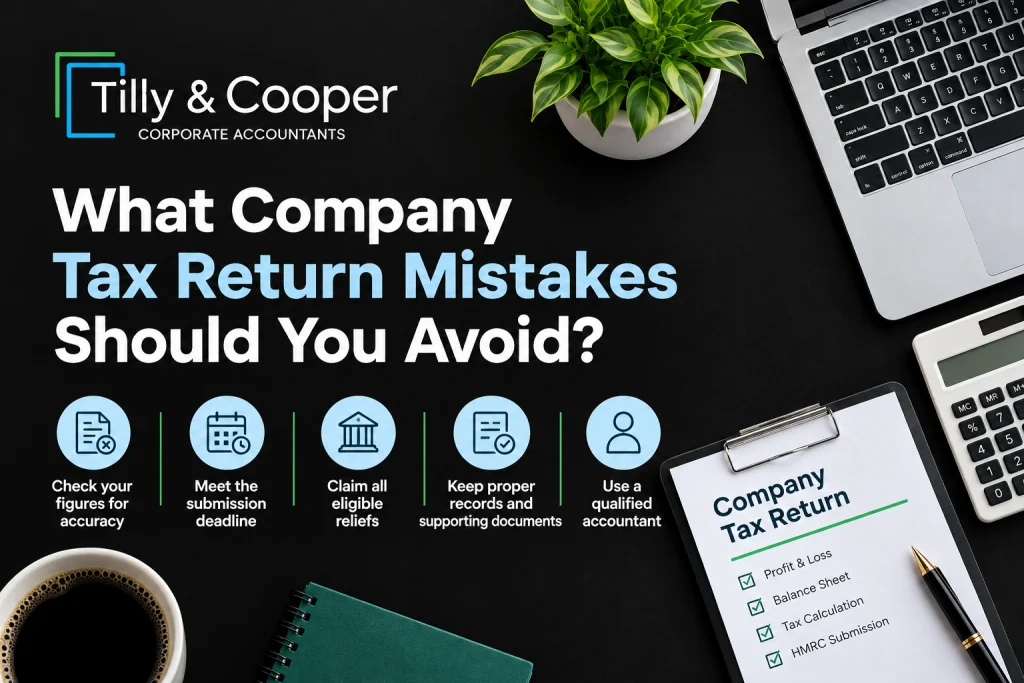
The main Company Tax Return mistakes involve inaccurate accounts, missed tax adjustments, incorrect periods and incomplete supporting information. Start by checking that the CT600 agrees with the final company accounts and tax computation. Review expenses before claiming Corporation Tax deductions. Do not assume every cost recorded in the accounts receives tax relief. Check depreciation and qualifying capital expenditure separately. Review brought-forward losses before using them. Confirm that all taxable income for the accounting period appears in the calculation.
Use the correct Corporation Tax accounting dates. Include all required supplementary pages and supporting computations. Companies also need to take reasonable care when preparing tax returns. Correct an error promptly after discovering it. HMRC can charge penalties for certain inaccuracies, particularly where reasonable care was not taken.
What Are the Most Common Company Tax Return Questions?
Company Tax Return questions usually concern terminology, losses, repayments, and filing responsibilities.
The following points clarify the areas that often confuse.
Is a Company Tax Return the Same as a Corporation Tax Return?
Yes. “Corporation Tax Return” commonly describes the same filing, although HMRC officially uses “Company Tax Return”. The return reports the company’s Corporation Tax position. Form CT600 provides the main return form. The complete filing normally includes accounts and tax computations as well. The two expressions therefore usually refer to the same tax compliance process.
Do You File a Company Tax Return if the Company Made No Profit?
Yes, a company can still need to file a Company Tax Return when it made a loss or has no tax to pay. HMRC specifically requires a return where it has issued a notice to deliver one. A trading loss does not make a company dormant.
For example, a business could make £80,000 of sales and incur £90,000 of allowable costs. It traded during the year despite making a loss. Its tax return reports that loss. The loss may also affect tax calculations for another period where relief rules allow.
Can a Company Receive a Corporation Tax Refund?
Yes. A company can receive a repayment when it has paid more Corporation Tax than it ultimately owes. An overpayment can arise after an amended calculation or qualifying tax claim. Certain loss claims can also alter the company’s final Corporation Tax position. Check the HMRC Corporation Tax account before expecting a repayment. Keep evidence supporting any adjustment that reduces the liability. A repayment should follow the company’s correct tax calculation rather than an estimate.
Why Is an Accurate Company Tax Return Important?
An accurate Company Tax Return connects the company’s financial records with its correct Corporation Tax liability. Good bookkeeping provides reliable financial information. Annual accounts organise that information into the company’s financial results. The tax computation applies Corporation Tax rules to those results. Form CT600 then reports the final tax position to HMRC.
This process explains why a Company Tax Return involves more than completing one form. Companies must also meet separate payment and filing deadlines. Since 1 April 2026, most companies need commercial software for electronic Corporation Tax filing. Late-return penalties also increased from that date. Keeping accurate records throughout the year makes preparation easier. It also reduces the risk of missed adjustments, inconsistent figures, and unnecessary penalties.