

Balance Sheet vs Profit and Loss Account: What Is the Difference?
A balance sheet shows a business’s financial position at one date. A profit and loss account shows performance over a period. The balance sheet records assets, liabilities, and equity. The profit and loss account records revenue, expenses, and the resulting profit or loss.Understanding balance sheet vs profit and loss helps business owners read financial reports more clearly. Both reports use connected accounting data. However, each answers a different financial question.A balance sheet answers, “What does the business own and owe?” A profit and loss account answers, “Did the business make a profit?” UK statutory accounts include both a balance sheet and a profit and loss account. Filing requirements can differ by company size and eligibility.
What Is a Balance Sheet?
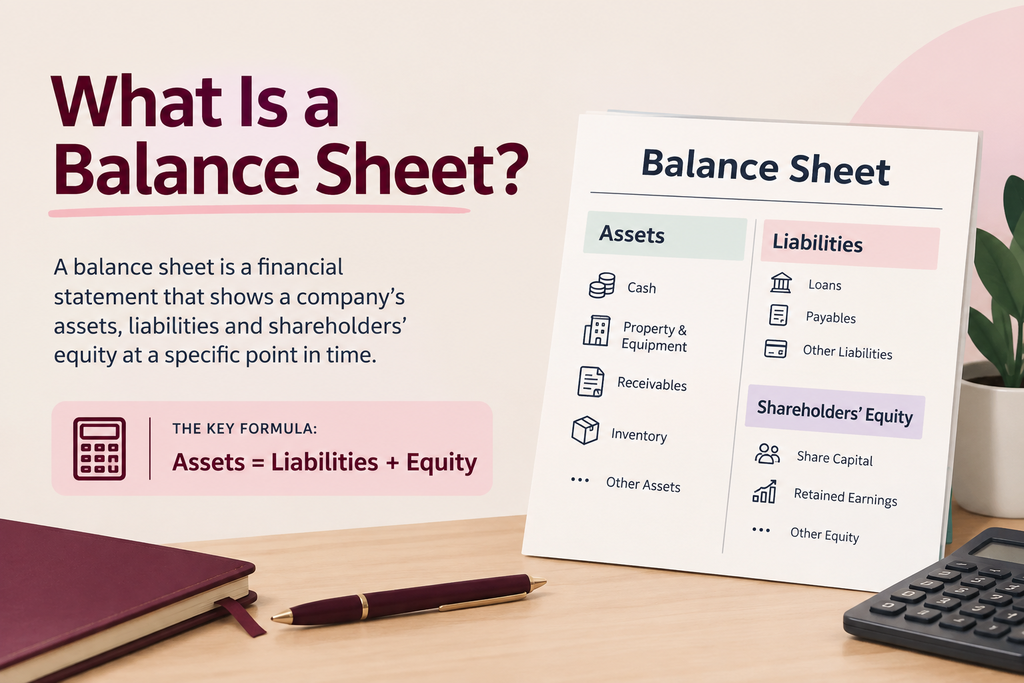
A balance sheet shows a business’s assets, liabilities and equity at a specific date. It provides a snapshot of financial position. For annual accounts, this date is normally the final day of the company’s financial year. Assets represent resources controlled by the business. Examples include equipment, stock, cash and money owed by customers. Liabilities represent amounts the business owes.
Examples include supplier balances, loans, taxes and other financial obligations. Equity represents the owners’ interest after liabilities are deducted from assets. It can include share capital and retained earnings. The basic accounting relationship is:
Assets = Liabilities + Equity
For example, a company might hold £120,000 of assets and £45,000 of liabilities. Its equity would equal £75,000. Working capital equals current assets minus current liabilities. It helps directors assess the company’s short-term financial position. These reports also support statutory accounts preparation at the financial year end.
What Is a Profit and Loss Account?
A profit and loss account shows revenue, expenses, and profit or loss over an accounting period. It measures financial performance rather than position. The report may cover one month, one quarter, or a full financial year. Businesses often call this report a P&L. The term income statement is also widely used for the same report. Revenue records income generated from normal business activities.
Expenses record costs incurred while generating revenue and operating the business. The difference between income and relevant costs determines whether the business reports a profit or loss. For example, a company may record £300,000 of revenue and £240,000 of costs. The resulting profit would be £60,000 before further adjustments. A P&L therefore helps directors understand profitability across a defined accounting period.
Balance Sheet vs P&L: Key Differences
A balance sheet shows financial position at one date. A P&L shows financial performance over a defined period.
| Area | Balance Sheet | Profit and Loss Account |
| Main purpose | Shows financial position | Shows financial performance |
| Time focus | One specific date | A defined accounting period |
| Main elements | Assets, liabilities and equity | Revenue, expenses, profit or loss |
| Main question | What does the business own and owe? | Did the business make a profit or loss? |
| Profit impact | Accumulated results affect equity | Shows profit generated during the period |
| Working capital | Shows current assets and liabilities | Does not directly calculate working capital |
| Performance analysis | Gives limited trading performance detail | Shows revenue, costs and profitability |
| Reporting use | Financial position and net assets | Trading results and profitability |
Consider a company preparing accounts to 31 December. Its balance sheet shows assets, liabilities and equity on 31 December. Its P&L shows revenue and expenses across the accounting period ending on that date.
This date-versus-period distinction explains much of the difference between balance sheet and profit and loss reporting. The reports remain connected. Transactions recorded during the year can affect both statements in different ways.
What Does a Balance Sheet Include?
A balance sheet includes assets, liabilities and equity. These categories explain the company’s financial position. Fixed assets are resources used over a longer period. Examples include machinery, vehicles, equipment and certain intangible assets. Current assets usually support trading or convert into cash within the shorter term.
Examples include stock, trade debtors, bank balances and cash. Trade debtors represent amounts customers owe the business. Current liabilities are amounts normally due within the shorter term. Examples include trade creditors, taxes and short-term borrowing. Long-term liabilities can include loans and other obligations payable after a longer period. The balance sheet also contains capital and reserves.
Share capital shows the amount recognised as share capital for the company’s issued shares. Retained earnings represent accumulated profits kept within the business after relevant losses and distributions. These categories help directors assess net assets, working capital and the wider financial structure. A company can report strong profits while holding weak working capital. Reading only the P&L could hide that financial pressure.
What Does a Profit and Loss Account Include?
A profit and loss account includes revenue and expenses. These figures determine the business’s profit or loss for a period. Turnover usually appears near the top of the report. It represents revenue from the company’s ordinary activities. Cost of sales records direct costs linked with producing goods or delivering services. Subtracting cost of sales from turnover produces gross profit. A business with £200,000 turnover and £120,000 cost of sales has £80,000 gross profit.
Operating expenses then reduce this figure. These expenses can include wages, rent, software, insurance, professional fees and other overheads. Operating profit reflects the result from normal business operations before certain further items. Interest charges can then affect profit before tax.
The tax charge reduces profit before tax to arrive at profit after tax, where applicable. Different businesses can use different layouts based on their reporting framework and circumstances. The important relationship remains the same. Revenue increases financial performance, while business expenses reduce the resulting profit. This structure helps management review margins, costs, and overall profitability.
How Are the Balance Sheet and P&L Connected?
The balance sheet and P&L connect through recorded transactions and the resulting profit or loss. A profitable year can increase retained earnings when the company keeps those profits. Losses can reduce retained earnings. Dividends and other equity movements can also affect the closing balance. Consider a company starting the year with £50,000 of retained earnings. It then earns £20,000 after tax during the year. Without dividends or other relevant movements, retained earnings can increase to £70,000.
The £20,000 profit appears through the P&L for that accounting period. The accumulated £70,000 then appears within reserves on the balance sheet. Individual transactions also show how the two reports connect. A £5,000 customer invoice can affect both reports. The P&L records £5,000 of revenue when the business recognises that income under its accounting rules.
The balance sheet can record £5,000 as a trade debtor while the customer owes the money. When the customer pays, cash increases and trade debtors decrease. The payment does not create another £5,000 of revenue. A £20,000 bank loan works differently. The balance sheet records £20,000 more cash and a £20,000 loan liability.
Receiving the loan does not create £20,000 of profit in the P&L. Buying equipment provides another example. Cash may decrease while fixed assets increase on the balance sheet. The purchase does not normally become an immediate full P&L expense. Depreciation can allocate the relevant cost across accounting periods. These examples show why businesses should read both statements together.
Which Report Is More Important?
Neither report is universally more important. Each answers a different financial question. The profit and loss account helps directors understand profitability and trading performance. The balance sheet helps them understand assets, liabilities, equity, and financial position. A profitable P&L does not automatically mean the business has a strong balance sheet.
A company could make £100,000 profit while carrying significant debt or overdue liabilities. The reverse can also happen. A company might hold substantial assets but report weak trading performance during the current year. Profitability, liquidity and solvency therefore require different financial information.
The P&L gives more detail about profitability. The balance sheet gives more information about financial position, debt and working capital. Directors gain a clearer picture when they review both reports together.
How Can Small Businesses Use Both Reports?
Small businesses can use both reports to monitor profitability, cash pressure, debt and financial position.The P&L can show whether revenue is increasing or falling. It can also reveal changes in gross margin and operating expenses. Directors can compare monthly or quarterly results to identify trends. The balance sheet adds another layer of information. Trade debtors show how much customers still owe. Trade creditors show amounts outstanding to suppliers.
Cash and bank balances show liquid resources available at the reporting date. Current assets and current liabilities help directors assess working capital. For example, a company might report a £40,000 annual profit. Its balance sheet might show £70,000 owed by customers and only £5,000 in the bank.
The company is profitable, but delayed customer payments could create short-term cash pressure. This example shows why profit and cash are not the same. Regular management accounts can combine the P&L, balance sheet and cash flow information. This gives directors a wider view of business performance throughout the year.
Reading both statements across several periods can also improve trend analysis. Several balance sheets can show whether debt, cash or working capital is improving or weakening. Several P&Ls can reveal changes in sales, margins and expenses. Together, these reports support better-informed business decisions.
FAQs
No. A balance sheet shows financial position at a specific date. A profit and loss account shows performance over a period.The balance sheet contains assets, liabilities and equity. The P&L contains revenue, expenses and profit or loss.
Is a P&L the same as an income statement?
Yes. P&L (Profit and Loss Statement) and Income Statement generally mean the same thing. Both show a business’s financial performance over a period:
Revenue – Expenses = Profit or Loss
You may also hear terms such as Statement of Profit or Loss or Statement of Comprehensive Income depending on the accounting framework and what is included.
Profits can affect equity on the balance sheet through retained earnings or other reserves.The exact movement also depends on losses, dividends and other relevant equity transactions.
A balance sheet shows cash at a specific date. It does not show every cash movement during the period.A cash flow statement, or cash flow report, explains cash movements more directly.
Yes. A profitable business can still have limited cash when money remains tied up elsewhere.Examples include unpaid customer invoices, stock purchases and debt repayments.
UK statutory accounts include a balance sheet and profit and loss account, alongside other required information.Current filing options allow some qualifying small companies and micro-entities to provide less information publicly.
A balance sheet measures financial position at one date. A P&L measures financial performance across a period.Both reports provide different parts of the same financial picture.Understanding balance sheet vs profit and loss helps directors assess profitability alongside assets, liabilities and working capital.