

What Is the Accounting Cycle? 8 Steps & Its Importance
The accounting cycle is the process businesses use to record, organise, check, and report financial transactions during an accounting period. It takes everyday financial activity, such as sales, purchases, payments, and expenses, and turns it into useful accounting records and financial statements.
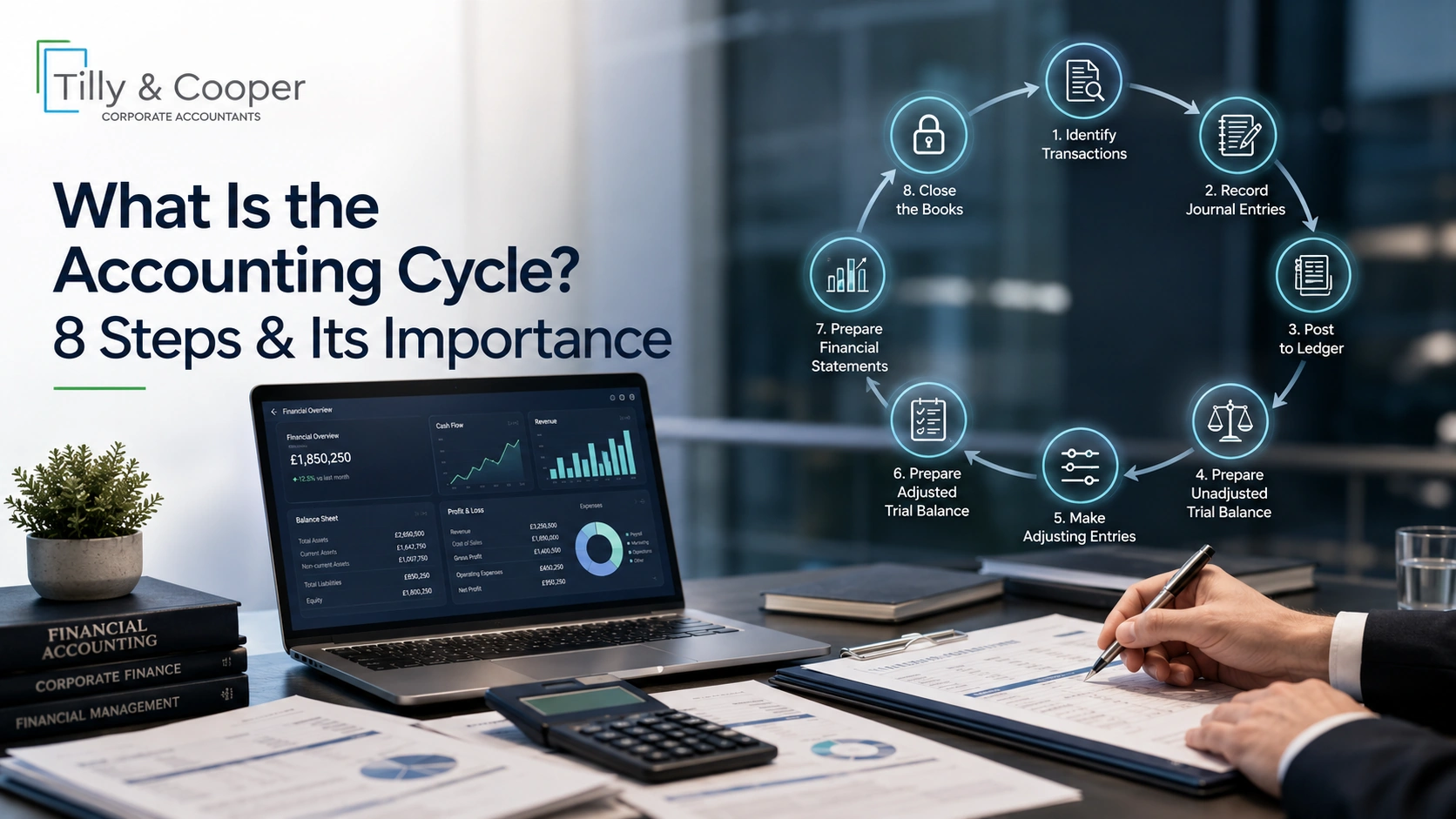
The process usually moves through eight main stages. These include identifying transactions, recording journal entries, posting them to the general ledger, preparing a trial balance, making adjustments, preparing an adjusted trial balance, creating financial statements, and closing the books.
A well-managed accounting cycle helps businesses understand their financial position, prepare reliable reports, maintain organised records, and meet accounting and tax responsibilities. For UK businesses, it can also support preparing annual accounts, Corporation Tax information, VAT records, and other financial reporting requirements.
What Is the Accounting Cycle?
The accounting cycle is a recurring series of steps that turns financial transactions into organised financial statements for a specific accounting period. It starts when a financial transaction happens and continues until the books for that period are reviewed and closed.
A transaction may include:
- Making a sale.
- Receiving money from a customer.
- Paying a supplier.
- Buying equipment.
- Paying wages.
- Taking out a business loan.
- Paying rent or other expenses.
Each transaction needs to be identified, recorded, classified, and checked before it becomes part of the final financial reports. The accounting cycle is closely connected with double-entry bookkeeping. Under this system, a transaction normally affects at least two accounts. One side is recorded as a debit and the other as a credit. The basic accounting equation is:
Assets = Liabilities + Equity
Keeping this equation balanced is essential to accurate bookkeeping and financial reporting. Although the accounting cycle is often explained as a period-end process, many of its steps happen every day through bookkeeping and accounting software.
What Are the 8 Steps of the Accounting Cycle?
The accounting cycle follows 8 clear steps that help a business record, organise, check, and report its financial activity accurately. Each step builds on the previous one, starting with identifying transactions and ending with closing the books for the period. Following these stages in order helps keep accounting records complete, balanced, reliable, and ready for financial reporting and review purposes.
- Identify financial transactions.
- Record journal entries.
- Post entries to the general ledger.
- Prepare an unadjusted trial balance.
- Make adjusting entries.
- Prepare an adjusted trial balance.
- Prepare financial statements.
- Close the books.
Each stage adds more structure and accuracy to the financial information.
1. How Do You Identify Financial Transactions?
The first step is deciding which business activities need to be recorded in the accounting system. Not every event creates an accounting entry. A transaction normally needs to have a measurable financial effect on the business.
Common examples include:
- Selling goods or services.
- Purchasing stock.
- Paying suppliers.
- Receiving customer payments.
- Paying wages.
- Buying business assets.
- Paying rent.
- Receiving finance.
- Paying interest.
- Recording business expenses.
The business should also keep evidence of each transaction.
Source documents may include:
- Sales invoices.
- Supplier invoices.
- Receipts.
- Bank statements.
- Purchase orders.
- Credit notes.
- Contracts.
- Payroll reports.
- Expense claims.
These documents support the accounting records and create an audit trail. Good record keeping at this stage makes the rest of the accounting cycle much easier.
2. How Are Journal Entries Recorded?
Once a transaction has been identified, it is recorded as a journal entry. A journal entry shows how the transaction affects the business’s accounts and keeps the accounting records balanced.
A journal entry normally includes:
- The date.
- The accounts affected.
- The debit.
- The credit.
- A short description or reference.
For example, imagine a business pays £1,000 in office rent from its bank account.
The entry could be:
Debit: Rent Expense £1,000
Credit: Bank £1,000
The rent expense increases while the amount held in the bank decreases. Under double-entry bookkeeping, total debits should equal total credits. Modern accounting software often creates these entries automatically when users record invoices, bills, bank transactions, expenses, or payroll. The software may automate the entry, but the accounting principles behind it remain the same.
3. What Is Posting to the General Ledger?
After transactions are recorded, they are grouped into individual accounts in the general ledger. The general ledger is the main accounting record that brings together transactions by account.
Typical ledger accounts include:
- Bank.
- Cash.
- Trade receivables.
- Trade payables.
- Sales.
- Purchases.
- Rent.
- Wages.
- VAT.
- Equipment.
- Loans.
- Share capital.
This makes it easier to see the total activity and balance of each account. For example, instead of checking every individual rent payment in the journal, the accountant can review the rent account in the ledger and see all related transactions together. The general ledger therefore turns individual transaction records into organised account balances.
4. What Is an Unadjusted Trial Balance?
An unadjusted trial balance is a list of the balances in the general ledger before period-end adjustments are made.It shows the debit and credit balances of the accounts. The main purpose is to check whether:
Total debits = Total credits
If the totals do not agree, there is usually an error that needs to be investigated. However, an important point is that a balanced trial balance does not prove that every accounting entry is correct.
For example, a transaction may have been:
- Missed completely.
- Recorded twice.
- Posted to the wrong account.
- Recorded at the wrong amount on both sides.
- Classified incorrectly.
In these cases, total debits and credits may still balance.A trial balance is therefore an important checking tool, but it should be supported by reconciliations and account reviews.
5. What Are Adjusting Entries?
Adjusting entries update the accounts at the end of an accounting period so that income, expenses, assets, and liabilities are shown in the correct period.
They are especially important under accrual accounting.
Under accrual accounting, income is generally recorded when it is earned, and expenses are recognised when they are incurred, rather than simply when cash enters or leaves the bank.
Common adjusting entries include the following.
Accrued Expenses
An accrued expense is a cost that relates to the current accounting period but has not yet been paid or invoiced.
Examples include:
- Accountancy fees.
- Utility bills.
- Wages.
- Interest.
- Professional fees.
Prepayments
A prepayment happens when a business pays for something in advance.For example, if an insurance policy covers 12 months but part of that period falls into the next financial year, the unused part may be carried forward as a prepayment.
Accrued Income
Accrued income is income that a business has earned but has not yet received or invoiced by the end of the accounting period. It is recorded as income in the period in which it is earned and usually appears as a current asset on the balance sheet.
Deferred Income
Deferred income is money a business has received before it has earned the related revenue. It is recorded as a liability until the goods or services are provided, after which the amount is recognised as income in the appropriate accounting period.
Depreciation
Depreciation is the process of spreading the cost of a fixed asset over its useful life. It reflects the reduction in an asset’s value due to use, age, or wear and tear and is recorded as an expense in the accounts.
Examples may include:
- Computers.
- Vehicles.
- Machinery.
- Office equipment.
Adjustments help make sure the accounts reflect what actually relates to the reporting period.
6. What Is an Adjusted Trial Balance?
After the adjusting entries have been posted, the business prepares an adjusted trial balance. This includes the updated account balances that will be used to prepare the financial statements. The accountant checks again that debits and credits are equal.
They may also review unusual or unexpected balances, such as:
- Negative asset balances.
- Old unpaid supplier balances.
- Unexpected debtor balances.
- Bank differences.
- Incorrect VAT balances.
- Suspense accounts.
- Unusual expense movements.
Any important issues should normally be corrected before the accounts are finalised. The adjusted trial balance provides a cleaner and more complete picture of the accounting records at the reporting date.
7. How Are Financial Statements Prepared?
Once the adjusted figures are ready, they are used to prepare the financial statements. The exact statements required depend on the type and size of the business and the reporting framework it follows.
Common financial statements include:
Income Statement
An income statement is a financial statement that shows a business’s revenue, expenses, and profit or loss over a specific accounting period. It helps business owners understand financial performance by showing whether the business earned more income than it spent during that period.
Balance Sheet
A balance sheet is a financial statement that shows a business’s assets, liabilities, and equity at a specific point in time. It provides a clear picture of what the business owns, what it owes, and the value remaining for its owners.
It normally includes:
- Assets.
- Liabilities.
- Equity.
Cash Flow Statement
A cash flow statement explains how cash moved into and out of the business during the period. Depending on the entity and the reporting framework, a cash flow statement may not always be required as part of statutory accounts.
Statement of Changes in Equity
This statement explains how the owners’ or shareholders’ equity changed during the period. Financial statements are one of the main outputs of the accounting cycle because they turn detailed accounting data into information that users can understand.
8. What Does Closing the Books Mean?
Closing the books means finalising the accounting records for the completed period before moving into the next one. Revenue and expense accounts relate to the period that has just ended and are closed as part of the year-end or period-end process. Balance sheet accounts usually remain open.
These include:
- Assets.
- Liabilities.
- Share capital.
- Reserves.
- Other equity balances.
Their closing balances are carried forward into the next accounting period. Modern accounting software can automate much of this process, including balance roll-forwards. However, year-end adjustments and account reviews still need to be completed correctly. Some accounting cycle models also include a post-closing trial balance to confirm that the remaining balances have been carried forward properly.
What Is an Example of the Accounting Cycle?
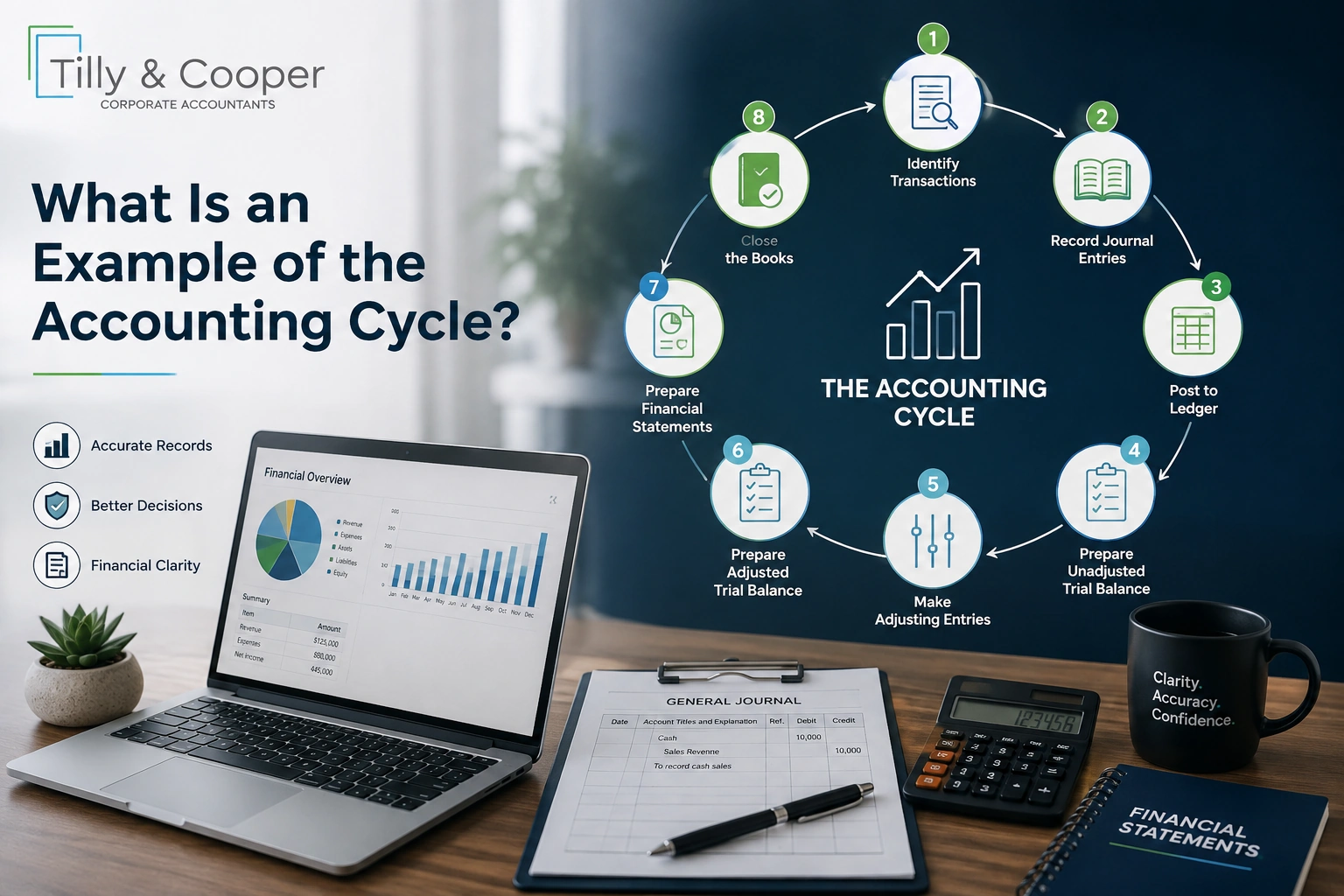
A simple example can show how the accounting cycle works in practice.Suppose a business buys a computer for £1,500 and pays from its business bank account.
Step 1: Identify the Transaction
The computer purchase is a business transaction because it affects the company’s finances.The supplier invoice is kept as supporting evidence.
Step 2: Record the Journal Entry
The initial journal entry may be:
Debit: Computer Equipment £1,500
Credit: Bank £1,500
The business now has a new asset and £1,500 less in its bank account.
Step 3: Post to the Ledger
The entry is posted to the computer equipment account and the bank account in the general ledger.
Step 4: Include It in the Trial Balance
Both balances are included in the trial balance.
Step 5: Make Adjustments
At the end of the accounting period, depreciation may need to be recorded.
A depreciation entry may include:
Debit: Depreciation Expense
Credit: Accumulated Depreciation
Step 6: Prepare the Adjusted Trial Balance
The updated asset and depreciation balances are included in the adjusted trial balance.
Step 7: Prepare Financial Statements
The computer appears within the relevant asset figures on the balance sheet, while the depreciation charge affects the profit and loss account.
Step 8: Close the Period
The accounting period is completed and the relevant balance sheet values are carried forward.This example shows how one transaction moves from the original document through to the financial statements.
Why Is the Accounting Cycle Important?
The accounting cycle matters because it gives businesses a consistent way to manage financial information.Without a proper process, transactions can be missed, duplicated, classified incorrectly, or reported in the wrong accounting period.
It Improves Accounting Accuracy
Regular checks help identify mistakes before the financial statements are completed.Trial balances, reconciliations, adjustments, and account reviews all support better accuracy.
It Supports Reliable Financial Reporting
Financial statements depend on the accounting information behind them.If the bookkeeping records are incomplete or inaccurate, the final reports may also be unreliable.
It Helps Businesses Make Better Decisions
Business owners and managers rely on financial information when deciding whether to:
- Hire staff.
- Reduce costs.
- Increase prices.
- Borrow money.
- Expand.
- Invest.
- Improve cash flow.
Better accounting information supports better decisions.
It Creates a Clear Audit Trail
The accounting cycle connects source documents, journal entries, ledger balances, and financial reports. This makes transactions easier to trace and review.
It Supports Compliance
Businesses may need accurate financial records for tax, statutory accounts, VAT, audits, and other reporting obligations. For UK companies, organised accounting records can support the preparation of annual accounts, Corporation Tax returns, VAT returns, and other required information.
It Improves Financial Control
Regular review of accounts can help identify:
- Unusual transactions.
- Overdue debts.
- Incorrect payments.
- Bank differences.
- Missing expenses.
- Possible control weaknesses.
The accounting cycle is therefore not just a reporting process. It is also an important part of financial control.
What Is the Purpose of the Accounting Cycle?
The main purpose of the accounting cycle is to turn individual financial transactions into complete, organised, and useful financial information. A business may process hundreds or thousands of transactions during a year. Looking at each transaction separately provides limited insight. The accounting cycle groups these transactions into useful categories.
For example:
Customer invoices become part of sales and trade receivables. Supplier bills become part of expenses, assets, purchases, or trade payables. Bank transactions become part of the business’s cash and bank balances. Once organised, this information can answer important questions such as:
- Is the business making a profit?
- How much cash is available?
- How much do customers owe?
- How much does the business owe suppliers?
- What assets does the business own?
- How much debt does it have?
- Which costs are increasing?
- How has its financial position changed?
The purpose of the accounting cycle is therefore wider than simply recording transactions. It creates the foundation for reporting, financial control, analysis, and decision-making.
How Does the Accounting Cycle Help a Small Business?
For a small business, the accounting cycle provides a clear and practical way to keep financial records organised throughout the year. It helps business owners understand what money is coming in, what is being spent, and what amounts are still due.
It can help the owner keep track of:
- Customer invoices.
- Supplier bills.
- Business expenses.
- Payroll.
- Bank transactions.
- VAT.
- Taxes.
- Amounts owed by customers.
- Amounts owed to suppliers.
Regular bookkeeping also reduces the need to organise or rebuild a full year of financial records shortly before an accounts or tax deadline.For UK small businesses and limited companies, well-organised records can make annual accounts, Corporation Tax returns, VAT reporting, and day-to-day financial management much easier. The accounting cycle also gives business owners a clearer picture of their profit, cash flow, costs, liabilities, and overall financial position.
How Does Accounting Software Improve the Accounting Cycle?
Accounting software improves the accounting cycle by automating the recording, classification, and processing of financial transactions. Instead of entering every transaction manually, businesses can use bank feeds, invoice data, expense records, and payment information to update accounting records more efficiently. The software can automatically create journal entries, post transactions to the general ledger, calculate account balances, and support bank reconciliation. This reduces manual data-entry errors and helps maintain accurate, consistent, and up-to-date financial information throughout the accounting period.
Accounting software also makes later stages of the accounting cycle faster and easier to manage. Businesses can generate an unadjusted trial balance, record adjusting entries, prepare an adjusted trial balance, and produce financial statements from the same accounting system. Reports such as the income statement, balance sheet, and cash flow statement can be created quickly. A clear audit trail also helps accountants review transactions, identify errors, monitor financial performance, and complete period-end reporting efficiently.
What Is the Role of the Accounting Cycle in Auditing?
A well-organised accounting cycle gives auditors a clear path from the financial statements back to the original transactions and supporting evidence. Auditors can trace figures through general ledger accounts, journal entries, invoices, receipts, contracts, bank statements, and payroll records. This audit trail helps confirm whether transactions are genuine, accurately recorded, correctly classified, and supported by appropriate documentation. As a result, the audit process can become more structured and efficient.
The accounting cycle also supports audit testing and the review of internal controls. Organised records make it easier for auditors to select transactions, verify supporting documents, confirm balances, and examine controls over bank reconciliations, payment approvals, journal entries, customer accounts, supplier accounts, system access, and period-end reviews. Regular checks may also reveal duplicate entries, missing invoices, incorrect classifications, unexplained bank differences, unusual journal entries, or inaccurate accruals. However, the accounting cycle cannot prevent every error or instance of fraud, so effective controls, proper management review, and professional judgement remain essential. This cycle itself cannot prevent every error or fraud. Strong controls, proper review, and professional judgement are still required.
What Is the Difference Between the Accounting Cycle and the Budget Cycle?
The accounting cycle records and reports what has already happened financially, while the budget cycle plans and controls what a business expects to happen in the future. The accounting cycle includes identifying transactions, recording journal entries, posting to the ledger, preparing trial balances, making adjustments, producing financial statements, and closing the books. Its main purpose is to maintain accurate accounting records and report the financial position and performance of a business.
The budget cycle focuses on financial planning. It usually involves setting financial goals, estimating revenue and expenses, preparing budgets, approving spending plans, monitoring actual results, and comparing performance against budgeted figures. Management may then revise forecasts or take corrective action where necessary. In simple terms, the accounting cycle explains actual financial results, while the budget cycle helps a business plan future income, costs, cash flow, and resource allocation. Both processes work together because accounting data provides the historical information needed to prepare realistic budgets and measure future performance.
What Is the Difference Between the Accounting Cycle and the Operating Cycle?
The accounting cycle and operating cycle both relate to business activity, but they measure different aspects of a business. The accounting cycle is a financial recording and reporting process, whereas the operating cycle measures how long it takes a business to convert its operating activities into cash. The accounting cycle focuses on recording transactions accurately and preparing financial reports for a specific accounting period.
A typical operating cycle may involve buying inventory, selling inventory, creating accounts receivable, and collecting cash from customers. The accounting cycle records each of these transactions within the financial records through journal entries, ledger accounts, adjustments, and financial statements. In simple terms, the operating cycle focuses on the time taken to convert resources into cash, while the accounting cycle focuses on recording and reporting the financial effect of those activities.
What Is the Difference Between the Accounting Cycle and Month-End Close?
The accounting cycle is the full process of recording, organising, adjusting, reporting, and closing financial transactions, while the month-end close focuses on finalising the accounts for a particular month.
A month-end close may include:
- Bank reconciliations.
- Reviewing customer balances.
- Reviewing supplier balances.
- Recording accruals.
- Recording prepayments.
- Checking payroll.
- Reviewing VAT.
- Posting depreciation.
- Reviewing the trial balance.
- Preparing management reports.
The month-end close is therefore one practical part of the wider accounting cycle. A business may complete month-end closes throughout the year and then perform a more detailed year-end close before preparing annual financial statements.
How Long Does the Accounting Cycle Take?
The length of the accounting cycle depends on the reporting period a business follows. It may be completed monthly, quarterly, or annually, depending on the organisation’s accounting and reporting requirements. Most businesses record financial transactions throughout the year and perform important procedures, such as bank reconciliations and account reviews, at the end of each month. Larger organisations may also carry out more detailed month-end and quarter-end closing procedures to keep their financial records accurate and up to date.
At the end of the financial year, the accounting cycle is usually more detailed because the business may need to prepare annual financial statements, year-end adjustments, tax computations, and other statutory information. The time required to complete the cycle also depends on the quality of the bookkeeping records. A business that maintains accurate and organised records throughout the year can normally complete the accounting cycle more efficiently than one that delays reconciliations and reviews until year-end.A business that maintains bookkeeping can normally complete the process more efficiently than one that waits until year-end to review its records.
Who Performs the Accounting Cycle?
Different people may be involved in the accounting cycle depending on the size and structure of the business. In smaller businesses, one person may manage most accounting tasks, while larger organisations often divide the work between specialist finance teams.
These may include:
- Business owners.
- Bookkeepers.
- Accountants.
- Accounts payable staff.
- Accounts receivable staff.
- Payroll teams.
- Management accountants.
- Financial accountants.
- Financial controllers.
- Finance directors.
In a small business, a bookkeeper or accountant may manage most stages of the accounting cycle. In a larger organisation, different teams may be responsible for areas such as invoicing, payroll, payments, reporting, and financial controls.
Accounting software can also automate many routine tasks, such as recording transactions, matching bank payments, generating reports, and preparing trial balances. However, financial information still needs to be reviewed to make sure the records are accurate and complete.
Who Uses Information Produced by the Accounting Cycle?
Information produced by the accounting cycle is used by both internal and external stakeholders. Business owners use financial statements to understand profitability, cash flow, assets, liabilities, and financial performance. Managers rely on accounting information to control costs, prepare budgets, set targets, and make operational decisions. Investors and shareholders review financial reports to assess business performance, financial strength, and potential returns. Lenders and banks use accounting information to evaluate whether a business can repay loans and meet financial obligations.
Suppliers may examine financial information before offering credit terms. HM Revenue & Customs uses accounting records and tax returns to assess tax liabilities and check compliance with UK tax rules. Auditors review accounting information to verify that financial statements are accurate and prepared. Employees may also use financial information to understand business stability and prospects. Together, these users depend on reliable accounting records to support decisions, accountability, compliance, and financial planning.
What Are the Limitations of the Accounting Cycle?
The accounting cycle provides useful structure, but it cannot guarantee that every financial record is completely accurate.Several limitations should be understood.
A Balanced Trial Balance Can Still Contain Errors
Equal debits and credits do not prove that every transaction has been recorded correctly.An entry may still be duplicated, missed, or posted to the wrong account.
It Depends on the Quality of the Original Records
If invoices, receipts, contracts, or bank information are missing or incorrect, the final reports may also be unreliable.
Professional Judgement Is Still Needed
Some accounting areas involve estimates and judgement.
Examples include:
- Depreciation.
- Provisions.
- Accruals.
- Asset values.
- Bad debt estimates.
Poor Records Can Make the Process Slow
A business with disorganised bookkeeping may spend a large amount of time correcting transactions and reconciling balances.
It Mainly Looks Backwards
The accounting cycle mainly records financial events that have already happened.
It does not replace:
- Budgeting.
- Forecasting.
- Financial planning.
- Cash flow projections.
Businesses should use historical accounting information together with forward-looking financial data.
How Do You Design an Accounting Cycle for Your Business?
A practical accounting cycle should be simple enough to follow regularly and detailed enough to keep financial records accurate.
Choose an Accounting Period
Decide how often financial records will be reviewed.Monthly reviews are useful for many businesses because errors and cash flow issues can be identified earlier.
Set Up a Chart of Accounts
The chart of accounts organises transactions into categories.Common groups include:
- Assets.
- Liabilities.
- Equity.
- Revenue.
- Cost of sales.
- Expenses.
Create a Document Management Process
Keep invoices, receipts, bank records, contracts, and payroll documents in an organised system. Digital records can make documents easier to find and review.
Choose Suitable Accounting Software
Select software that matches the size and needs of the business.Useful features may include:
- Bank feeds.
- Invoicing.
- Expense tracking.
- VAT reporting.
- Payroll integration.
- Reconciliation.
- Financial reporting.
Reconcile Accounts Regularly
Important accounts should be reviewed frequently.
These may include:
- Business bank accounts.
- Credit cards.
- Payment processors.
- Trade receivables.
- Trade payables.
- Payroll balances.
- VAT and tax accounts.
Create a Period-End Checklist
A regular checklist can include:
- Bank reconciliation.
- Customer balance review.
- Supplier balance review.
- Payroll checks.
- Accruals.
- Prepayments.
- Depreciation.
- VAT review.
- Trial balance review.
- Management reports.
A consistent process reduces the chance of important steps being missed.
How Do Accounting Services Handle the Accounting Cycle?
Accounting services can manage some or all stages of the accounting cycle, depending on a business’s needs. An accountant or bookkeeper may record financial transactions, review bookkeeping records, complete bank reconciliations, monitor customer and supplier balances, process payroll accounting, maintain VAT records, and prepare accruals, prepayments, and depreciation adjustments. They may also review the trial balance, make year-end adjustments, prepare financial statements, and organise tax-related accounting information.
Online bookkeeping can make routine stages of the accounting cycle faster through cloud accounting software, bank feeds, digital receipts, and automated transaction matching. This can be especially useful for small businesses that do not have an internal finance team. For UK businesses, professional accounting support can also help keep financial records accurate, organised, and ready for annual accounts, Corporation Tax returns, VAT reporting, and other statutory filing obligations.ns.
What Happens If the Accounting Cycle Is Not Completed Correctly?
An incomplete or poorly managed accounting cycle can lead to unreliable financial information.
For example:
- Missing expenses may overstate profit.
- Incorrect accruals may place costs in the wrong accounting period.
- Missing depreciation may overstate profit and asset values.
- Poor bank reconciliation may create incorrect cash balances.
- Duplicate entries may overstate income or expenses.
- Incorrect VAT coding may affect VAT records.
Poor accounting records can also cause delays when preparing financial statements, tax returns, or audit information. Regular bookkeeping and period-end reviews are usually easier than trying to correct an entire year of transactions at once.
Is the Accounting Cycle the Same as Bookkeeping?
No. Bookkeeping is part of the accounting cycle, but the accounting cycle covers a wider process. Bookkeeping mainly focuses on recording and organising financial transactions.
The accounting cycle also includes:
- Trial balances.
- Reconciliations.
- Adjusting entries.
- Financial statement preparation.
- Period-end closing.
Bookkeeping provides much of the financial information that moves through the accounting cycle.
Does Every Business Use the Accounting Cycle?
Every business needs some form of process for recording, reviewing, and reporting its financial transactions. The complexity depends on the business. A small sole trader may use a simple bookkeeping system. A growing limited company may use cloud accounting software, regular reconciliations, and monthly management accounts. A large company may have several finance teams, detailed internal controls, and formal month-end and year-end closing procedures. The process may look different, but the basic aim remains the same: turn financial transactions into accurate and useful accounting information.
FAQs
What Is the Accounting Cycle in Simple Words?
The accounting cycle is the process a business follows to record financial transactions and turn them into organised financial reports.
What Are the Main Steps of the Accounting Cycle?
The main steps are identifying transactions, recording journal entries, posting to the general ledger, preparing a trial balance, making adjustments, preparing an adjusted trial balance, preparing financial statements, and closing the books.
Why Is the Accounting Cycle Necessary?
It helps businesses maintain organised records, prepare reliable financial statements, monitor financial performance, and support tax and reporting requirements.
How Often Is the Accounting Cycle Completed?
Businesses may complete the accounting cycle monthly, quarterly, or annually depending on their reporting needs.
What Comes After the Trial Balance?
Adjusting entries are normally made after the initial trial balance. An adjusted trial balance is then prepared before the financial statements are finalised.
What Comes After Financial Statements?
The books are closed for the completed accounting period, and relevant balance sheet balances are carried forward into the next period.
Can Accounting Software Complete the Accounting Cycle?
Accounting software can automate many stages, but transactions, adjustments, reconciliations, and financial reports still need to be reviewed.
What Is the Main Goal of the Accounting Cycle?
The main goal is to turn individual financial transactions into complete, organised, and reliable financial information that can support reporting and business decisions.

