

Financial Statements Explained: Types, Preparation, and Analysis
Financial statements help businesses understand where they stand financially. They show how much money a business earns, spends, owns, and owes during a specific accounting period. Whether you run a small business or a large company, accurate financial statements support better decisions, improve financial reporting, and help you meet legal obligations.
Every business relies on accounting records and bookkeeping to prepare reliable financial reports. These reports allow management, investors, lenders, shareholders, and auditors to evaluate business performance and financial health. They also support tax reporting, business planning, and compliance with accounting standards such as IFRS and GAAP. This guide explains the main types of financial statements, how they are prepared, how to read them, and why they matter to every business.
What Are Financial Statements?
Financial statements are formal reports that summarise a business’s financial activities, financial position, and performance during a specific period. They organise information from accounting records into structured financial reports that show assets, liabilities, shareholders’ equity, revenue, expenses, profit, loss, and cash flow.
Most businesses prepare annual financial statements, while many also produce monthly or quarterly reports to monitor business finances throughout the year. Accurate financial statements help business owners understand whether the business is growing, remaining stable, or facing financial challenges. They also provide valuable information for lenders, investors, regulators, and tax authorities.
Why Are Financial Statements Important to Investors and Business Owners?
Financial statements provide the information businesses need to measure financial performance, manage cash, and make informed decisions. Without reliable financial reporting, it becomes difficult to understand whether a business is profitable or financially stable.
Financial statements help businesses to:
- Measure revenue and expenses.
- Calculate gross profit and net income.
- Monitor cash flow.
- Review assets and liabilities.
- Plan future investments.
- Apply for business finance.
- Prepare tax returns.
- Meet legal reporting requirements.
- Identify financial risks early.
Reliable financial reporting also increases confidence among shareholders, lenders, suppliers, and potential investors.
Who Uses Financial Statements in Business?
Several groups rely on financial statements to make business and financial decisions. Each user reviews different information depending on their objectives.
Business Owners
Owners monitor business finances, profitability, and cash management. Financial statements help them decide whether to expand, reduce costs, or invest.
Management
Management uses financial analysis to monitor daily operations, control expenses, improve efficiency, and measure business performance.
Investors
Investors review company financial statements before deciding whether to buy, sell, or keep their investment. They often focus on profitability, growth, and retained earnings.
Lenders
Banks and other lenders assess financial health before approving loans. They usually review liquidity, debt levels, and operating cash flow.
Shareholders
Shareholders evaluate annual financial statements to understand company performance and prospects.
Auditors
Auditors examine financial reports to confirm that they fairly represent the company’s financial position and comply with applicable accounting standards.
Government Authorities
Tax authorities use financial statements to verify taxable profits and ensure businesses meet their reporting obligations.
Understanding How Financial Statements Work
Financial statements collect information from bookkeeping records and organise it into standard financial reports. Every financial transaction recorded during the accounting period contributes to the final reports.
For example:
- Sales increase revenue.
- Purchases increase expenses.
- Equipment purchases increase assets.
- Loan repayments reduce liabilities.
- Owner investments increase shareholders’ equity.
At the end of the reporting period, accountants summarise all transactions into a complete set of annual accounts. These reports provide a clear picture of business finances and allow users to compare financial performance over different accounting periods.
What Are the Four Main Financial Statements?
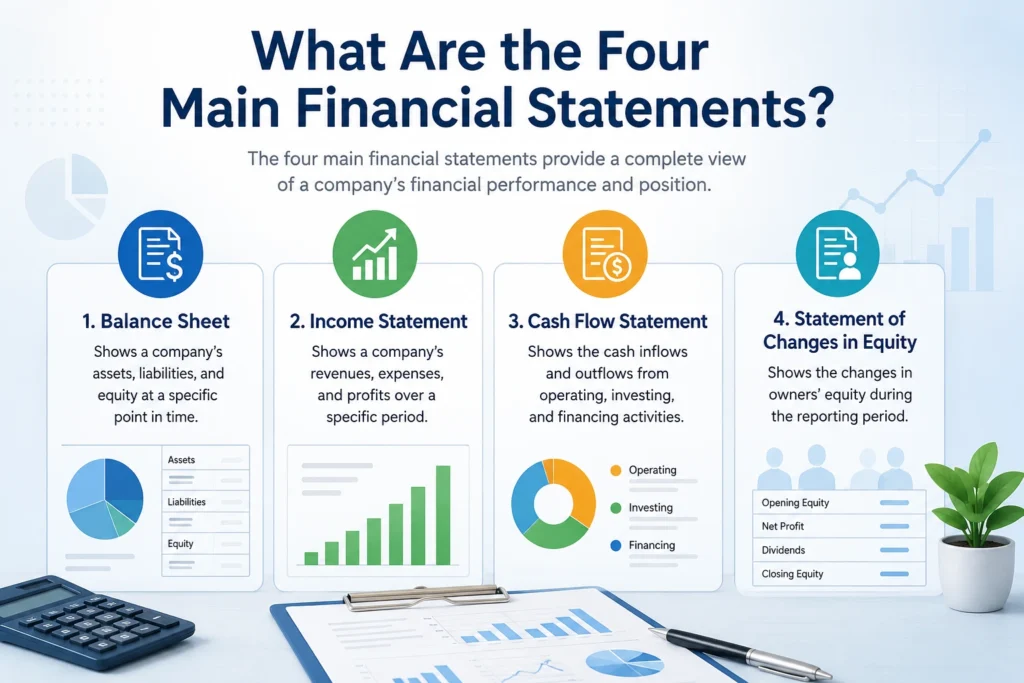
The four primary financial statements work together to explain every major aspect of a company’s financial activities. Each report provides different information, but all are connected.
Balance Sheet
The balance sheet presents the company’s financial position at a specific date. It reports three main elements: assets, liabilities, and equity. This statement helps users understand what the business owns, what it owes, and the value remaining for shareholders.
Income Statement
The income statement, sometimes called the profit and loss statement, measures business performance over a period.
It reports:
- Revenue
- Cost of sales
- Gross profit
- Operating expenses
- Operating income
- Net income
This statement shows whether the business made a profit or loss during the accounting period.
Cash Flow Statement
The cash flow statement explains how cash enters and leaves the business. It separates cash movement into three categories:
- Operating cash flow
- Investing cash flow
- Financing cash flow
Positive cash flow helps businesses pay suppliers, employees, taxes, and lenders on time.
Statement of Changes in Equity
The statement of changes in equity explains how shareholders’ equity changes during the reporting period.
It records changes caused by:
- Business profits
- Business losses
- Dividend payments
- New share issues
- Owner contributions
- Retained profit
This statement helps investors understand how company value changes over time.
How Are Financial Statements Prepared?
Financial statements are prepared by recording financial transactions, organising accounting records, making year-end adjustments, and producing financial reports in accordance with recognised accounting standards. Every business starts with accurate bookkeeping. Each sale, purchase, payment, receipt, and expense is recorded throughout the accounting period. At the end of the month or year, accountants review these records and prepare the company’s annual financial statements.
The preparation process usually includes these six steps:
- Record daily business transactions.
- Reconcile bank accounts and accounting records.
- Adjust entries for accruals, depreciation, and prepayments.
- Prepare a trial balance.
- Produce the financial statements.
- Review the reports for accuracy and compliance.
Businesses in the UK normally prepare financial statements under UK GAAP or IFRS, depending on their reporting requirements.
What Does an Accountant Do When Preparing Financial Statements?
An accountant prepares financial statements by reviewing accounting records, correcting errors, applying accounting standards, and presenting accurate financial reports.
Their responsibilities usually include:
- Reviewing bookkeeping records
- Reconciling bank accounts
- Recording adjusting journals
- Calculating depreciation
- Preparing accruals and prepayments
- Producing annual accounts
- Preparing supporting notes
- Checking compliance with IFRS or UK GAAP
- Assisting with tax reporting
Professional accountants also explain the results to business owners and identify opportunities to improve financial management.
What Type of Accountant Prepares Financial Statements?
Qualified financial accountants usually prepare statutory financial statements for companies. Depending on the business, preparation may involve different accounting professionals, including:
- Chartered Accountants
- Certified Public Accountants (CPAs)
- ACCA-qualified accountants
- Financial accountants
- Management accountants
- Public practice accountants
Larger organisations may also involve finance directors and external auditors before issuing annual financial reports.
What Is the Usual Format of Financial Statements?
Most statements follow a standard format to make financial reporting consistent and easy to understand.A complete set of annual financial statements usually includes:
- Balance Sheet
- Income Statement
- Cash Flow Statement
- Statement of Changes in Equity
- Notes to the Accounts
The notes to the accounts explain accounting policies, significant transactions, estimates, commitments, and other information that supports the figures presented in the statements.
What Are Some Examples of Financial Statements?
Businesses prepare different financial statements depending on their reporting needs and legal requirements.
Common examples include:
- Annual financial statements
- Monthly statements
- Interim financial reports
- Consolidated financial statements
- Statutory financial statements
- Management accounts
- Cash flow reports
- Profit and loss statements
- Balance sheets
- Statements of changes in equity
For example, a small retail business may prepare monthly management accounts to monitor sales and expenses, while a limited company prepares annual statutory financial statements for filing and compliance.
Statement of Financial Position Explained
A statement of financial position shows a company’s assets, liabilities, and shareholders’ equity at a specific date. The statement of financial position is another name for the balance sheet. It helps business owners, investors, and lenders understand what the company owns, what it owes, and the value belonging to its shareholders. Unlike the income statement, which measures performance over time, the statement of financial position provides a snapshot of the business on the reporting date.
Statement of Financial Position vs Balance Sheet: Are They the Same?
Yes. A statement of financial position and a balance sheet are the same financial statement. The term balance sheet remains widely used in everyday business accounting. However, accounting standards such as IFRS commonly use the term statement of financial position.
Both names describe the same report and contain the same information:
- Assets
- Liabilities
- Shareholders’ equity
The name may differ, but the purpose remains the same.
How Do You Analyse Financial Statements?
Financial statement analysis involves reviewing financial reports to measure profitability, liquidity, efficiency, and long-term financial health. Looking at one figure alone rarely tells the whole story. Accountants compare several reports and financial ratios to understand how the business performs over time.
Review Profitability
Start by reviewing revenue, gross profit, operating income, and net income. Steady profit growth often indicates a healthy and well-managed business.
Measure Liquidity
Liquidity shows whether the business can meet its short-term obligations. The current ratio compares current assets with current liabilities.
Assess Debt Levels
Review loans and other liabilities to understand how much debt the company carries. A manageable debt level usually reduces financial risk.
Evaluate Cash Flow
A profitable business still needs positive operating cash flow. Strong cash flow allows the company to pay employees, suppliers, lenders, and taxes on time.
Compare Financial Performance
Compare financial statements with previous years and businesses in the same industry. Trend analysis often reveals strengths and weaknesses that a single year’s figures cannot show.
How Do You Analyse a Balance Sheet?
Read a balance sheet by reviewing assets, liabilities, and shareholders’ equity together rather than separately. Begin with current assets because they show the company’s short-term financial resources.
Next, review non-current assets, including:
- Property
- Equipment
- Vehicles
- Machinery
- Investments
Then examine liabilities carefully.
Look for:
- Bank loans
- Trade creditors
- Corporation Tax
- VAT liabilities
- Lease obligations
Finally, review shareholders’ equity. Increasing equity often reflects retained profits and long-term business growth. A strong balance sheet generally includes:
- Healthy cash reserves
- Positive working capital
- Controlled borrowing
- Growing retained earnings
What Does Retained Profit Mean in Accounting?
Retained profit is the portion of net income that remains in the business after paying dividends to shareholders. Instead of distributing all profits, many businesses keep part of their earnings to support future growth.
Retained profits often help businesses:
- Purchase new equipment
- Expand operations
- Improve cash flow
- Repay loans
- Invest in new opportunities
Growing retained profits usually strengthen shareholders’ equity and improve long-term financial stability.
Statutory Financial Statements: Meaning and Requirements
Statutory financial statements are financial reports that businesses prepare to meet legal reporting requirements. In the UK, many limited companies must prepare statutory accounts under the Companies Act 2006 and applicable accounting standards.
A complete set of statutory financial statements usually includes:
- Balance Sheet
- Income Statement (where required)
- Statement of Changes in Equity (where applicable)
- Cash Flow Statement (where applicable)
- Notes to the Accounts
These reports may also accompany the company’s annual confirmation and tax filing obligations.
What Are Consolidated Financial Statements and How Do They Work?
Consolidated financial statements combine the financial information of a parent company and its subsidiaries into one set of reports. Instead of presenting each company separately, consolidation treats the entire group as a single economic entity. Consolidated financial statements remove transactions between group companies to avoid double counting. Large corporate groups often prepare consolidated reports to provide investors with a complete picture of the group’s financial performance.
Do Financial Statements Need to Be Audited?
Not every business must have its financial statements audited, but some companies have a legal audit requirement.In the UK, audit requirements depend on factors such as company size, turnover, assets, and employee numbers.An independent audit provides additional confidence that the financial statements fairly present the company’s financial position.
During an audit, auditors review:
- Accounting records
- Supporting documents
- Internal controls
- Accounting policies
- Financial reporting procedures
Even when an audit is not legally required, some businesses choose one to improve credibility with investors and lenders.
What Financial Information Do Shareholders Receive?
Shareholders receive financial information that helps them evaluate the company’s financial performance and financial position.
A complete annual reporting package may include:
- Annual financial statements
- Directors’ Report
- Auditor’s Report (where applicable)
- Statement of Changes in Equity
- Notes to the Accounts
- Dividend information
These reports help shareholders understand profitability, financial stability, dividend policy, and future business prospects before making investment decisions.
Are Financial Statements the Same in Every Country?
No. Financial statements follow similar accounting principles worldwide, but reporting standards and legal requirements differ between countries. Many countries use International Financial Reporting Standards (IFRS), while others apply their own accounting frameworks.
For example:
- The United Kingdom permits IFRS and UK GAAP.
- The United States primarily follows US GAAP.
- Other countries adopt IFRS with local regulatory requirements.
Although presentation may vary, every financial statement aims to report assets, liabilities, equity, income, expenses, and cash flow accurately.
What Are the Limits of Financial Statements?
Financial statements provide valuable information, but they do not explain every aspect of a business.Users should understand their limitations before making important financial decisions.
Common limitations include:
- Historical information may not reflect current market conditions.
- Estimates affect figures such as depreciation and provisions.
- Intangible assets may not show their full economic value.
- Financial statements cannot measure employee skills or customer loyalty.
- Inflation may reduce the relevance of older asset values.
Reviewing financial statements alongside industry trends and operational information provides a more balanced assessment.
What Are the Most Common Financial Statement Mistakes and How Can You Avoid Them?
Accurate financial statements depend on complete accounting records, careful review, and consistent reporting practices.The most common mistakes include:
Recording Incorrect Revenue
Recognising revenue too early or too late can distort business performance.
Missing Business Expenses
Failing to record allowable expenses overstates profit and increases tax liability.
Misclassifying Assets and Liabilities
Incorrect classification affects liquidity ratios and financial analysis.
Ignoring Bank Reconciliations
Unreconciled bank accounts often lead to inaccurate cash balances.
Omitting Accruals and Prepayments
Ignoring year-end adjustments results in incomplete financial reporting.
Mathematical Errors
Simple calculation mistakes can affect several financial statements at once.
Poor Record Keeping
Incomplete bookkeeping increases the risk of inaccurate annual accounts and delayed reporting. Regular reviews by qualified accountants help reduce these errors and improve the reliability of financial statements.

