
Cash Accounting vs Accrual Accounting: What Is the Difference?
Cash accounting records income and expenses when money changes hands. Accrual accounting records them when income is earned, or costs relate to the accounting period. This timing difference affects when a business records revenue, expenses, and taxable profit. In this guide, cash basis mainly refers to HMRC’s Income Tax cash basis for eligible sole traders and partnerships. It is separate from the VAT Cash Accounting Scheme. Under cash basis accounting, an unpaid customer invoice does not normally count as income yet. The business records the income when the customer pays. Under accrual accounting, the business records income in the period it earns that income. Payment can arrive later.
The same principle applies to expenses. Cash basis generally records allowable costs when the business pays them. Accrual accounting recognises costs in the period they relate to.HMRC commonly calls accrual accounting traditional accounting for self-employed businesses. Understanding cash accounting vs accrual accounting helps business owners see how timing affects business profits and financial records.
What Is Cash Basis Accounting?
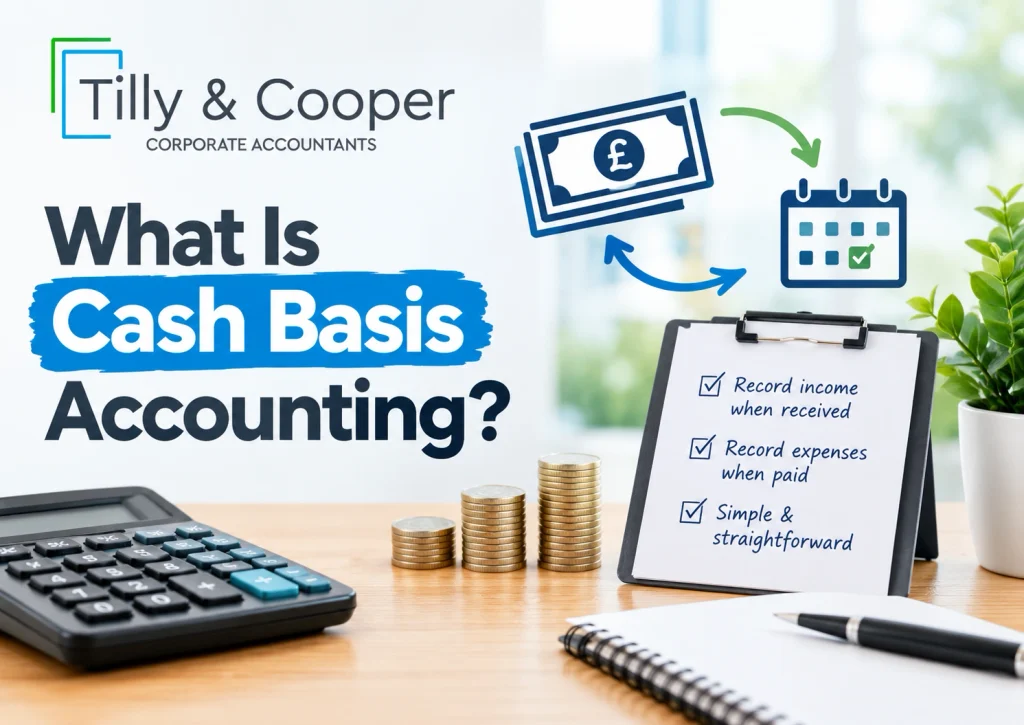
Cash basis accounting records business income when it is received and allowable expenses when they are paid.The method focuses on actual money moving into or out of the business. For example, a sole trader sends a £3,000 invoice on 20 March. The customer pays on 15 April. Under the cash basis, the £3,000 normally enters the profit calculation when payment arrives in April. The invoice date does not normally determine when that income enters the cash basis calculation.
The same approach applies to expenses. Suppose the business receives a £600 supplier bill in March but pays it in April. The expense normally enters the cash basis records in April. Cash basis requires fewer period-end adjustments than accrual accounting. A business does not normally account separately for debtors, creditors, stock or work in progress when calculating cash-basis profits.
Cash basis does not mean payments must involve physical cash. Bank transfers, card payments, cheques and other payment methods can count. The important point is when the business receives or makes payment. From 6 April 2024, cash basis became the default method for eligible sole traders and partnerships without corporate partners. An eligible business can choose traditional accounting instead. Accurate records remain important.
What Is Accrual Accounting?
Accrual accounting records income when it is earned and expenses in the period they relate to.HMRC commonly describes this approach as traditional accounting for self-employed businesses. The method focuses on economic activity rather than only cash movements. Consider a business that invoices a customer for £5,000 in December.
The customer does not pay until February. Under accrual accounting, the business records the £5,000 in the relevant accounting period. The unpaid amount can remain as a debtor until payment arrives. Supplier costs work in a similar way. A business can record an expense in the relevant period even when it pays the supplier later.
The unpaid amount can appear as a creditor. Accrual accounting can also involve accruals and prepayments. An accrual records a cost relating to the current period before payment occurs or an invoice arrives. A prepayment deals with a cost paid before the period receiving the benefit.
For example, a business may pay a 12-month insurance policy in advance. Accrual accounting can allocate the insurance cost across the months covered by the policy. This matching gives management a clearer view of income and the costs connected with earning it.
Cash Basis vs Accrual Basis: Key Differences
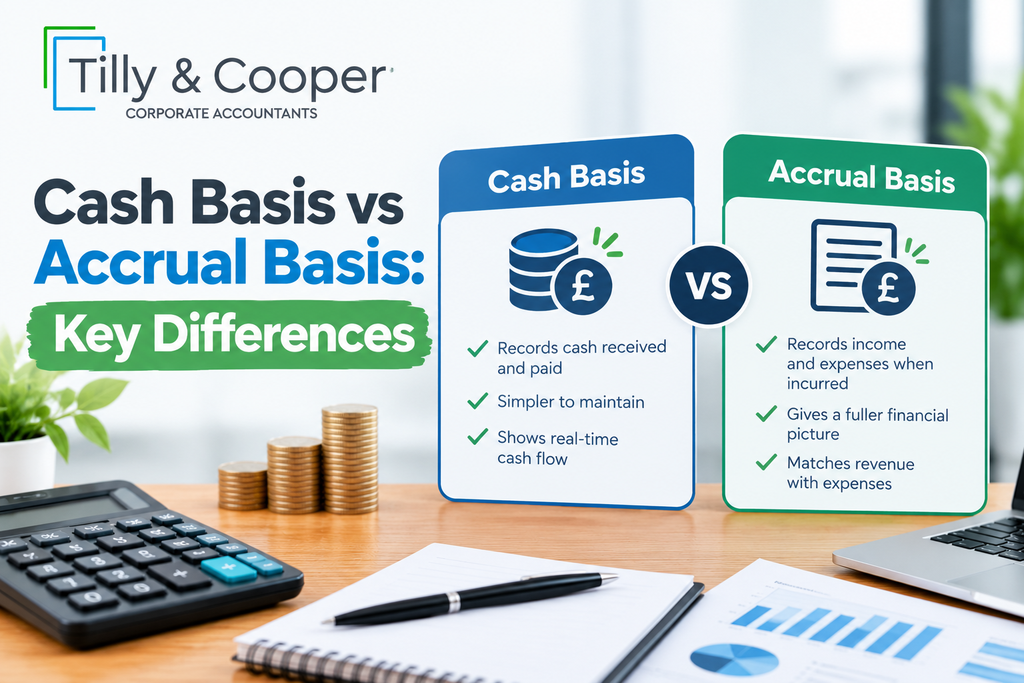
Cash basis and accrual basis mainly differ in when they recognise business income and expenses.
| Area | Cash Basis | Accrual Basis |
| Income | Recorded when payment is received | Recorded when earned |
| Expenses | Recorded when payment is made | Recorded in the relevant period |
| Unpaid customer invoices | Normally excluded until payment arrives | Recorded as debtors where applicable |
| Unpaid supplier bills | Normally recognised when paid | Recorded as creditors where applicable |
| Accruals | Normally not required in the same way | Used to match costs with periods |
| Prepayments | Mainly follows payment timing | Allocated across relevant periods |
| Stock | No normal year-end stock adjustment for an ongoing cash-basis profit calculation | Closing stock can affect the period’s profit calculation |
| Complexity | Fewer period-end adjustments | More period-end adjustments can apply |
| Main UK users | Eligible unincorporated businesses | Companies and businesses using traditional accounting |
| Financial information | Focuses mainly on money received and paid | Includes amounts earned, owed and payable |
HMRC states that cash-basis users do not normally need to account separately for debtors, creditors, stock or work in progress when calculating profits.
A simple example shows the timing difference. A consultant completes £8,000 of work in March but receives payment in May. Cash basis records the £8,000 when payment arrives in May. Accrual accounting recognises the income in the period when the business earns it. The difference concerns when the £8,000 enters the business profit calculation under each accounting basis.
Who Can Use the Cash Basis in the UK?
HMRC’s trading cash basis is available to sole traders and partnerships without corporate partners, subject to specific exclusions.From the 2024 to 2025 tax year, cash basis became the default accounting method for eligible businesses. They can elect to use traditional accounting instead. This changed the previous UK cash-basis rules. Before 6 April 2024, a general £150,000 turnover entry limit applied to the old regime. That general turnover restriction no longer applies to the current trading cash basis.
A sole trader can therefore use the current cash basis when eligible. A partnership can also use it where there are no corporate partners. However, several business types remain excluded. Limited companies cannot use HMRC’s trading cash basis. Limited liability partnerships cannot use it either. Partnerships with one or more corporate partners are also excluded
. HMRC lists further exclusions for certain specialised businesses and tax arrangements. Eligibility therefore depends on business structure and circumstances rather than turnover alone. Cash-basis profits can feed into an individual’s Self Assessment tax return where the relevant reporting requirements apply.
Can a Limited Company Use the HMRC Cash Basis?
No. A limited company cannot use the HMRC Income Tax cash basis available to eligible sole traders and partnerships.HMRC restricts the trading cash basis to qualifying unincorporated businesses. Limited companies and limited liability partnerships are excluded. Limited companies calculate profits under company accounting and Corporation Tax rules. A limited company can still monitor cash received and paid through its bank account.
It can also prepare cash flow reports for management purposes. However, monitoring cash does not turn the company’s statutory accounting records into HMRC cash-basis records. This distinction matters because “cash accounting” can describe different concepts. HMRC’s Income Tax cash basis is a specific tax accounting method. Cash flow reporting is a separate way of monitoring movements in money. The VAT Cash Accounting Scheme also operates under separate VAT rules.
When Can Accrual Accounting Give a Clearer Picture?
Accrual accounting can give a clearer picture when unpaid invoices, supplier bills, stock or complex transactions affect business performance.A cash-only view can make one period look stronger or weaker because payment dates move between periods. Consider a consultancy that completes £50,000 of work in March. Customers pay £35,000 during March and £15,000 in April. Cash basis focuses on the amount actually received during each relevant period. Accrual accounting can show the income earned and the amount still owed by customers.
This helps management separate trading performance from payment timing. A combined example makes the difference clearer. A business invoices customers for £40,000 in March but receives only £15,000 before the period ends. It also receives a £12,000 supplier invoice for work completed in March but pays it in May.
Cash basis focuses on the amounts actually received and paid under the cash-basis rules. Accrual accounting places the relevant revenue and supplier cost into the period in which the business activity occurred.This can give management a more complete view of that period’s performance. Businesses carrying significant stock can also gain useful information from accrual accounting.
Closing stock can affect how the cost of goods sold relates to the period’s revenue. Businesses seeking finance may also need more detailed accounting information. HMRC notes that traditional accounting may suit a complex business or one seeking finance because lenders may want to see what the business owes and what customers owe it. Accrual accounting therefore provides information about economic activity that cash movements alone may not show.
What Happens When a Business Changes Accounting Method?
Changing accounting method can require transitional adjustments so income and expenses are not counted twice or omitted.The opening position under the new method must reflect items already recognised under the previous method. For example, a business moving from cash basis to accrual accounting may have unpaid customer invoices. It may also have unpaid supplier bills, stock, prepayments or other outstanding balances. These items can require adjustments during the transition.
A business moving from accrual accounting to cash basis can face similar timing differences. The purpose of the transition rules is to prevent the same amount being taxed or relieved twice. They also prevent income or expenses from falling out of the calculation completely.
Changing accounting method therefore involves more than changing a setting within bookkeeping software. Opening balances and tax adjustments can need review. Businesses with significant debtors, creditors or stock should check the tax treatment before changing their accounting basis.
Which Accounting Method Is Better for Your Business?
Neither accounting method is better for every business. The suitable method depends on structure, complexity and reporting needs.Cash basis can suit an eligible sole trader with straightforward transactions. It requires fewer period-end accounting adjustments. It also means unpaid customer invoices do not normally enter cash-basis income before payment. Accrual accounting can suit businesses that need a fuller view of financial activity. It records debtors, creditors and relevant period-end adjustments.
This can help management understand what customers owe and what the business still needs to pay. Businesses with significant stock can also find accrual accounting more informative. The same applies to businesses with longer customer or supplier payment terms. Finance requirements can influence the choice. Banks and other lenders may want accounts showing unpaid invoices, liabilities and other outstanding balances.
Business structure can make the choice automatically. Limited companies cannot use HMRC’s trading Income Tax cash basis. Eligible sole traders and partnerships normally use cash basis unless they choose traditional accounting. The suitable method therefore depends on what the business needs its accounts to show. Cash basis focuses on simplicity and actual payments. Accrual accounting provides more detail about financial performance and outstanding balances.
FAQs
Cash basis does not normally recognise a customer invoice as income until payment is received.The business should still keep proper records of invoices and outstanding amounts. Cash basis changes when income enters the profit calculation. It does not remove the need for accurate records.
No. HMRC’s Income Tax cash basis and the VAT Cash Accounting Scheme are separate arrangements.The Income Tax cash basis affects how eligible businesses calculate trading profits. The VAT Cash Accounting Scheme controls when qualifying businesses account for VAT. Using one does not automatically mean a business uses the other.
Eligible businesses using the cash basis generally record trading income when they receive payment.Money owed by a customer does not normally enter cash-basis income until the business receives it.
Traditional accounting is HMRC’s common term for an accounting method that follows accrual principles.Income and expenses are recorded according to the relevant accounting period rather than only payment dates. The method can involve debtors, creditors, accruals and prepayments.
A limited company cannot use HMRC’s trading Income Tax cash basis for sole traders and qualifying partnerships.Limited companies follow company accounting and Corporation Tax requirements.
No. Cash basis mainly changes the timing of when qualifying income and expenses enter the business profit calculation. The tax effect depends on the business’s receipts, payments, allowable expenses and wider circumstances. Cash accounting vs accrual accounting is therefore mainly a difference in timing, structure and reporting detail. Cash basis focuses on money received and paid.
Accrual accounting records income and costs in the periods they relate to. For eligible UK sole traders and partnerships, cash basis is now the default method for calculating trading profits. Accrual accounting remains available where traditional accounting provides more useful financial information.

