
What Is Self Assessment? Complete UK Tax Return Guide
Self Assessment is HMRC’s system for taxpayers who need to report income, gains, reliefs, or other tax liabilities that cannot be dealt with completely through PAYE or another automatic collection method. You may need to complete a Self Assessment tax return if you are self-employed, a business partner, a landlord, receive foreign or other untaxed income, make taxable capital gains, or have another reporting requirement.
For the 2025/26 tax year, which ran from 6 April 2025 to 5 April 2026, taxpayers who need to register for the first time generally need to tell HMRC by 5 October 2026. Paper returns are normally due by 31 October 2026, while online returns and the main tax payment are due by 31 January 2027.
Self Assessment places responsibility on taxpayers to provide complete and accurate information. HMRC then uses the information submitted to determine the tax due or any repayment available. This guide explains who needs to file, how to register, what income to report, which expenses and reliefs may apply, the 2025/26 deadlines, payments on account, late filing penalties and the Making Tax Digital rules that started in April 2026.
What Is Self Assessment?
Self Assessment is the tax return system HM Revenue & Customs uses when a taxpayer needs to report income, gains, or liabilities that it doesn’t automatically deal with. Most employees pay Income Tax through PAYE because their employer deducts tax from their salary before payment. However, PAYE may not deal with income from self-employment, property, partnerships, investments, foreign sources or other taxable activities.
A Self Assessment tax return can include:
- employment income
- self-employment profits
- partnership income
- UK property income
- savings interest
- dividend income
- foreign income
- pension income
- taxable capital gains
- allowable tax reliefs
- tax already deducted
Self Assessment can also be required for liabilities such as the High Income Child Benefit Charge where the amount is not collected through PAYE. The taxpayer provides the relevant information, and HMRC’s online service or compatible software calculates the resulting tax position.
Who Needs to File a Self Assessment Tax Return?
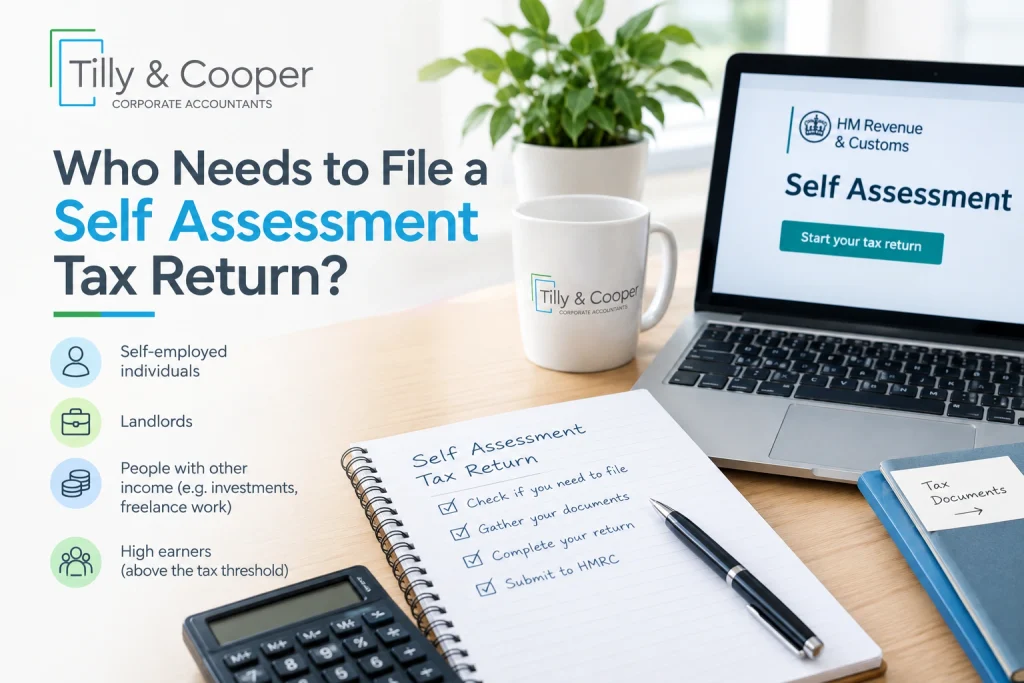
You need to file a Self Assessment tax return if HMRC requires one or your income and circumstances meet its filing rules. For the 2025/26 tax year, HMRC says a return is required where, among other circumstances, you were a sole trader with more than £1,000 of gross trading income, were a partner in a business partnership, had certain Capital Gains Tax liabilities, or had to pay the High Income Child Benefit Charge without paying it through PAYE. Certain off-payroll workers repaying a student or postgraduate loan can also be required to file.
You may also need to file because you receive untaxed income from:
- property or land
- tips or commissions
- savings
- dividends
- foreign sources
- taxable UK income while non-UK resident
HMRC can also issue a formal notice requiring you to complete a tax return. If HMRC has asked you to file, you should not simply ignore the notice because you believe no tax is due.
Do Self-Employed People Need to File Self Assessment?
A sole trader normally needs to file a Self Assessment tax return when gross trading income exceeds £1,000 during the tax year. The £1,000 threshold applies to gross income before deducting any business expenses. A self-employed tax return usually reports the total business turnover earned during the year, allowable business expenses, and the resulting taxable profit or loss. It can also include other personal income, relevant tax reliefs, and Class 4 National Insurance where this applies. These figures allow HMRC to calculate the taxpayer’s overall Income Tax and National Insurance position accurately.
The trading allowance can mean that someone with gross trading income of £1,000 or less does not need to report that income, although exceptions and special circumstances can apply. Sole traders should still keep accurate records of income and expenses, even where they believe the trading allowance removes the need to file a Self Assessment return.
Do Landlords Need to File Self Assessment?
Landlords may need to use Self Assessment when they receive taxable income from property. The property allowance can provide up to £1,000 of tax-free qualifying property income each tax year. If qualifying gross property income is £1,000 or less, you will not normally need to tell HMRC where the property allowance applies. If income exceeds £1,000, further reporting may be required depending on the amount and your circumstances.
Landlords should maintain records of:
- rent received
- letting agent fees
- repairs and maintenance
- insurance
- allowable property expenses
- finance costs where relevant
- property transactions
The tax rules differ between gross income, taxable property profit and the amount that determines how income should be reported. Check your individual position rather than relying only on the amount of rent received.
Do Company Directors Automatically Need Self Assessment?
Being a company director does not automatically create a Self Assessment filing requirement. A director may still need to submit a tax return where their personal income, gains or other tax circumstances fall within HMRC’s reporting rules.For example, a director may need Self Assessment if they receive taxable property income, foreign income, significant untaxed investment income, or make taxable capital gains. A filing requirement can also arise where the director has self-employment income outside the company or another personal tax liability that must be reported through Self Assessment.
The requirement therefore depends on the director’s overall tax position rather than their job title alone. A director whose only income is salary that has been correctly taxed through PAYE will not normally need to file a Self Assessment tax return simply because they are a company director. Directors should review their wider income sources each tax year to confirm whether a separate filing obligation applies.
Who Does Not Normally Need to File Self Assessment?
A person whose income and tax have been fully dealt with through PAYE or another system may not need a Self Assessment return if no separate filing requirement applies. For example, an employee whose only income is salary that has been fully taxed through PAYE will not normally need Self Assessment.
Your position may change if you start receiving:
- rental income
- self-employment income
- foreign income
- taxable investment income
- taxable capital gains
- other untaxed income
HMRC provides an online tool for checking whether a return is needed for the 2025/26 tax year.
When Do You Need to Register for Self Assessment?
For the 2025/26 tax year, you generally need to tell HMRC by 5 October 2026 if you need a tax return and have not filed before or were previously registered but did not need to file for 2024/25.
Registration tells HMRC that you need to enter or return to the Self Assessment system. If you register after 5 October 2026, HMRC can give you a different filing deadline. This is normally 3 months from the date of its letter or email. However, registering late does not normally extend the 31 January 2027 tax payment deadline. Register as early as possible so that you have enough time to access your account and prepare the required information.
What Is a Unique Taxpayer Reference?
A Unique Taxpayer Reference, or UTR, is the 10-digit reference HMRC uses to identify a taxpayer within Self Assessment. You may need your UTR when:
- managing Self Assessment
- contacting HMRC
- making certain payments
- authorising an accountant
- dealing with tax correspondence
Your UTR is different from your National Insurance number. Keep both references secure and use the correct one when dealing with HMRC.
How Does Self Assessment Work?
Self Assessment follows five main stages: check, register, record, file and pay. First, check whether HMRC requires you to complete a return. Register by the relevant deadline if you are entering Self Assessment for the first time. Next, maintain records supporting your income, expenses, gains and reliefs throughout the tax year. After the tax year ends, complete the relevant sections of your tax return. Report the figures that apply to your circumstances and review the resulting calculation carefully. Finally, submit the return and pay the amount due by the applicable deadlines.This process is separate from the detailed steps used to complete the online form. Keeping the overall lifecycle simple makes it easier to manage each annual filing obligation.
What Information Do You Need for Self Assessment?
You need records that support the income, expenses, gains, tax deductions and reliefs reported on your tax return. The documents required depend on your circumstances.
Common records include:
- P60
- P45
- taxable benefit information
- payslips
- bank statements
- savings interest information
- dividend records
- property income records
- business accounts
- sales invoices
- business expense receipts
- pension contribution records
- Gift Aid records
- foreign income details
- capital gains calculations
You should also have your:
- National Insurance number
- UTR
- HMRC account details
- current personal information
Collect the documents before starting your return. This reduces the risk of omitting income or claiming an amount that cannot be supported.
What Income Must You Report on Self Assessment?
You must report each type of taxable income or gain that HMRC requires to be included for the relevant tax year.
Different sections of a Self Assessment return deal with different income sources.
| Income or Gain | Typical Source |
| Employment income | Salary, bonuses and taxable benefits |
| Self-employment income | Sole trader business profits |
| Partnership income | Share of partnership profits |
| Property income | Rental profits |
| Savings income | Taxable bank or investment interest |
| Dividend income | Shares and investments |
| Foreign income | Overseas income where reportable |
| Pension income | Taxable pension receipts |
| Capital gains | Reportable disposals of assets |
Not every receipt is taxable. Allowances, exemptions and reliefs can change the amount you need to report or the tax ultimately payable. Do not omit an income source merely because tax has already been deducted. Some taxed income must still be included so that HMRC can calculate your overall liability correctly.
What Expenses and Tax Reliefs Can You Claim?
You can claim expenses, allowances and tax reliefs where the relevant HMRC conditions are satisfied. For sole traders, allowable business expenses can reduce taxable profit and therefore lower the amount of Income Tax due.
Qualifying costs can include office expenses, business travel, staff costs, professional fees, insurance, advertising, software subscriptions, business telephone costs and certain premises expenses. However, an expense is not automatically allowable simply because it was paid from a business bank account. The tax treatment depends on what the cost was for and whether it meets HMRC’s rules.
Other taxpayers may also qualify for tax relief on pension contributions, Gift Aid donations, business losses, qualifying investments or certain employment expenses. The available relief depends on the taxpayer’s circumstances and the type of payment involved.
Only claim expenses and reliefs that meet the relevant conditions, and keep suitable records such as invoices, receipts and statements to support the amounts reported.
How Do You Complete a Self Assessment Tax Return Online?
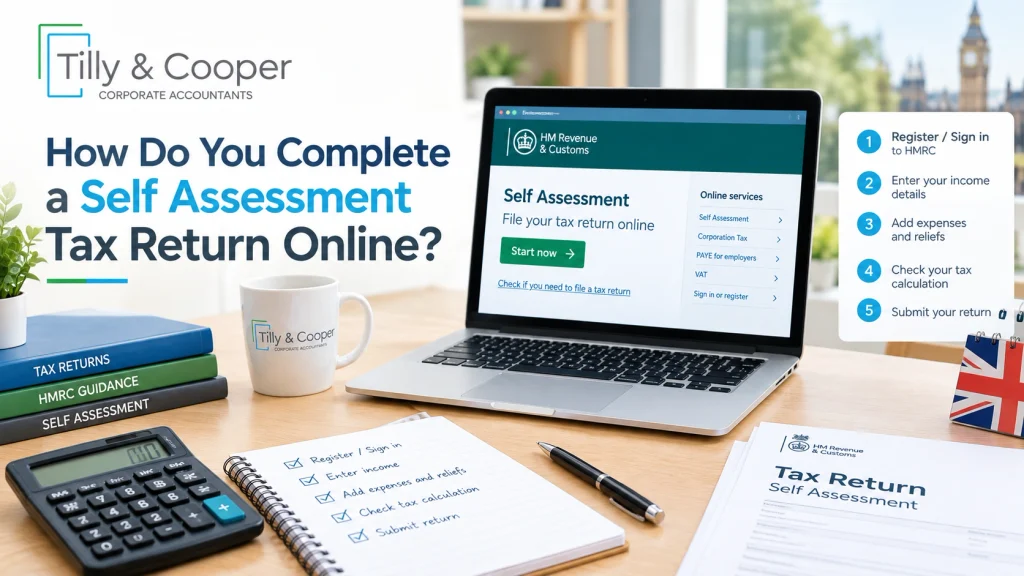
Complete an online Self Assessment return by gathering your records, signing in to HMRC, entering each relevant income source, checking the calculation, and submitting the return electronically.
Step 1: Gather Your Records
Collect all relevant income, expense, gain, and tax information before starting. Having complete records reduces interruptions and missing figures.
Step 2: Sign In to Your HMRC Account
Access the official Self Assessment service using the sign-in method connected to your HMRC account. Compatible commercial tax software can also be used where appropriate.
Step 3: Select the Correct Tax Year
For the return currently due by 31 January 2027, use the period: 6 April 2025 to 5 April 2026. Do not combine income from different tax years.
Step 4: Check Your Personal Information
Review your name, address and other identifying details. Incorrect information can cause correspondence or account problems.
Step 5: Report Each Relevant Income Source
Complete the sections relating to your circumstances. These may cover:
- employment
- self-employment
- property
- partnerships
- savings
- dividends
- pensions
- foreign income
- capital gains
Report figures using the records for the correct tax year.
Step 6: Claim Allowable Expenses and Reliefs
Enter qualifying expenses and reliefs. Keep evidence supporting each significant figure.
Step 7: Review the Tax Calculation
Check:
- total income
- expenses
- tax already paid
- reliefs
- capital gains
- payments on account
- other charges
Correct errors before submitting.
Step 8: Submit the Tax Return
Submit the completed return electronically. Keep the submission confirmation and a copy of your tax calculation for your records.
When Can You Submit Your 2025/26 Self Assessment Tax Return?
You can submit your 2025/26 Self Assessment return from 6 April 2026 until the applicable filing deadline. You do not need to wait until January 2027. HMRC confirms that an online return can be submitted at any time from 6 April 2026 up to the filing deadline. Filing early can give you:
- more time to correct errors
- earlier knowledge of your tax liability
- additional time to plan payment
- more time to deal with missing records
- earlier access to any repayment due
Submitting early does not normally mean the tax must be paid immediately. The normal payment deadline still applies.
What Are the 2025/26 Self Assessment Deadlines?
The standard online filing and tax payment deadline for the 2025/26 tax year is 31 January 2027.
| Requirement | Deadline |
| 2025/26 tax year ends | 5 April 2026 |
| Tell HMRC you need Self Assessment, where required | 5 October 2026 |
| Paper tax return | 31 October 2026 |
| Online return for eligible PAYE tax-code collection | 30 December 2026 |
| Online Self Assessment return | 31 January 2027 |
| Balancing payment | 31 January 2027 |
| First payment on account, if applicable | 31 January 2027 |
| Second payment on account, if applicable | 31 July 2027 |
HMRC must normally receive a paper tax return by 11:59pm on 31 October 2026 and an online return by 11:59pm on 31 January 2027.
What Is the 30 December Self Assessment Deadline?
The 30 December deadline only applies if you want an eligible Self Assessment bill collected through your PAYE tax code. It is not the standard online filing deadline. HMRC can normally collect a Self Assessment bill through your PAYE code where all the main conditions are met. You must:
- owe less than £3,000
- already pay tax through PAYE
- submit a paper return by 31 October or an online return by 30 December
HMRC must also be able to collect the amount through your PAYE income without exceeding its coding limits. You cannot reduce a bill of £3,000 or more with a part-payment merely to qualify. If you do not qualify, the usual payment methods and 31 January deadline apply.
What Are Payments on Account?
Payments on account are advance payments towards your next Self Assessment liability. They are normally due twice each year:
- 31 January
- 31 July
Each payment is usually equal to half of the previous year’s relevant Income Tax and Class 4 National Insurance liability after taking account of tax collected at source. For example, if the amount used to calculate your payments on account is £4,000:
First payment on account: £2,000
Second payment on account: £2,000
Payments on account are generally not required where the relevant previous-year amount is less than £1,000 or more than 80% of the tax was collected outside Self Assessment, such as through PAYE. The payments do not necessarily represent your final tax liability. A balancing payment or repayment can arise when the following year’s actual figures are known.
What Happens If You File Your 2025/26 Tax Return Late?
A required 2025/26 Self Assessment return filed after the applicable deadline can trigger an immediate £100 late-filing penalty. The current penalty structure can increase as the delay continues.
| Filing Delay | Potential Penalty |
| Immediately late | £100 |
| More than 3 months | £10 per day for up to 90 days |
| 6 months late | 5% of tax due or £300, whichever is greater |
| 12 months late | Further penalty based on the circumstances |
The initial £100 penalty can apply even when there is no tax to pay. More serious penalties can arise after 12 months where information has been deliberately withheld. For taxpayers who entered Making Tax Digital for Income Tax from 6 April 2026, the existing Self Assessment penalty rules still apply to the 2025/26 return due on 31 January 2027. The newer MTD penalty regime applies to later obligations.
What Happens If You Pay Self Assessment Tax Late?
Late payment can result in interest and separate penalties even when the tax return was submitted on time. Under the existing Self Assessment rules, a late-payment penalty can generally arise on tax remaining unpaid at:
- 30 days
- 6 months
- 12 months
A penalty of 5% of the unpaid tax can apply at each relevant stage under the current rules. HMRC can also charge late-payment interest. Filing and payment are separate obligations. Submitting your return on time does not remove payment penalties or interest if the tax remains unpaid.
What Should You Do If You Cannot Pay Your Tax Bill?
Contact HMRC or consider whether you qualify for a Time to Pay arrangement if you cannot pay your Self Assessment bill in full. Do not delay filing your return because you cannot afford the tax. Submitting on time prevents a payment problem from also becoming a late-filing problem.
A Time to Pay arrangement may allow an eligible taxpayer to spread an outstanding tax bill over an agreed period. Interest can continue to apply, so early action is important.
How Long Should You Keep Self Assessment Records?
The required record-keeping period depends on whether you are self-employed and whether your tax return was submitted on time. Self-employed taxpayers generally need to retain their business records for at least 5 years after the 31 January submission deadline for the relevant tax year.
People completing Self Assessment who are not carrying on a business generally have a shorter standard retention period, although longer periods can apply where a return is late or HMRC opens an enquiry. Keep evidence supporting:
- income
- expenses
- property transactions
- tax deducted
- tax relief claims
- business assets
- capital gains and losses
Records can generally be maintained electronically, provided they remain complete, accurate and accessible. People within Making Tax Digital for Income Tax have additional digital record-keeping requirements.
What Happens When You Stop Being Self-Employed?
Stopping self-employment does not automatically end your Self Assessment obligations.You should tell HMRC when you stop trading and complete any final return that is required. Your final tax return may need to include:
- final business turnover
- final allowable expenses
- profit or loss
- capital allowances
- balancing adjustments
- business asset disposals
- other personal income
Keep your records for the required retention period after the business has stopped. Moving into PAYE employment does not automatically close an existing Self Assessment record.
How Does Making Tax Digital Affect Self Assessment?
Making Tax Digital for Income Tax requires certain sole traders and landlords to maintain digital records, use compatible software and send quarterly updates to HMRC. The first mandatory phase started in April 2026.
Who Must Use Making Tax Digital From April 2026?
Sole traders and landlords generally need to use Making Tax Digital for Income Tax from 6 April 2026 if their qualifying income for 2024/25 exceeded £50,000 and no exemption applies.
Qualifying income is broadly the total gross income before expenses from self-employment and property used for the MTD test. The planned thresholds are:
| Qualifying Income | Mandatory Start |
| More than £50,000 | 6 April 2026 |
| More than £30,000 | 6 April 2027 |
| More than £20,000 | 6 April 2028 |
The rules are based on qualifying self-employment and property income rather than taxable profit. Specific exemptions and special rules can apply, including in certain cases of digital exclusion.
What Are the MTD Quarterly Deadlines?
The standard quarterly update deadlines are 7 August, 7 November, 7 February and 7 May. For the 2026/27 tax year, the main deadlines are:
| Quarterly Update | Deadline |
| First update | 7 August 2026 |
| Second update | 7 November 2026 |
| Third update | 7 February 2027 |
| Fourth update | 7 May 2027 |
| 2026/27 tax return through MTD software | 31 January 2028 |
Standard update periods normally run cumulatively from:
- 6 April to 5 July
- 6 April to 5 October
- 6 April to 5 January
- 6 April to 5 April
Taxpayers using an eligible 31 March accounting period can choose calendar update periods. The filing deadlines remain 7 August, 7 November, 7 February and 7 May.
Do MTD Quarterly Updates Replace the Tax Return?
No. Quarterly MTD updates do not replace the annual tax return. A taxpayer who entered MTD on 6 April 2026 still submits their 2025/26 Self Assessment tax return in the normal way by 31 January 2027.
Their first annual tax return submitted through MTD-compatible software relates to 2026/27 and is due by 31 January 2028. This transition is important because the quarterly updates relate to the new MTD year, while the January 2027 return relates to the previous tax year.
How Do MTD Penalties Work?
The new MTD penalty system uses points for late submissions rather than the traditional immediate £100 filing penalty. However, there is a transitional concession for the first mandatory MTD year.HMRC states that no penalty points are issued for late quarterly updates for 2026/27. Taxpayers must still maintain digital records and submit the required updates before they can complete their annual return. From later periods, missed deadlines can generate penalty points. Reaching the applicable threshold can lead to a fixed financial penalty. The existing penalty regime continues to apply to the 2025/26 Self Assessment return due 31 January 2027.
Can You Use the HMRC App for Self Assessment?
The HMRC app can help you manage parts of Self Assessment, but it is not a complete substitute for every tax-return filing function.Depending on the service available, you can use the app to:
- find your UTR
- check your Self Assessment position
- view amounts owed
- make certain payments
- access other HMRC information
For a full Self Assessment return or more complex tax reporting, use the appropriate HMRC online service or compatible software. Taxpayers within Making Tax Digital must use compatible software for their MTD digital records and submissions.
How Do You Claim a Self Assessment Tax Refund?
You may be able to claim a refund when your Self Assessment calculation shows that you have paid more tax than you owe. Check your tax calculation and HMRC account before requesting repayment.HMRC may sometimes use an overpayment against another liability rather than paying it directly to you. This can include amounts becoming due shortly, such as a payment on account. Check that your bank and contact information are accurate before making a repayment request. Use official HMRC services and be cautious of unexpected messages asking for bank details in return for a tax refund.
How Do You Get an SA302 Tax Calculation?
An SA302 is HMRC’s tax calculation showing income, relevant allowances and reliefs, and the tax calculated for the year. It is commonly requested as evidence of income for:
- mortgage applications
- loan applications
- financial assessments
Taxpayers who use HMRC’s online Self Assessment service can normally access and print their tax calculation and tax year overview. Taxpayers using commercial software may obtain the equivalent calculation through their software.HMRC makes online SA302 information available for the previous 4 years. A newly submitted return can take up to 72 hours before the online documents become available to print.
Is It Worth Using an Accountant for Self Assessment?
Professional support can be useful when a Self Assessment return involves several income sources, complex tax rules or significant financial transactions. A straightforward return may be manageable without an accountant. Professional advice may be particularly useful if you have:
- self-employment
- rental properties
- partnership income
- foreign income
- significant capital gains
- several income sources
- business losses
- complex tax reliefs
- Making Tax Digital obligations
- an HMRC enquiry
- an error in an earlier return
An accountant can help organise the information, identify allowable deductions, calculate tax liabilities and submit the required information correctly. Using an accountant does not remove the taxpayer’s responsibility to provide complete and accurate information. The most effective approach to Self Assessment is to check your filing requirement early, maintain accurate records throughout the year, report all required income, claim only valid expenses and reliefs, and meet every filing and payment deadline.