
Corporation Tax UK 2026/27: Rates, Deadlines, Calculations and Reliefs
Corporation Tax is a tax charged on the taxable profits of UK companies and certain organisations. HM Revenue & Customs, or HMRC, administers and collects the tax. For the financial year starting 1 April 2026, the main Corporation Tax rate is 25%. The small profits rate remains 19% for qualifying companies with lower profits. Marginal Relief can apply between the standard £50,000 and £250,000 profit limits.
These limits can be reduced where associated companies exist. Short accounting periods can also reduce them. Companies calculate their own Corporation Tax liability. They must then pay HMRC and submit any required Company Tax Return. Payment and filing deadlines differ.
Most companies pay Corporation Tax before their Company Tax Return becomes due. Company tax calculations can also involve business expenses, capital allowances, losses, investments, and chargeable gains. This guide explains the 2026/27 Corporation Tax rates, calculations, deadlines, reliefs, penalties, and filing responsibilities for UK companies.
How Does Corporation Tax Work for UK Companies?
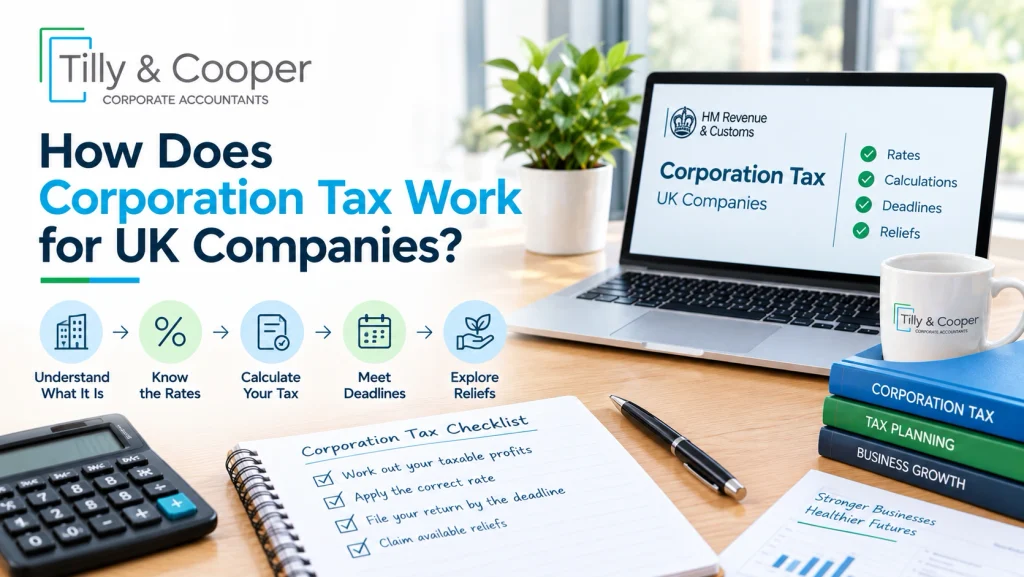
Corporation Tax applies to taxable profits arising during a company’s Corporation Tax accounting period. A UK-resident company normally falls within company tax on its UK and overseas profits. International tax rules can alter the final position.
It is separate from the personal taxes of directors and shareholders. The company pays tax on its taxable profits. A director can separately pay Income Tax on salary or taxable benefits. Shareholders can also face personal tax on dividends.
Which Types of Company Profit Are Taxable?
Corporation Tax can apply to trading profits, investment income, property income, and chargeable gains. Trading profit comes from the company’s normal business activities. For example, a consultancy can earn fees from clients. A retailer can earn profit from selling products. Investment income can include taxable interest and other investment returns.
Property income can arise where a company rents commercial or residential property. Chargeable gains can arise when the company disposes of certain assets for a gain. Companies pay Corporation Tax on qualifying chargeable gains. They do not normally pay Capital Gains Tax like individuals.
Who Normally Pays Corporation Tax?
UK limited companies form the main group of businesses that pay Corporation Tax. This includes most private limited companies and public limited companies. Certain other organisations can also fall within the Corporation Tax system. Examples include clubs, societies, co-operatives, and some unincorporated associations. A non-UK company can also face UK tax liability in specific circumstances. For example, a foreign company can become liable through a UK permanent establishment or UK property business. Tax treaties can affect the final tax treatment of international companies.
Do Sole Traders and Partnerships Pay Corporation Tax?
Sole traders and ordinary partnerships do not normally pay Corporation Tax on their business profits. A sole trader usually reports business profit through Self Assessment. Individual partners normally pay tax on their respective shares of partnership profits. A limited company acting as a partner is treated differently. The corporate partner can pay the company’s tax bill on its taxable share of partnership profits.
What Corporation Tax Rates Apply in 2026/27?
The main Corporation Tax rates for 2026/27 are 19% and 25%, with Marginal Relief between the standard limits. HMRC confirms the following rates for the financial year beginning 1 April 2026.
| Company profit position | Corporation Tax treatment |
| Up to £50,000 | 19% small profits rate, subject to eligibility |
| £50,001 to £250,000 | 25% less available Marginal Relief |
| Above £250,000 | 25% main rate |
The standard Marginal Relief fraction remains 3/200. The £50,000 and £250,000 limits can be reduced for short accounting periods. Associated companies can also reduce both limits.
When Does the 19% Small Profits Rate Apply?
The 19% small profits rate can apply when a qualifying company’s profits fall within the lower limit. The standard lower limit is £50,000 for a 12-month accounting period. However, taxable profits alone do not always determine the rate.HMRC also uses augmented profits when testing the small profits and Marginal Relief limits. Augmented profits generally include taxable total profits plus certain qualifying distributions from other companies.
For a simple company with £40,000 of qualifying taxable profits:
£40,000 × 19% = £7,600 Corporation Tax
This example assumes no associated companies or other factors affect the calculation.
How Does Corporation Tax Marginal Relief Work?
Marginal Relief reduces Corporation Tax when a qualifying company’s profits fall between the relevant lower and upper limits. The standard limits are £50,000 and £250,000 for 12 months. The calculation first applies the 25% main rate. Marginal Relief then reduces the resulting corporate tax liability. The standard fraction remains 3/200 for the financial year beginning 1 April 2026.
Assume a company has £100,000 of taxable profits. Also assume its augmented profits are £100,000. Company profit tax at 25% equals £25,000. Marginal Relief equals £2,250. The final corporate tax liability becomes £22,750. The company’s effective Corporation Tax rate is therefore 22.75%. The calculation can change where augmented profits differ from taxable profits.
Why Can the Marginal Corporation Tax Rate Reach 26.5%?
Additional profits within the standard Marginal Relief band can face an effective marginal tax rate of 26.5%. This does not mean all company profits face a 26.5% rate. It applies to additional profit earned within the Marginal Relief range. The company’s overall effective rate remains below 25% until it reaches the upper limit. This distinction matters when directors forecast the tax effect of earning additional profits.
How Do Associated Companies Affect Corporation Tax Rates?
Associated companies divide the standard Corporation Tax profit limits between the companies concerned. Companies can become associated where one controls another. Association can also arise where the same person or group controls both companies. Suppose two companies are associated throughout a 12-month accounting period. The £50,000 lower limit normally becomes £25,000 for each company.
The £250,000 upper limit normally becomes £125,000 for each company. This can move a company into Marginal Relief earlier. It can also make the 25% main rate apply at a lower profit level. Directors controlling several businesses should check associated-company rules before calculating company tax.
Do Close Investment-Holding Companies Get the 19% Rate?
Close investment-holding companies generally pay the 25% main rate regardless of their profit level. They cannot normally claim the small profits rate or Marginal Relief. However, not every close company is a close investment-holding company. Trading companies can fall outside the definition where they meet the relevant conditions. The classification therefore depends on what the company actually does.
How Do Companies Calculate Corporation Tax?
Companies calculate Corporation Tax by adjusting accounting results under UK tax rules. The company’s accounts provide the starting point. The tax computation then adjusts those figures.Some accounting expenses reduce taxable profit. Other costs receive no tax computation deduction. Capital allowances, losses, and other reliefs can also change the final taxable amount. The applicable Corporation Tax rate then applies to the resulting profits.
What Is Taxable Profit for Corporation Tax?
Taxable profit is the profit figure used to calculate the company’s Corporation Tax liability. It can differ from the accounting profit shown in statutory accounts. A company starts with its accounting results. It then makes the tax adjustments required by CorporateTax rules. Taxable profit can include trading income, investment income, property income, and chargeable gains. Available reliefs can reduce the final amount.
Which Business Expenses Can Reduce Corporation Tax?
Qualifying revenue expenses can reduce taxable profits when Corporation Tax rules allow the deduction. Common examples include wages, business rent, insurance, software, professional fees, and advertising costs. The cost must relate properly to the company’s business.
Not every accounting expense qualifies. Client entertainment provides one common example. Most business entertainment costs do not qualify as deductible trading expenses for business tax. Fines and penalties can also receive different tax treatment. Companies should therefore review expenses before preparing their tax computation.
How Are Capital Purchases Treated for Corporation Tax?
Capital purchases can qualify for capital allowances instead of an ordinary revenue-expense deduction. Capital expenditure often covers assets used over several accounting periods. Examples include machinery, computers, equipment, and certain business vehicles.
Accounting depreciation does not normally provide company tax relief itself. Companies usually add depreciation back within the tax computation. They can then claim available capital allowances on qualifying expenditure.
The Annual Investment Allowance remains £1 million for 2026/27. It can provide 100% relief on qualifying expenditure. Companies can also claim full expensing on qualifying main-rate plant and machinery. Full expensing provides a 100% first-year deduction. The asset must generally be new and unused. Cars do not qualify.
What Capital Allowance Changes Apply From 2026?
Two important capital allowance changes affect companies during 2026. A new 40% first-year allowance applies to qualifying expenditure from 1 January 2026. Qualifying plant and machinery must generally be new, unused, and eligible for main-rate allowances. Cars do not qualify for the 40% allowance.
The main writing-down allowance also changes. The rate falls from 18% to 14% from 1 April 2026. The special-rate writing-down allowance remains 6%. A hybrid rate can apply where an accounting period crosses 1 April 2026. These changes make capital allowance planning particularly important during 2026/27.
Can Company Losses Reduce Corporation Tax?
Qualifying company losses can reduce taxable profits under the Corporation Tax loss relief rules. Trading losses can normally reduce other profits in the same accounting period. Unused trading losses can sometimes move back to earlier periods. The normal carry-back period is the previous 12 months, subject to the relevant conditions. Unused losses can also move forward.
Most post-April 2017 trading losses can generally reduce future total profits, subject to restrictions. Companies within qualifying groups can also access group relief in certain circumstances. Special rules apply to terminal losses when a company stops trading.
Do Dividends Reduce Corporation Tax?
No. Dividends paid to shareholders do not reduce a company’s taxable profits. Dividends represent distributions of company profits. They are not normal business expenses. Suppose a company has £80,000 of taxable profits. It then pays shareholders £30,000 in dividends. The dividend does not reduce taxable profit to £50,000. The company calculates tax on its taxable profits first. It can then distribute available profits subject to company law.
When Must Companies Pay and File Corporation Tax?
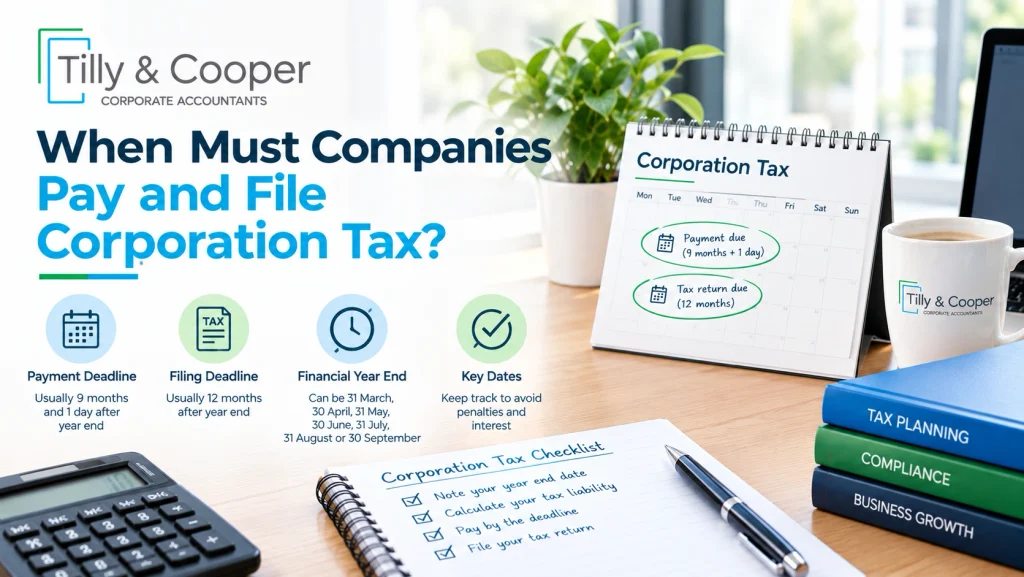
Most UK companies must pay Corporation Tax before they file their Company Tax Return with HMRC. The payment and filing deadlines are different, so companies should keep track of both dates. For a company with taxable profits of up to £1.5 million, Corporation Tax is normally due nine months and one day after the end of the accounting period.
For example, if the accounting period ends on 31 March 2027, the Corporation Tax payment will usually be due by 1 January 2028.The Company Tax Return is normally due 12 months after the end of the accounting period. Using the same example, the return would usually need to be filed by 31 March 2028. Companies must calculate their taxable profits, work out the tax due, and pay HMRC by the relevant deadline.
Larger companies with higher taxable profits may need to pay business tax in instalments instead of making one payment. Late payment may lead to interest charges. Late filing can also result in penalties. Keeping accurate accounting records and preparing the figures early can make the process easier and reduce the risk of missing an important HMRC deadline.
When Is Corporation Tax Normally Due?
Most companies pay Corporation Tax nine months and one day after their accounting period ends. For example, assume the accounting period ends on 31 March 2026. The normal payment deadline becomes 1 January 2027.HMRC confirms this standard deadline for companies outside the instalment payment regime. Directors should not wait until the Company Tax Return deadline before calculating the liability. Late payment can lead to interest.
When Is a Company Tax Return Due?
A Company Tax Return is normally due 12 months after the end of its Corporation Tax accounting period. For an accounting period ending on 31 March 2026, the normal deadline becomes 31 March 2027. The Company Tax Return deadline therefore comes after the normal company tax payment date. A company must still file a required return when it makes a loss. A nil Corporation Tax liability does not automatically remove the filing requirement.
What Is the Difference Between a Financial Year and an Accounting Period?
A Corporation Tax financial year runs from 1 April to 31 March. A company’s accounting period follows its own company tax reporting dates. These periods do not always match. For example, a company’s accounting period could run from January to December. That accounting period crosses two Corporation Tax financial years. Different tax rates can therefore require time apportionment when rates change between those years. This distinction also matters for certain allowances and tax thresholds.
When Do Large Companies Pay Corporation Tax by Instalments?
Companies above the adjusted £1.5 million profit threshold normally pay Corporation Tax through instalments. Statutory exceptions can apply. For example, instalments do not normally apply where total corporate tax liability stays below £10,000. A first-period exception can also apply in specified cases where profits remain within £10 million. Associated companies divide the £1.5 million and £10 million thresholds. Very large companies face a separate regime. The standard very-large-company profit threshold is £20 million. Associated companies can also reduce that threshold. Businesses approaching these levels should forecast Corporation Tax before their year-end.
How Do Companies Register, File and Pay Corporation Tax?
Companies must register correctly, maintain records, file required returns, and make electronic Corporation Tax payments. These duties remain separate from Companies House requirements.
How Does a Company Register for Corporation Tax?
A company needs to ensure HMRC knows when it starts activities that create Corporation Tax responsibilities. Companies can register for Corporation Tax when completing certain company registration processes. They can also add corporate tax services through their business tax arrangements later. A company that has not started business may remain dormant for Corporation Tax purposes. Trading or other taxable activities can change that position.
What Information Goes Into a CT600?
The CT600 reports the company’s Corporation Tax position for the relevant accounting period. The return contains information about taxable profits, reliefs, losses, and business tax due. A complete Company Tax Return involves more than the CT600 form. Companies normally submit supporting accounts and tax computations. The tax computation explains how the figures in the accounts become the Corporation Tax figures. Most companies must file electronically.
How Do Companies Pay Corporation Tax?
Companies pay Corporation Tax electronically using payment methods accepted by HMRC. The company needs the correct company tax payment reference. HMRC uses this reference to allocate the payment correctly. Processing times differ between payment methods. The payment must reach HMRC by the relevant deadline. Companies should therefore check the payment method before the due date.
What Happens if a Company Misses a Corporation Tax Deadline?
Late payment can create interest, while late returns can create separate filing penalties. Paying tax and filing a return are separate responsibilities. Completing one does not remove problems with the other.
What Happens When Corporation Tax Is Paid Late?
HMRC charges late payment interest when Corporation Tax remains unpaid after its due date. Interest increases the total amount owed. HMRC can change its interest rates over time. Companies should check the current rate when dealing with overdue tax. Paying the outstanding liability promptly can limit further interest.
What Are the Company Tax Return Penalties From 1 April 2026?
Company Tax Returns with filing dates from 1 April 2026 face higher late-filing penalties. The standard penalties are:
| Delay | Standard penalty |
| Return filed late | £200 |
| More than 3 months late | Another £200 |
| 6 months late | 10% of unpaid Corporation Tax |
| 12 months late | Another 10% of unpaid Corporation Tax |
HMRC introduced the higher fixed penalties for returns due from 1 April 2026. Repeated failures can increase the fixed penalties. The third and successive consecutive late returns can attract £1,000 and £2,000 fixed penalties. The statutory conditions must be met before these higher repeated-failure penalties apply.
Can a Company Get a Penalty When No Corporation Tax Is Due?
Yes. A company can receive a late-filing penalty even when no Corporation Tax is payable. The return requirement remains separate from the tax payment. HMRC requires a Company Tax Return when it has issued a notice to deliver one. The company must still file when it makes a loss or has no corporate Tax to pay.
How Is Corporation Tax Different From Other Business Taxes?
Corporation Tax applies to company profits, while other UK taxes target different income or transactions.
| Tax | What it mainly applies to |
| Corporation Tax | Taxable company profits |
| Income Tax | Taxable income of individuals |
| VAT | Taxable supplies of goods and services |
| PAYE | Income Tax collected through payroll |
| National Insurance | Qualifying earnings and employment liabilities |
A company can have several tax responsibilities at the same time. For example, a profitable company can pay Corporation Tax. The same company can also register for VAT when the relevant rules apply. It can operate PAYE for employees and directors. Directors and shareholders can then have separate personal tax responsibilities. Keeping these taxes separate helps businesses calculate the correct liabilities.
How Can Tilly & Cooper Help With Corporation Tax?
Tilly & Cooper can help companies calculate Corporation Tax, prepare CT600 returns, identify reliefs, and meet HMRC deadlines. It becomes more complex when a company has several sources of income. Associated companies can affect the applicable profit limits. Capital expenditure can create several capital allowance choices. Trading losses can also require careful relief planning.
International activities, property income, group structures, and investment companies can add further complexity. Tilly & Cooper can help review accounting records and prepare the Corporation Tax computation. We can also consider allowable expenses, capital allowances, losses, and available reliefs.
For 2026/27, companies should pay particular attention to the 40% first-year allowance. They should also consider the main writing-down allowance reduction to 14%. The core company tax rates remain 19% and 25%. Marginal Relief continues to apply between the relevant limits for qualifying companies. Accurate Corporate Tax planning means calculating the correct taxable profit, claiming available reliefs, and meeting each HMRC deadline.