
What Is Accounting? Basics, Types, Cycle & Standards
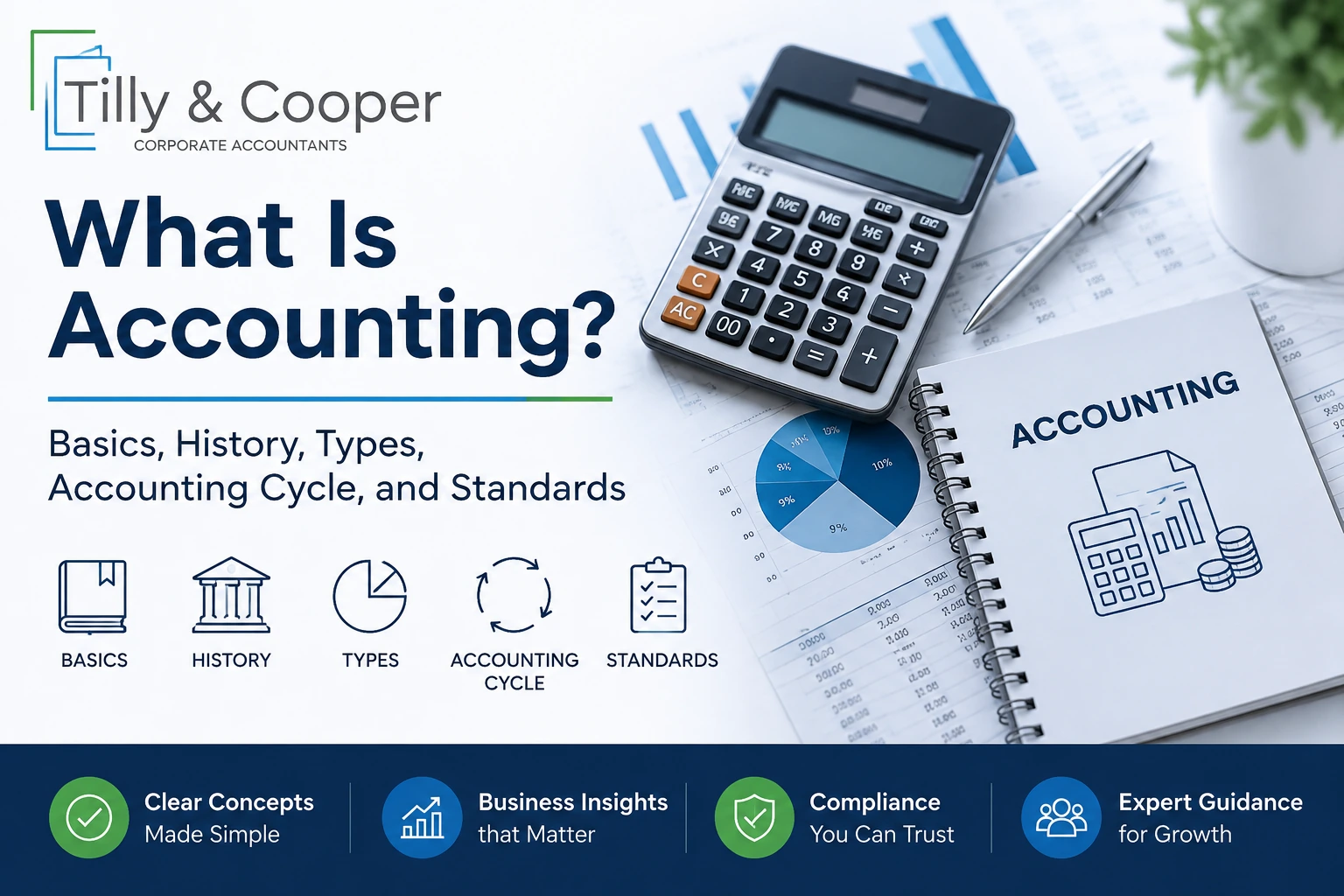
Accounting is the process of recording, organising, analysing, and reporting financial transactions. It helps a business understand how much money it earns, what it spends, what it owns, what it owes, and whether it is making a profit or loss. Businesses use accounting information to prepare financial statements, manage cash flow, calculate taxes, control costs, plan budgets, and make better decisions. Modern accounting is built around ideas such as the accounting equation, double-entry bookkeeping, debits and credits, accrual accounting, and recognised financial reporting standards. This article explains what accounting is, how it works, its basic principles, financial statements, accounting cycle, history, different types, standards, career paths, and its role in small businesses.
What Is Accounting?
Accounting is the systematic process of identifying, recording, classifying, summarising, analysing, and communicating financial information. Every business carries out financial transactions. It may receive payments from customers, buy products, pay employees, borrow money, purchase equipment, or pay suppliers. Accounting records these activities and organises them into useful financial information.
This information helps business owners, managers, investors, lenders, tax authorities, and other users understand an organisation’s financial position and performance. This system commonly uses double-entry bookkeeping, in which every transaction has at least two effects in the accounting records.
What Is the Purpose of Accounting?
The main purpose of accounting is to provide accurate and useful financial information that helps businesses make decisions, measure performance, and meet their financial and legal responsibilities. The main purposes of accounting include:
Recording Financial Transactions
It creates an organised record of financial activity.
Common transactions include:
- Sales
- Customer payments
- Supplier purchases
- Salaries and wages
- Rent
- Utilities
- Loan repayments
- Equipment purchases
- Tax payments
Keeping proper records makes it easier to see where money comes from and where it goes.
Summarising Financial Information
Individual transactions do not always provide a clear picture of a business. They bring this information together into structured reports such as:
- Balance sheets
- Income statements
- Cash flow statements
These reports make financial information easier to understand.
Measuring Business Performance
Accounting helps determine whether a business is making a profit or loss.
Owners and managers can compare:
- Revenue
- Expenses
- Gross profit
- Operating profit
- Cash flow
- Assets
- Liabilities
This helps them understand how the business is performing over time.
Supporting Financial Decisions
Accounting information supports decisions about:
- Hiring employees
- Reducing costs
- Increasing prices
- Buying equipment
- Opening new locations
- Borrowing money
- Investing in new products
Without reliable financial information, these decisions become much harder.
Supporting Compliance
Businesses may have tax, financial reporting, payroll, and other legal obligations. Accurate accounting records make it easier to prepare returns, financial statements, and supporting documents when required.
Why Is Accounting Important?
Accounting is important because it shows what is happening financially inside a business.A company may have money in its bank account and still be unprofitable. Another business may report a profit but struggle to pay its bills because customers have not paid on time.
Accounting helps explain these differences.
It Shows Whether a Business Is Profitable
Accounting compares income with expenses to determine whether a business is making a profit or loss.
It Helps Control Costs
Businesses can use information to identify areas where spending is increasing, or margins are falling.
It Supports Cash Flow Management
Accounting tracks money coming into and going out of a business.
This helps owners plan for:
- Supplier payments
- Payroll
- Taxes
- Loan repayments
- Investment
It Helps Manage Customer Payments
Accounts receivable records show how much customers owe the business. Monitoring unpaid invoices helps improve cash collection.
It Helps Manage Supplier Payments
Accounts payable records show amounts owed to suppliers. This helps a business plan payments and maintain good supplier relationships.
It Supports Business Funding
Banks, lenders, and investors often review financial information before providing finance. Reliable financial records can help demonstrate a business’s financial strength.
It Supports Business Valuation
When a business is sold, buyers may review its:
- Revenue
- Profit
- Assets
- Liabilities
- Cash flow
- Debt
- Financial records
Well-maintained accounts make the business easier to understand and value.
What Are the Basics of Accounting?
Accounting is built on several basic concepts that explain how financial information is recorded and reported.
The most important basics include:
- Assets
- Liabilities
- Equity
- Revenue
- Expenses
- The accounting equation
- Debits and credits
- Double-entry bookkeeping
What Is the Accounting Equation?
The accounting equation is a fundamental accounting formula that shows the relationship between a business’s assets, liabilities, and owner’s equity. It states that everything a business owns must be financed either by money owed to others or by the owner’s investment in the business.
The basic accounting equation is:
Assets = Liabilities + Equity
For example, if a company has assets worth £100,000 and liabilities of £60,000, its equity would be £40,000.
The equation becomes:
£100,000 = £60,000 + £40,000
The accounting equation remains balanced when transactions are recorded correctly using double-entry bookkeeping.
What Are Assets?
Assets are economic resources that a business owns or controls and expects to provide future financial benefit. They form one side of the accounting equation and appear on a company’s balance sheet. Common business assets include cash, inventory, equipment, property, vehicles and money owed by customers. Some businesses also hold intangible assets, such as patents, trademarks or certain software rights.
Assets are generally divided into two main categories:
- Current assets are expected to be used, sold or converted into cash within the normal operating cycle, usually within 12 months. Examples include cash, trade receivables and inventory.
- Non-current assets are held for longer-term use in the business. Examples include buildings, machinery, vehicles and equipment.
Within the accounting equation, assets are financed by either liabilities or owner’s equity:
Assets = Liabilities + Owner’s Equity
For example, if a business buys equipment worth £20,000 using a bank loan, its assets increase by £20,000 and its liabilities also increase by £20,000. This keeps the accounting equation balanced.
What Are Liabilities?
Liabilities are amounts a business owes to other people or organisations.
Examples include:
- Bank loans
- Supplier balances
- Accounts payable
- Accrued expenses
- Tax liabilities
Liabilities may be classified as current or non-current depending on when they are expected to be settled.
What Is Equity?
Liabilities are financial obligations that a business owes to other people, suppliers, lenders or organisations. They represent amounts the business must repay or settle in the future and appear on the balance sheet. Common liabilities include bank loans, trade payables, unpaid bills, taxes due, wages payable and other business debts.
Liabilities are generally divided into two main categories:
- Current liabilities are amounts expected to be paid within 12 months, such as supplier invoices, short-term loans and taxes due.
- Non-current liabilities are amounts payable over a longer period, such as long-term bank loans and certain lease obligations.
Liabilities form an important part of the accounting equation:
Assets = Liabilities + Owner’s Equity
For example, if a business borrows £30,000 from a bank, its cash assets increase by £30,000 and its liabilities also increase by £30,000. The accounting equation therefore remains balanced. Liabilities help show how much of a business’s assets are financed through borrowed money or amounts owed to third parties rather than through the owner’s equity. investment, or makes distributions to owners.
What Is Revenue?
Revenue is income earned from the normal activities of a business.
Examples include:
- Product sales
- Service income
- Subscription fees
- Rental income
- Commission income
Revenue is not the same as profit.
A business must deduct its expenses from revenue to determine its profit or loss.
What Are Expenses?
Expenses are costs incurred while running a business and earning revenue.
Examples include:
- Salaries
- Rent
- Utilities
- Advertising
- Insurance
- Materials
- Professional fees
- Software
- Travel costs
Expenses reduce the profit of a business.
What Are Debits and Credits in Accounting?
Debits and credits are the two sides used to record transactions under double-entry bDebits and credits are the two sides used to record transactions under double-entry bookkeeping. Every accounting entry normally contains at least one debit and one credit.
As a basic rule:
- A debit usually increases assets and expenses.
- A credit usually increases liabilities, equity, and revenue.
The opposite normally reduces these accounts. For example, suppose a business pays £500 in office rent from its bank account.
The entry may be:
- Debit Rent Expense: £500
- Credit Bank: £500
The rent expense increases while the bank balance decreases. Understanding debits and credits is essential because they form the basic language of double-entry accounting.
What Is Double-Entry Bookkeeping?
Double-entry bookkeeping is a system where every financial transaction affects at least two accounts. The total amount recorded as debits must equal the total amount recorded as credits.
For example, if a company sells services worth £2,000 on credit:
- Accounts receivable increases by £2,000.
- Sales revenue increases by £2,000.
The accounting entry would normally be:
- Debit Accounts Receivable: £2,000
- Credit Sales Revenue: £2,000
Double-entry bookkeeping helps keep accounting records balanced and provides a clear trail for reviewing transactions.
What Is a Journal in Accounting?
A journal is the place where financial transactions are first recorded in chronological order.
Each journal entry normally shows:
- The date
- Accounts affected
- Debit amount
- Credit amount
- Description of the transaction
For example, the purchase of office equipment may first be recorded as a journal entry before being posted to the relevant ledger accounts.
What Is a Ledger in Accounting?
A ledger organises accounting transactions by account. Instead of showing transactions only by date, a ledger brings together all activity relating to a particular account.
Examples of ledger accounts include:
- Cash
- Bank
- Sales
- Rent
- Accounts receivable
- Accounts payable
The general ledger contains the main accounts used to prepare a company’s trial balance and financial statements.
What Is a Trial Balance?
A trial balance is a list of balances taken from the general ledger.It is used to check whether total debit balances equal total credit balances.A balanced trial balance does not prove that every transaction is correct. Some errors can still exist even when debits and credits agree. However, it is an important step in reviewing accounting records before financial statements are prepared.
What Is a Chart of Accounts?
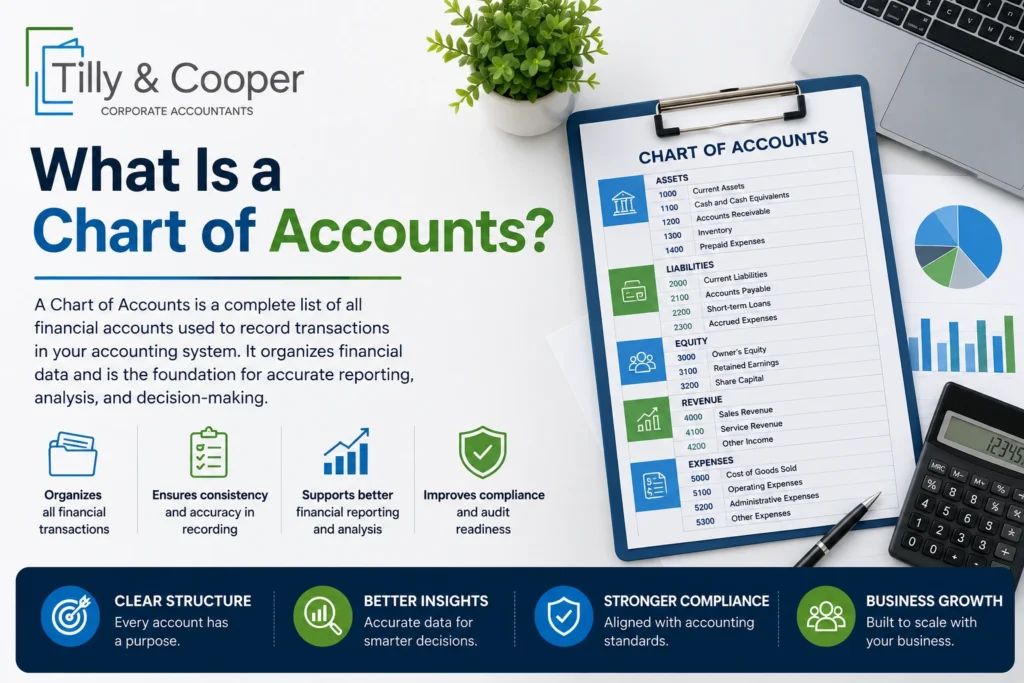
A chart of accounts (COA) is an organised list of the accounts a business uses to record transactions.
Accounts are normally grouped into categories such as:
- Assets
- Liabilities
- Equity
- Revenue
- Expenses
For example, a business may have separate expense accounts for:
- Rent
- Advertising
- Salaries
- Software
- Travel
- Insurance
- Professional fees
A well-designed chart of accounts makes bookkeeping, reporting, and financial analysis easier.
What Is an Example of Accounting?
Suppose a business provides services worth £5,000 and sends an invoice to a customer.
The transaction may be recorded as:
- Debit Accounts Receivable: £5,000
- Credit Sales Revenue: £5,000
Revenue increases because the business has earned income. Accounts receivable increases because the customer owes the business £5,000.
When the customer later pays the invoice, the entry may be:
- Debit Bank: £5,000
- Credit Accounts Receivable: £5,000
The bank balance increases while the customer’s outstanding balance is cleared.
Another example is purchasing inventory worth £2,000 on credit.
The initial entry may be:
- Debit Inventory: £2,000
- Credit Accounts Payable: £2,000
When the supplier is later paid:
- Accounts payable decreases.
- The bank balance decreases.
These examples show how accounting follows a transaction from the moment it happens until it is settled.
What Are Cash and Accrual Accounting?
Cash and accrual accounting are two methods used to decide when income and expenses should be recorded.
Cash Accounting
Cash accounting generally records income when money is received and expenses when money is paid.For example, if a customer pays an invoice in January, the income is normally recorded in January under the cash method.
Accrual Accounting
Accrual accounting generally records income when it is earned and expenses when they are incurred, even if payment happens later. For example, suppose a business completes a £10,000 project in December but receives payment in January. Under accrual accounting, the revenue would generally be recognised in December because that is when it was earned. Under cash accounting, it would generally be recorded when the money is received. The accounting method a business uses can depend on its size, reporting framework, tax rules, and legal requirements.
What Financial Statements Does Accounting Produce?
Accounting information is used to prepare financial statements that explain a company’s financial position and performance.The main financial statements include the balance sheet, income statement, and cash flow statement.
What Is a Balance Sheet?
A balance sheet shows the financial position of a business at a particular date.
It normally includes:
- Assets
- Liabilities
- Equity
The balance sheet helps readers understand what the company owns, what it owes, and the value remaining for its owners.
What Is an Income Statement?
An income statement, also known as a profit and loss statement in many businesses, shows financial performance over a period.
It normally includes:
- Revenue
- Cost of sales
- Operating expenses
- Other income or expenses
- Profit or loss
The income statement helps users understand whether the business generated a profit during the reporting period.
What Is a Cash Flow Statement?
A cash flow statement explains how cash moved into and out of a business during a period.
Cash flows are normally divided into:
- Operating activities
- Investing activities
- Financing activities
The cash flow statement is important because profit and cash are not the same thing.
A business can report a profit but still experience cash shortages.
What Is an Accounting Period?
An accounting period is the period covered by financial records or financial reports.
An accounting period may be:
- One month
- One quarter
- Six months
- One financial year
Businesses use accounting periods to measure and compare financial performance over time.
What Is the Accounting Cycle?
The accounting cycle is the sequence of steps used to turn financial transactions into organised accounting records and financial statements.
The cycle repeats for each accounting period.
It is commonly explained in six to eight stages depending on how individual steps are grouped.
A detailed accounting cycle can be shown in eight steps.
1. Identify Financial Transactions
The process begins when a financial event takes place.
Businesses collect supporting documents such as:
- Sales invoices
- Purchase invoices
- Receipts
- Bank statements
- Payroll records
- Expense claims
- Credit card statements
2. Record Journal Entries
Transactions are recorded using debits and credits. Each journal entry identifies the accounts affected by the transaction.
3. Post Entries to the General Ledger
Journal entries are transferred to the relevant ledger accounts. This allows the business to see the total activity within each account.
4. Prepare an Unadjusted Trial Balance
Balances from the general ledger are brought together to check whether total debits equal total credits.
5. Record Adjusting Entries
At the end of the period, some balances may need adjusting.
Common adjustments include:
- Accrued expenses
- Accrued income
- Prepayments
- Deferred income
- Depreciation
- Corrections
These adjustments help ensure financial activity is recorded in the correct period.
6. Prepare an Adjusted Trial Balance
After adjusting entries have been posted, another trial balance is prepared. The adjusted balances are then used to prepare the financial statements.
7. Prepare Financial Statements
The business prepares its financial reports, which may include:
- Income statement
- Balance sheet
- Cash flow statement
- Statement of changes in equity
8. Record Closing Entries
Temporary accounts may be closed at the end of the accounting period. Revenue and expense accounts are generally reset so that the next reporting period can begin with fresh balances. The accounting cycle then starts again.
What Are the Main Accounting Principles?
Accounting principles help determine how financial transactions should be recognised, measured, recorded, and reported. The exact requirements depend on the reporting framework being used, but several concepts are important across accounting systems.
Accrual Principle
Income and expenses should generally be recognised when they are earned or incurred rather than only when cash changes hands.
Consistency
Businesses should apply accounting methods consistently so that financial information can be compared between periods.Changes may sometimes be necessary, but they should be properly considered and disclosed where required.
Going Concern
Financial statements are normally prepared on the assumption that the business will continue operating for the foreseeable future unless there is evidence otherwise.
Materiality
Financial information is considered material when leaving it out or reporting it incorrectly could influence the decisions of users.
Prudence
Accounting estimates should use appropriate care and judgement, particularly when there is uncertainty.Prudence should not be used to deliberately understate assets or profits.
Revenue Recognition
Revenue should be recognised according to the applicable accounting rules when the relevant conditions have been met.
Matching of Income and Expenses
Under accrual accounting, costs are generally recognised in the period to which they relate so that financial performance can be measured more accurately.
Full and Relevant Disclosure
Financial statements should provide the information needed to help users understand important transactions, estimates, risks, and accounting policies.
What Are Accounting Standards?
Accounting standards are formal rules and principles used to prepare and present financial information.
They help improve:
- Consistency
- Comparability
- Transparency
- Reliability
- Financial reporting quality
Different countries and organisations may use different accounting frameworks. Two of the best-known frameworks are U.S. GAAP and IFRS Accounting Standards.
What Is U.S. GAAP?
U.S. GAAP stands for United States Generally Accepted Accounting Principles. The Financial Accounting Standards Board, or FASB, establishes accounting standards for many private-sector organisations in the United States.
U.S. GAAP provides guidance on areas including:
- Revenue recognition
- Leases
- Inventory
- Assets
- Liabilities
- Financial instruments
- Financial statement presentation
U.S. public companies generally prepare financial reports under U.S. GAAP.U.S. GAAP is often described as containing detailed accounting guidance, although professional judgement is still required when applying it.
What Is IFRS?
IFRS stands for International Financial Reporting Standards.IFRS Accounting Standards are issued by the International Accounting Standards Board (IASB). They are used or permitted in many jurisdictions around the world.
IFRS provides accounting requirements for areas such as:
- Revenue
- Leases
- Financial instruments
- Business combinations
- Assets
- Liabilities
- Financial statement presentation
IFRS is often described as more principles-based, with greater reliance on judgement in some areas. Both IFRS and U.S. GAAP aim to produce useful, transparent, and comparable financial information, although their treatment of some transactions differs.
What Is the History of Accounting?
Accounting has existed in different forms for thousands of years.
Early societies needed ways to record:
- Trade
- Taxes
- Grain
- Livestock
- Property
- Debts
Ancient civilisations such as those in Mesopotamia and Egypt developed early record-keeping systems to track economic activity. Accounting continued to develop as trade became more complex. One of the most important developments came during the Renaissance.
Who Is Known as the Father of Accounting?
Luca Pacioli is commonly known as the Father of Accounting. Pacioli was an Italian mathematician who published a description of double-entry bookkeeping in 1494. He did not invent double-entry bookkeeping. Merchants were already using forms of the system. However, his work documented the method and helped spread knowledge of it. The basic idea remains central to modern accounting: transactions are recorded through matching debit and credit effects.
How Did Modern Accounting Develop?
Modern accounting developed as businesses became larger and financial activity became more complex.
The Industrial Revolution increased the need for:
- Reliable business records
- Cost information
- Investor reporting
- Auditing
- Financial controls
Professional accounting organisations later developed, and accounting became an established profession.During the twentieth century, formal accounting standards became increasingly important.Organisations such as the FASB and IASB developed structured financial reporting frameworks.Technology then changed the way accounting work was performed.
Manual ledgers gradually gave way to:
- Spreadsheets
- Desktop accounting software
- Cloud accounting platforms
- Automated bank feeds
- Enterprise systems
- Data analysis tools
Accounting technology continues to develop, but the purpose remains the same: turning financial activity into useful information.
What Are the Different Types of Accounting?
Accounting has developed into several specialised areas because businesses need financial information for different purposes.
The main types include:
- Financial accounting
- Management accounting
- Cost accounting
- Tax accounting
- Auditing
- Forensic accounting
- Fund accounting
What Is Financial Accounting?
Financial accounting focuses mainly on preparing financial information for external users.
These users may include:
- Investors
- Shareholders
- Banks
- Lenders
- Regulators
Financial accounting produces reports such as:
- Balance sheet
- Income statement
- Cash flow statement
- Statement of changes in equity
- Notes to financial statements
These reports normally follow an applicable financial reporting framework.
What Is Management Accounting?
Management accounting provides financial and non-financial information to people inside a business.Managers use this information to make decisions about:
- Budgets
- Pricing
- Costs
- Staffing
- Investments
- Production
- Business expansion
Management accounting reports can be designed around the specific needs of a business.They do not normally have to follow the same standardised format as external financial statements.
What Is Cost Accounting?
Cost accounting focuses on understanding the cost of producing goods or delivering services.
It may analyse:
- Direct materials
- Direct labour
- Overheads
- Fixed costs
- Variable costs
- Cost per unit
Businesses use cost accounting to:
- Set prices
- Improve efficiency
- Control spending
- Measure product profitability
- Support production decisions
Cost accounting is particularly important for manufacturing businesses.
What Is Tax Accounting?
Tax accounting focuses on tax calculations, records, returns, compliance, and planning.
A tax accountant may help with:
- Tax returns
- Tax calculations
- Record keeping
- Tax payment deadlines
- Tax planning
- Supporting tax enquiries
Tax accounting rules are not always the same as financial accounting rules.The treatment of a transaction for tax purposes can differ from its treatment in financial statements.
What Is Auditing?
Auditing is the examination of financial information, controls, processes, or financial statements.
There are two common types.
External Auditing
External auditors provide an independent review of financial statements where an audit is required or requested.
Internal Auditing
Internal auditors work within or for an organisation to review areas such as:
- Internal controls
- Risk
- Governance
- Processes
- Compliance
Auditing can help identify errors, weaknesses, and areas where controls need improvement.
What Is Forensic Accounting?
Forensic accounting combines accounting with investigation and financial analysis.
Forensic accountants may investigate:
- Fraud
- Embezzlement
- Asset misappropriation
- Financial disputes
- Business valuations
- Insurance claims
- Suspicious transactions
Their work may support court proceedings, regulatory investigations, or commercial disputes.
What Is Fund Accounting?
Fund accounting is commonly used by governments, charities, and non-profit organisations. It focuses on tracking money according to its intended purpose.
For example, money received under a restricted grant may need to be spent only on the activity approved by the funding organisation. Fund accounting therefore focuses strongly on accountability rather than simply measuring profit.
What Does an Accountant Do?
An accountant records, reviews, analyses, and reports financial information.The exact responsibilities depend on the accountant’s role and area of specialisation.
An accountant may work in:
- Financial reporting
- Tax
- Audit
- Management accounting
- Cost accounting
- Business advisory
- Financial systems
- Forensic investigations
Routine transaction recording may also be handled by bookkeepers, while accountants often focus more on review, analysis, compliance, reporting, and advice.
What Are the Responsibilities of an Accountant?
Common accounting responsibilities include:
Preparing Financial Statements
Accountants may prepare or review:
- Balance sheets
- Income statements
- Cash flow statements
- Management accounts
Reconciling Accounts
Accountants compare accounting records with external evidence.
Examples include:
- Bank reconciliations
- Supplier statement reconciliations
- Customer balance reviews
- Loan reconciliations
Managing Tax Compliance
Depending on their role, accountants may calculate taxes, prepare returns, maintain supporting records, and monitor deadlines.
Reviewing Financial Records
Accountants check records for:
- Errors
- Missing transactions
- Duplicates
- Unusual movements
- Incorrect classifications
Supporting Audits
They may provide:
- Supporting schedules
- Reconciliations
- Invoices
- Explanations
- Accounting records
Providing Business Advice
Accountants may help management understand:
- Profitability
- Costs
- Cash flow
- Budgets
- Financial risks
- Business performance
What Skills Does an Accountant Need?
Accountants need a mix of technical, analytical, communication, and technology skills.
Attention to Detail
Accounting records contain many small pieces of financial information.A small mistake can affect reconciliations, financial reports, or tax calculations.
Analytical Thinking
Accountants need to understand why financial figures have changed and what those changes mean.
Numerical Skills
Modern accounting software performs many calculations, but accountants still need to understand:
- Percentages
- Margins
- Ratios
- Variances
- Financial relationships
Knowledge of Accounting Standards
Accountants may need knowledge of IFRS, U.S. GAAP, local reporting standards, or other relevant rules.
Technology Skills
Accountants regularly work with:
- Accounting software
- Spreadsheets
- Payroll systems
- Reporting tools
- Enterprise software
- Data analysis platforms
Communication Skills
Accountants often need to explain financial information to people who do not have an accounting background.Being able to turn complex numbers into clear advice is therefore an important skill.
What Are the Different Accounting Careers?
Accounting offers many career paths. Common roles include:
Auditor
Auditors review financial records, controls, and financial statements.
Tax Accountant
Tax accountants specialise in tax compliance, calculations, returns, and planning.
Forensic Accountant
Forensic accountants investigate financial disputes, fraud, and unusual transactions.
Management Accountant
Management accountants provide financial information to help managers make business decisions.
Financial Accountant
Financial accountants prepare financial records and reports for external reporting purposes.
Financial Controller
A financial controller may oversee areas such as:
- Financial reporting
- Accounts payable
- Accounts receivable
- Payroll
- Month-end reporting
- Internal controls
Systems Accountant
Systems accountants work at the point where accounting and technology meet.They may manage financial software, improve processes, automate tasks, and maintain the quality of financial data.
What Is the Difference Between Accounting and Bookkeeping?
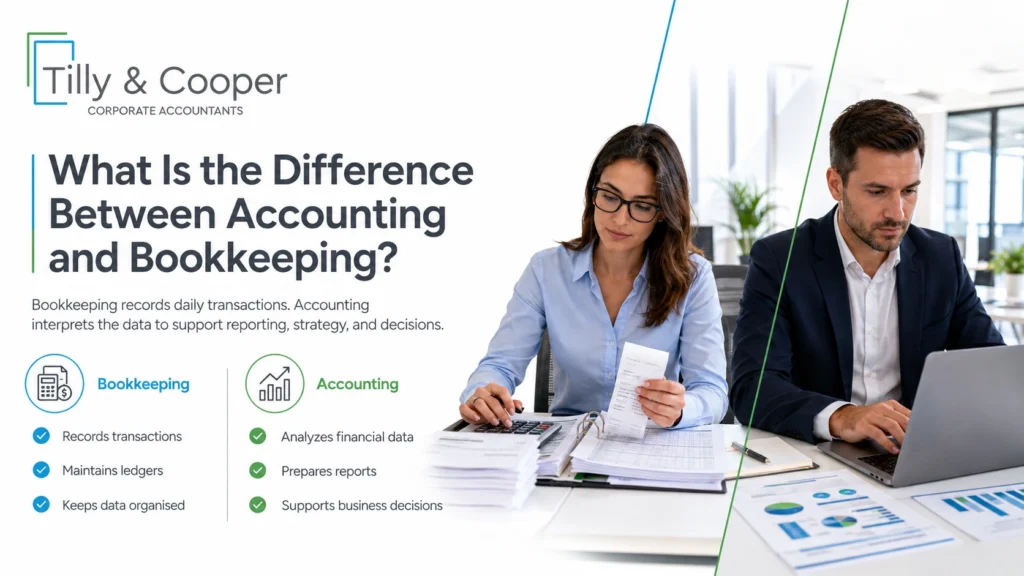
Bookkeeping focuses mainly on recording financial transactions, while accounting involves analysing, interpreting, reviewing, and reporting financial information.
A simple way to understand the difference is:
Bookkeeping records what happened. Accounting explains what the information means.
Bookkeeping may include:
- Entering invoices
- Recording expenses
- Posting bank transactions
- Maintaining ledgers
- Processing receipts
Accounting may include:
- Preparing financial statements
- Reviewing profitability
- Analysing costs
- Preparing forecasts
- Supporting tax work
- Advising management
Both functions are closely connected because reliable accounting depends on accurate bookkeeping.
What Is the Difference Between Finance and Accounting?
Accounting focuses on recording and reporting financial activity, while finance focuses more on managing money, raising capital, investing funds, and making future financial decisions.
Accounting answers questions such as:
- How much revenue did the business earn?
- What expenses were incurred?
- How much profit was made?
- What does the business own?
- How much does it owe?
Finance often focuses on questions such as:
- Where should money be invested?
- Should the business borrow?
- How should capital be raised?
- What return could an investment generate?
- How much financial risk should the business take?
Accounting often provides the historical information used to make financial decisions.
What Is an Accounting Information System?
An accounting information system (AIS) is the combination of people, processes, data, controls, and technology used to collect, process, store, and report financial information.
An AIS may support:
- Transaction recording
- Customer invoicing
- Supplier bills
- Payroll
- Asset records
- Bank reconciliations
- Financial reporting
- Internal controls
An accounting information system may range from a simple small-business platform to a complex enterprise system.
How Does Accounting Help Small Businesses?
Accounting helps small-business owners understand what is happening financially before problems become serious.Good accounting records can help answer questions such as:
- Are we making a profit?
- Do we have enough cash?
- Which services are most profitable?
- How much do customers owe us?
- How much do we owe suppliers?
- Can we afford to hire someone?
- How much tax may become payable?
Accounting also makes it easier to prepare financial information when applying for finance or speaking with investors.
What Are the Best Accounting Tips for Small Businesses?
Small businesses can improve their accounting by following a few simple habits.
Keep Personal and Business Money Separate
Using a separate business bank account makes bookkeeping and reconciliation easier.
Record Transactions Regularly
Do not leave months of bookkeeping until the end of the year.
Regular records are easier to check and correct.
Keep Supporting Documents
Keep invoices, receipts, contracts, and other financial records in an organised system.
Monitor Unpaid Customer Invoices
Follow up overdue invoices to protect cash flow.
Reconcile Bank Accounts Regularly
Bank reconciliation can help find:
- Missing transactions
- Duplicates
- Incorrect amounts
- Bank charges
- Unrecorded payments
Plan for Taxes
Monitor likely tax liabilities during the year rather than waiting until a filing or payment deadline.
Use Suitable Accounting Software
Accounting software can automate many routine tasks, but records should still be reviewed for accuracy.
How Do You Do Accounting for a Small Business?
Small business accounting involves recording income and expenses, keeping receipts, reconciling bank transactions, managing invoices, and tracking what the business owes. You should also prepare financial statements, monitor cash flow, calculate taxes, and keep accurate records for HMRC. Using accounting software can simplify these tasks and help business owners understand performance, meet deadlines, and make better financial decisions with confidence.
1. Choose the Appropriate Accounting Method
Decide whether the business will use cash or accrual accounting where permitted and appropriate.
2. Set Up a Chart of Accounts
Create suitable accounts for:
- Assets
- Liabilities
- Equity
- Revenue
- Expenses
3. Record Transactions
Record sales, purchases, payments, payroll, expenses, and other financial activity.
4. Reconcile Accounts
Compare accounting records with:
- Bank statements
- Credit card statements
- Loan statements
- Supplier records
5. Review Financial Reports
Prepare and review reports regularly.
Useful reports include:
- Profit and loss statement
- Balance sheet
- Cash flow report
- Accounts receivable report
- Accounts payable report
Regular review helps identify financial problems earlier.
What Accounting Software Do Small Businesses Use?
Small businesses commonly use accounting software such as Xero, QuickBooks, Sage, and FreeAgent to manage invoices, expenses, bank transactions, payroll, VAT, and financial reports. The best option depends on business size, budget, and accounting needs. Cloud-based software is popular because it allows owners and accountants to access records online, automate routine tasks, and keep information organised and up to date.
Popular accounting platforms include:
- QuickBooks
- Xero
- FreshBooks
- Zoho Books
- Sage
Businesses may compare software based on features such as:
- Invoicing
- Bank feeds
- Expense tracking
- Payroll integration
- Inventory
- Tax reporting
- Multi-currency support
- User access
- Financial reporting
Larger organisations may use systems such as:
- SAP
- Oracle
- NetSuite
There is no single accounting platform that is best for every business.The right software depends on what the organisation actually needs.
What Is Accounting in Simple Words?
Accounting is the system a business uses to keep track of its money and financial activity. It records what a business earns, spends, owns, and owes. It then turns those records into useful financial information. Good accounting helps businesses understand performance, manage cash flow, control costs, prepare financial reports, meet tax responsibilities, and make better decisions. From a small business recording its first sale to a large organisation preparing financial statements, the purpose of accounting remains the same: to turn financial activity into clear, reliable, and useful information.

