

IHT400 Form Explained: UK Inheritance Tax and Probate Guide
The IHT400 form is HMRC’s full Inheritance Tax account. Executors and administrators use it when tax is payable, or the deceased’s estate does not qualify as an excepted estate. It reports assets, debts, gifts, exemptions and reliefs.Reporting depends on the death date, estate value, residence and lifetime transactions. This covers eligibility, schedules, deadlines and probate.
What Does HMRC Use the IHT400 Form For?
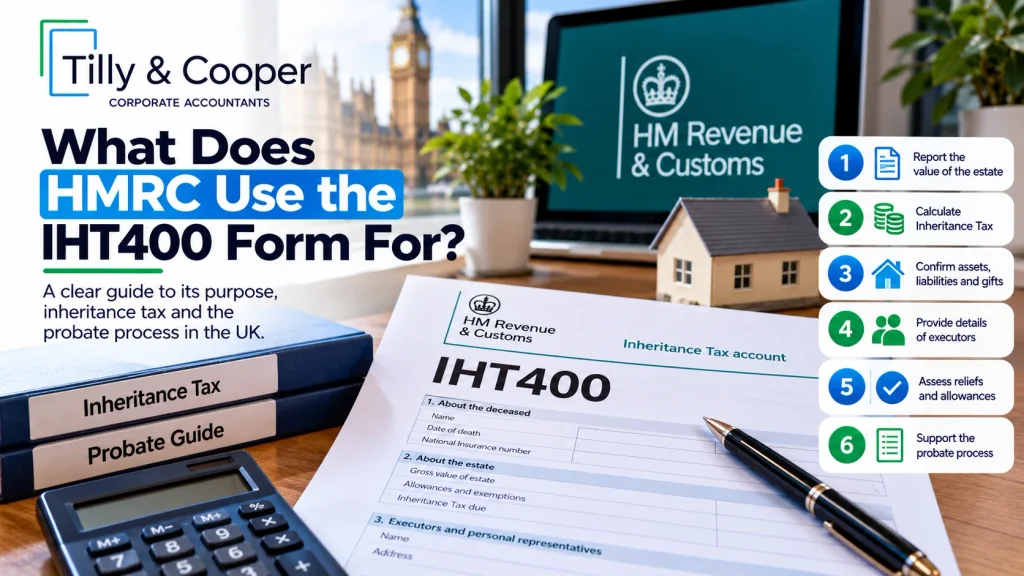
HMRC uses IHT400 to assess the estate’s potential Inheritance Tax liability, including asset values, debts, gifts and reliefs. It also covers relevant joint property, trusts and overseas assets. A return can be required even if no tax is payable.
Where Can You Download the IHT400 PDF and Guidance Notes?
Download the current IHT400 form, notes and calculation documents. HMRC’s interactive PDF requires Adobe Reader. HMRC says you cannot save an unfinished form. Gather the figures first, then print it.
Which Estates Must Complete IHT400?
Submit IHT400 where tax is payable or a full account is required because the estate does not satisfy the excepted-estate rules. The familiar £325,000 nil-rate band is not a stand-alone reporting test.
What Are the Excepted-Estate Thresholds?
For deaths from 1 January 2022, excepted-estate categories include low-value, exempt and certain overseas estates, subject to the applicable residence rules.
| Category | Main value threshold | Important conditions |
| Low-value excepted estate | Gross value within the available nil-rate band, commonly £325,000 or up to £650,000 with a qualifying transferable band | Limits on trusts, specified transfers, foreign assets and gifts with reservation |
| Exempt excepted estate | Gross estate no more than £3 million | Net chargeable amount must be within the available nil-rate band after permitted liabilities and specified spouse, civil partner or charity exemptions; other restrictions apply |
| Certain estates of people not long-term UK residents | Separate narrow rules, including qualifying UK cash, listed shares or securities with a gross UK value of less than £150,000 under IHT207 | Asset-type and residence conditions must be satisfied |
For low-value estates, relevant foreign assets must not exceed £100,000. Specified chargeable lifetime transfers must not exceed £250,000. Where an interest in trust is included, the qualifying single trust’s gross value must not exceed £250,000.
Exempt excepted estates have different trust conditions, including a £1 million gross ceiling for a qualifying single trust and a £250,000 limit on its chargeable value after specified exemptions. The £3 million threshold does not exempt every smaller estate from full reporting.
What Is the Difference Between IHT207 and IHT401a?
IHT207 is a simplified return for certain qualifying estates of people who were not long-term UK residents. The gross value of qualifying UK cash and quoted shares or securities must be less than £150,000, alongside the applicable residence conditions. It is not a substitute for IHT400 when someone lived overseas.
IHT401a accompanies IHT400 when the deceased was not a long-term UK resident and a full account is necessary. It provides the residence details supporting that position. HMRC introduced the long-term residence framework for deaths from 6 April 2025. Earlier deaths require checking the previous domicile-based rules and relevant forms.
When Are IHT400 and Inheritance Tax Due?
The full account is normally due 12 months after the end of the month of death, or three months after the personal representatives first act in that capacity if this is later. Inheritance Tax is generally payable by the end of the sixth month after death. These are different deadlines.
For a death on 12 January 2026, the usual tax payment date is 31 July 2026, and the normal account deadline is 31 January 2027. Special statutory situations may change the filing deadline.
Can Executors Pay Inheritance Tax in Instalments?
Yes. Qualifying tax attributable to certain assets, including property, may be paid in ten annual instalments. An election is required, and interest can apply to outstanding instalments. Sale of the relevant asset can accelerate the balance due. Different interest treatment applies to certain qualifying Agricultural Relief and Business Relief property from 6 April 2026. The ten-year instalment facility does not apply to the notional pension property included in estates under the reforms commencing on 6 April 2027.
What Documents Do You Need to Complete IHT400?
Compile the date-of-death value of the deceased’s home, other land, vehicles, possessions, bank accounts, investments and relevant business interests. Obtain professional valuations when necessary, particularly for property or unquoted shares.
Record jointly owned assets separately. Gather details of outstanding mortgages, allowable debts and funeral costs. Review gifts made during the seven years before death, any gifts where the donor continued to benefit, and relevant trusts.
Bank statements, property valuations, investment summaries, loan documents, trust deeds and gift records support the figures reported. Keep records of disputed items and estimates used.
How Will Pension Death Benefits Affect IHT400 From April 2027?
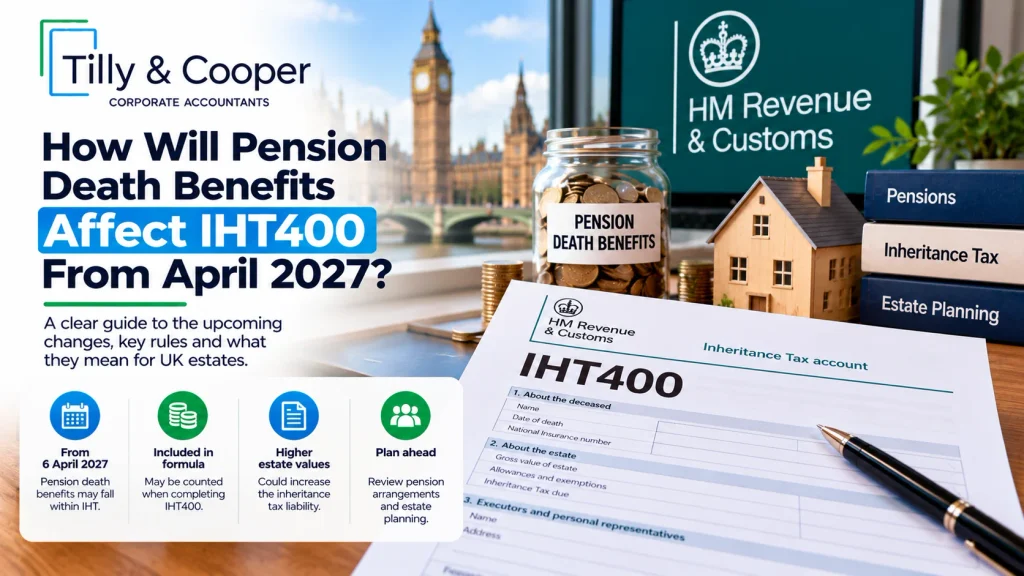
For deaths on or after 6 April 2027, most unused pension funds and pension death benefits will be included in the estate for Inheritance Tax purposes under Finance Act 2026. The previous rules still apply to earlier deaths, even where beneficiaries receive benefits later.
Statutory exceptions include specified death-in-service benefits and certain dependant pension benefits. Pension administrators and personal representatives will exchange information about relevant benefits and tax obligations.
HMRC published its first pensions technical note in May 2026 and a second technical note on 27 August 2026. The second document explains notional pension property, information sharing, withholding notices, direct-payment procedures and clearance. HMRC explicitly says these technical notes are not draft guidance. It plans separate operational guidance, secondary legislation and supporting materials before implementation.
How Do You Fill Out the IHT400 Form?
To fill out the IHT400 form, gather the deceased’s financial records, establish estate values and identify the relevant supplementary schedules. Use HMRC’s current guidance to report assets, debts, gifts and applicable reliefs. Check that figures match across the return before signing. The steps below provide a practical sequence for preparing the account, reviewing calculations and organising submission and tax payment.
- Identify the deceased and representatives. Enter the personal details, date of death, and people responsible for the estate.
- Value assets and allowable liabilities. Reconcile property, accounts, investments, debts and other interests.
- Choose supplementary schedules. Include only the forms relevant to the estate’s transactions and assets.
- Assess gifts, exemptions and reliefs. Consider spouse or civil partner exemptions, charitable gifts, transferable allowances and any qualifying property relief.
- Prepare the IHT400 calculation. Cross-check totals between the main return and its schedules.
- Review and sign. Complete the required declarations, retain copies and arrange submission and any tax payment.
Which Additional Inheritance Tax Forms May Be Needed?
The additional Inheritance Tax forms you need depend on the estate’s assets, any gifts, and the reliefs you claim. Some forms cover property, savings or pensions. Others help you claim allowances from a late spouse or civil partner. The table below explains each form’s purpose, so you can identify which forms may apply before preparing the estate’s Inheritance Tax return.
| Form | Purpose |
| IHT401 | Overseas domicile details for relevant earlier deaths |
| IHT401a | Long-term UK residence information under newer rules |
| IHT402 | Transferable nil-rate band |
| IHT403 | Gifts and lifetime transfers |
| IHT404 | Jointly owned assets |
| IHT405 | Houses, land and buildings |
| IHT406 | Bank and building society accounts |
| IHT407 | Household and personal goods |
| IHT409 | Pensions |
| IHT410 | Life assurance and annuities |
| IHT411 | Listed shares |
| IHT412 | Unlisted shares and control holdings |
| IHT413 | Business and partnership interests |
| IHT414 | Agricultural Relief |
| IHT417 | Foreign assets |
| IHT418 | Trust assets |
| IHT419 | Debts owed by the deceased |
| IHT423 | Direct Payment Scheme for eligible providers |
| IHT430 | Reduced Inheritance Tax rate for qualifying charity gifts |
| IHT435 | Residence nil-rate band |
| IHT436 | Transferable residence nil-rate band |
| IHT437 | Transferable unused 100% Agricultural or Business Relief allowance from a previously deceased spouse or civil partner |
| IHT421 | Northern Ireland probate summary, not an asset schedule |
| C1 | Scottish confirmation and inventory form, not an asset schedule |
How Is the IHT400 Calculation Worked Out?
The standard Inheritance Tax rate is generally 40% on the taxable value above available allowances. The ordinary nil-rate band is £325,000 in 2026–27. An eligible residence nil-rate band can add up to £175,000, subject to conditions and tapering. Unused allowances from a spouse or civil partner may also transfer.
| Simplified example | Amount |
| Net chargeable estate before nil-rate band | £525,000 |
| Ordinary nil-rate band | −£325,000 |
| Amount taxed at 40% | £200,000 |
| Illustrative Inheritance Tax | £80,000 |
This assumes no residence nil-rate band, transferable allowances, relevant lifetime gifts or further reliefs. Real calculations may require separate tax treatment for lifetime transfers and trusts. The charitable reduced rate of 36% applies only when its specific conditions are met.
How Do You Submit IHT400 and Proceed to Probate?
Submit IHT400 to HMRC by post, together with the relevant supplementary schedules and copies of any will and codicils. Use the address printed on the current form and retain copies. You must submit the account within 12 months of the death and before applying for probate. If Inheritance Tax is payable, you normally need to start paying before probate is granted.
To proceed with probate in England and Wales, wait for HMRC to issue your unique probate code. This usually arrives within 20 working days of HMRC receiving your IHT400 or tax payment, whichever is later. Use the code when applying online or by post. Scotland uses the confirmation process, while Northern Ireland requires form IHT421 alongside IHT400.
Postal address: HM Revenue and Customs, Inheritance Tax Team, BX9 1HT, United Kingdom. Check the current form instructions before posting.
How Do the England, Scotland and Northern Ireland Procedures Differ?
| Jurisdiction | Probate or confirmation process |
| England and Wales | HMRC sends a unique code used for the probate application |
| Scotland | Submit the relevant C1 confirmation and inventory form with IHT400. HMRC stamps and returns C1 for the Scottish confirmation application |
| Northern Ireland | Submit IHT421 with IHT400; HMRC completes the relevant section and returns or processes the probate summary under the applicable procedure |
HMRC normally supplies the probate or confirmation information within 20 working days of receiving IHT400 or the required Inheritance Tax payment, whichever is later. In Scotland, HMRC returns the stamped C1. The representatives then apply to the relevant sheriff court, which grants confirmation. The code, C1 or IHT421, enables the relevant probate application; neither provides final Inheritance Tax clearance.
How Long Does HMRC Take to Process IHT400?
HMRC normally provides the information needed to proceed with probate or confirmation within 20 working days of receiving IHT400 or the required tax payment, whichever is later. This does not mean HMRC has completed its tax review.
Preparing the return may take days for a simple estate, or weeks for one involving complex valuations, trusts or overseas assets. HMRC can later request evidence about gifts, debts and reliefs. Probate or confirmation follows a separate timetable.
What Are the Penalties for Late IHT400 Filing?
Late IHT400 filing can result in an initial £100 penalty, rising to £200 in total once the account is six months late. If the delay exceeds 12 months beyond the filing deadline, an additional penalty of up to £3,000 may apply where tax is due. The initial penalties cannot exceed the estate’s Inheritance Tax liability.
HMRC may waive late filing penalties where you have a reasonable excuse and submit the account promptly once that excuse ends. Interest on unpaid Inheritance Tax applies separately: it normally starts after the payment deadline, at the end of the sixth month following the death. Filing IHT400 on time does not prevent interest if payment is late.
What Is the Difference Between IHT400 and IHT205?
IHT400 and IHT205 serve different estate reporting purposes. IHT400 provides a full Inheritance Tax account when detailed reporting is required. IHT205 applies to certain excepted estates where the person died on or before 31 December 2021. For most excepted estates involving deaths from 1 January 2022, representatives provide the necessary details through the probate or confirmation process instead of IHT205.
| Feature | IHT400 | IHT205 |
| Purpose | Full estate account | Simplified historic excepted-estate reporting |
| Typical use | Taxable or non-excepted estate | Qualifying earlier deaths |
| Deaths from 2022 | Still required where full reporting applies | Generally not required |
Start by checking the date of death and whether the estate qualifies as excepted. An estate may still need IHT400 even when no Inheritance Tax is payable, so the tax bill alone does not determine which reporting process applies. Read HMRC’s guidance before preparing the paperwork, and seek advice if gifts, overseas assets or relief claims make the position unclear.
FAQs
No. Qualifying excepted estates generally do not need IHT400. However, estates outside these rules may need the form even when no Inheritance Tax is payable.
Yes. Executors can complete IHT400 themselves using HMRC’s guidance. Professional advice may help with overseas assets, trusts, business relief claims or disputed valuations.
Yes. GOV.UK provides the current IHT400 PDF and guidance notes free. Use Adobe Reader to complete the interactive form before printing.
No. You normally submit IHT400 by post to HMRC using the address on the form. Completing the PDF electronically does not submit it. Online probate applications follow a separate process
IHT400 is the full Inheritance Tax account. IHT207 covers certain excepted estates with limited assets in England, Wales or Northern Ireland. Eligibility depends on the deceased’s residence, domicile history and estate circumstances
Need Professional Help With Your IHT400 Form?
Completing an IHT400 form requires accurate estate valuations, supporting schedules and careful Inheritance Tax calculations. Mistakes can delay probate, result in HMRC enquiries or lead to unexpected tax liabilities. At Tilly & Cooper Corporate Accountants, we help executors and personal representatives navigate the IHT400 process with confidence. Our team can assist with estate valuations, inheritance tax calculations, available exemptions and reliefs, supporting HMRC forms and tax-related correspondence.
Whether you are managing a straightforward estate or dealing with property, investments, trusts or overseas assets, we provide professional guidance tailored to your circumstances. Get expert support with your IHT400 form and Inheritance Tax obligations. Contact Tilly & Cooper today to discuss your estate’s requirements.

