

What Is Administrative Restoration UK? Eligibility & RT01
Administrative Restoration UK works for eligible dissolved companies. It covers who can apply, which Registrar strike-off cases qualify, the six-year deadline, Form RT01, outstanding Companies House filings, Bona Vacantia requirements, and refusal options. It also explains the key statutory tests under the Companies Act 2006.
The article helps former directors, members and advisers understand the required restoration package before applying to Companies House. Most applications use Form RT01. Outstanding Companies House filings usually form part of the package. A six-year time limit normally applies from the dissolution date. Companies House must receive the application within that period.
The Companies Act 2006 contains the main legal framework. Sections 1024 to 1028A cover administrative restoration. Regulation 23 covers certain registered-office strike-off cases. These rules determine whether administrative restoration remains available. Administrative restoration does not cover every dissolved company. The strike-off reason must therefore be checked first.
What Is Administrative Restoration?
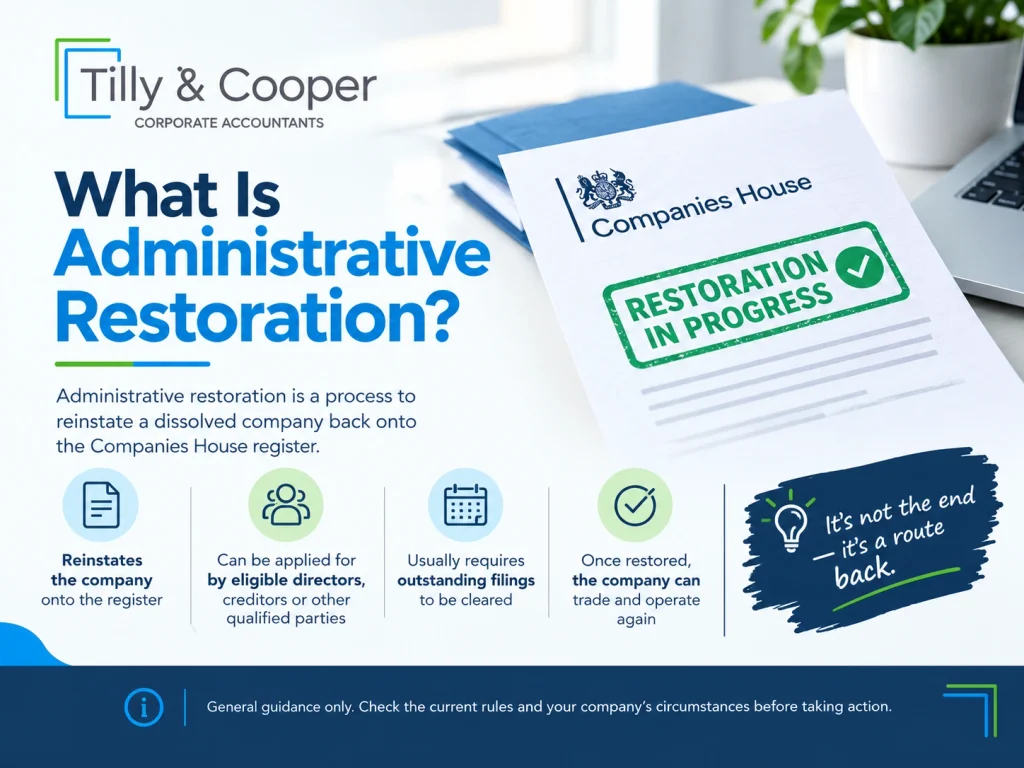
Administrative restoration returns an eligible company directly to the Companies House register. It avoids a court application where the statutory route applies. Section 1024 of the Companies Act 2006 creates the main application route. It covers qualifying Registrar strike-offs. The process starts with an application to the Registrar of Companies. The registrar then reviews the statutory conditions.
A successful restoration returns the company to the public register. The company then continues as if dissolution had not occurred. That legal effect can support normal company activity again. It can also help recover company rights or assets. Administrative restoration has a strict eligibility framework. A company cannot simply choose this route for convenience.
A company voluntarily struck off by its directors cannot use administrative restoration. Court restoration is the alternative route. Companies House confirms this distinction in its current restoration guidance. Companies House restoration guidance: The application normally has a six-year deadline. This period begins on the company’s dissolution date.
The application date also has a specific legal meaning. Section 1024 treats receipt by the registrar as the application date. Posting RT01 before the deadline does not guarantee compliance. Companies House must receive it within the permitted period. The administrative restoration timescale can then depend on package completeness. Missing filings can delay the process.
Who Can Apply?
Only a former director or former member can apply for administrative restoration. Section 1024 sets this applicant requirement.The person must have held that position before the relevant strike-off. Their status should therefore be checked first. A former member often means a former shareholder. However, the statutory term remains former member. Section 1024 specifically uses that wording. It does not give every interested party administrative restoration rights. Companies Act 2006, section 1024
A creditor cannot use administrative restoration solely because money remains unpaid. A creditor may need the court route instead. A liquidator also does not qualify solely through that former role. Section 1024 requires former director or former member status. The applicant confirms their eligibility through RT01. The form contains a formal statement of compliance.
That statement confirms the applicant’s former company position. It also confirms compliance with section 1025 requirements. The applicant should therefore check eligibility before preparing the wider package. This first review can prevent wasted filing costs. It can also identify the correct restoration route early.
Which Companies Qualify?
Administrative restoration only covers specific types of Registrar strike-off. The company’s dissolution history determines whether it qualifies.Current Companies House guidance identifies three relevant strike-off categories.
| Strike-off basis | Main administrative restoration test |
| Sections 1000 or 1001 | Company carried on business or remained in operation |
| Section 1002A | Registrar lacked the relevant reasonable cause |
| Regulation 22 | Registered-office restoration requirements must be satisfied |
These routes do not use identical eligibility tests. The Companies House record should show the strike-off history. The Gazette record can provide additional chronology. Directors should not rely only on the dissolution date.
The reason for strike off matters equally. A voluntary strike-off application falls outside this route. Administrative restoration cannot reverse a director-led voluntary strike off.
Registrar Strike Off Under Sections 1000 or 1001
A section 1000 or 1001 company must meet the operational activity test. The test applies when the company was struck off.
The statutory wording is important here. The company must have been carrying on business or in operation. This wording is broader than simply saying the company was trading. A company can remain operational without regular sales. Turnover alone does not always establish its status.
For example, a company might still hold active contracts. It might also maintain ongoing commercial arrangements. The actual circumstances around strike off therefore matter.,Companies House can request further information where eligibility needs clarification. Business records can help establish the operational position.
Those records do not form a standard RT01 requirement in every case. Applicants should therefore avoid sending unnecessary evidence automatically. The application should address the company’s actual circumstances. This distinction provides clearer eligibility analysis. It also avoids treating “trading” as the only possible test.
Other Qualifying Registrar Strike-Off Cases
Administrative restoration can also cover section 1002A and regulation 22 cases. Each route has additional requirements. Section 1002A concerns companies struck off following registration on a false basis. The restoration test focuses on the registrar’s original grounds. The registrar must have lacked the relevant reasonable cause. Companies House requires supporting evidence for section 1002A applications.
That evidence must address the relevant statutory grounds. Generic business records may not answer that issue. Regulation 22 creates another qualifying strike-off route. It concerns registered-office address rectification cases. Regulation 23 applies administrative restoration rules to those companies. It also modifies the section 1025 requirements. Registered Office Address Regulations 2024, Regulation 23A Regulation 22 application needs additional registered-office documentation. Companies House currently requires:
- a notice changing the registered office address;
- evidence showing the right to use that address.
These newer rules make accurate route identification important. Older restoration articles often focus only on sections 1000 and 1001. That approach can now miss qualifying cases.
What Conditions Must Be Met?
Every applicable administrative restoration condition must be satisfied before restoration. The conditions depend partly on the strike-off route. For sections 1000 and 1001, operational activity forms the first test. The company must have carried on business or remained operational. Section 1002A uses a different test. It focuses on the registrar’s reasonable cause. The application must also meet the six-year deadline. Companies House calculates this from the dissolution date.
The applicant must then bring the company records up to date. That requirement can include outstanding annual accounts. It can also include overdue confirmation statements. Other forms may become necessary in individual cases. Relevant filing fees must also be paid. Outstanding late filing penalties can apply to overdue accounts. Other fines and financial penalties can also require settlement.
Current Companies House guidance covers relevant penalties for future directors too. The late filing position deserves careful checking. Companies House normally ignores the dissolution period when measuring existing lateness. Consider accounts already two months late before dissolution. They normally remain two months late on restoration.
Different treatment applies to accounts becoming due during dissolution. Those accounts do not attract late filing penalties solely for that dissolved period. A Bona Vacantia requirement can also apply. This depends on company property or rights. The applicant must address each applicable condition before filing RT01.
A complete review should cover:
- applicant eligibility;
- strike-off route;
- six-year deadline;
- outstanding accounts;
- outstanding confirmation statements;
- filing fees and penalties;
- Bona Vacantia requirements;
- route-specific evidence.
This review keeps the application focused. It also reduces avoidable Companies House queries.
What Documents Are Required?

An administrative restoration package normally contains RT01 and outstanding statutory documents. The exact documents depend on the company record. Form RT01 starts the administrative restoration application. The current RT01 includes the applicant’s statement of compliance. This statement appears within section 3 of the form.
It confirms two core matters. The applicant confirms their former director or member status. They also confirm compliance with section 1025. The statement is therefore not normally a separate document. The current Companies House fee for RT01 is £341. Companies House can reject an application with the wrong fee. RT01 administrative restoration form and guidance
The RT01 application for administrative restoration deserves careful completion. Company details must match the public register. Outstanding documents should accompany RT01 where required. These documents commonly include accounts and confirmation statements. Additional forms can apply when company details require changes.
| Document or requirement | Purpose |
| RT01 | Starts the administrative restoration application |
| Statement of compliance within RT01 | Confirms applicant status and statutory compliance |
| Outstanding accounts | Brings the accounting record up to date |
| Confirmation statements | Updates required company information |
| Filing fees | Pays charges relating to outstanding documents |
| Late filing penalties | Settles applicable overdue accounts penalties |
| Bona Vacantia waiver | Provides Crown consent where required |
| Route-specific evidence | Supports section 1002A or regulation 22 cases |
Applicants should review the complete Companies House filing history first. Start with the latest accounts already filed. Then identify every missing accounting period. Next, check the confirmation statement history. This review can reveal several outstanding documents.
Do not prepare RT01 as a standalone form. Companies House expects a complete restoration package. The dedicated administrative restoration costs guide can explain wider costs separately. Keeping cost detail elsewhere protects this page’s eligibility focus.
Is a Bona Vacantia Waiver Needed?
A Bona Vacantia waiver is needed when relevant company property vested in the Crown. The requirement depends on the company’s asset position.A dissolved company’s property can pass to the Crown. This process is known as bona vacantia. Property can include money and other company rights. The precise asset position should be established early. Written Crown consent supports restoration where relevant property became bona vacantia. Companies House calls this consent a Bona Vacantia waiver letter.
The applicant bears responsibility for obtaining the required consent. A company without relevant vested property can have a different position. Applicants should therefore avoid assuming every restoration needs identical asset work. Company bank balances can make the issue particularly important. Property held in the company’s name can also require consideration.
The relevant Crown representative can vary by jurisdiction. Special property arrangements can affect that position too. The Bona Vacantia waiver for company restoration guide should cover those details separately. This article only needs to establish the waiver’s restoration function. That approach prevents overlap with the dedicated Bona Vacantia page.
What Happens If Companies House Refuses the Application?
A refused administrative restoration application can still lead to court restoration. A 28-day statutory period can become important. Companies House tells the applicant whether restoration has been approved. Successful restoration takes effect when the registrar sends the decision notice. The company then returns to the Companies House register. The law generally treats the company as continuously existing. Dissolution does not create a permanent legal break after restoration.
A refusal needs immediate review. The reason might concern missing documents. It might instead concern statutory eligibility. Those situations require different responses. Section 1030 provides a specific court application period after certain refusals. A qualifying applicant can apply to court within 28 days. This can remain possible after the normal six-year period expires.
The original administrative application must have met its time limit. Current section 1030 includes sections 1000, 1001 and 1002A cases. Companies Act 2006, section 1030. This rule does not convert administrative restoration into court restoration. It simply preserves a further route after qualifying refusals. Applicants should therefore review refusal notices promptly. A missed 28-day period can materially change the available option.
A former director or former member can apply. The applicant must also satisfy the remaining restoration requirements. Former involvement alone does not guarantee eligibility.
A shareholder can apply where they were a former company member. The statutory wording uses the term former member. The historic company record can help confirm that status.
A creditor cannot apply solely because the company owes money. Section 1024 limits applications to former directors and former members. A creditor may instead need to consider court restoration.
The statutory test is broader than ordinary trading activity. For sections 1000 and 1001, company must meet this test. It must have been carrying on business or in operation. A lack of recent sales does not automatically answer that question.
RT01 is the application form used for administrative restoration. The form includes the statement of compliance. RT01 alone may not complete the restoration package. Outstanding filings and supporting documents can also be required.
A qualifying applicant can consider court restoration after refusal. A 28-day period can apply after the registrar’s decision. This period can remain available beyond the six-year deadline.Administrative restoration UK provides a direct route for qualifying Registrar strike-offs. Eligibility should always be checked before preparing RT01. Check the applicant’s status first. Then confirm the statutory strike-off route.Next, check the six-year deadline. Identify each outstanding Companies House filing. Confirm any Bona Vacantia requirement before submitting the package. A complete application gives Companies House the information required for restoration.