


£35K After Tax UK: Take-Home Pay for 2026/27
A £35,000 salary gives an estimated take-home pay of £28,719.60 during the 2026/27 UK tax year. This means £35K After Tax is around £2,393.30 per month or £552.30 per week. This calculation assumes a standard 1257L tax code. It also assumes one employment in England, Wales, or Northern Ireland.
The estimate includes Income Tax and employee National Insurance. It excludes pension contributions, student loans, salary sacrifice, and other payroll deductions.HMRC sets the standard Personal Allowance at £12,570 for 2026/27. The basic Income Tax rate remains 20% on taxable income within the basic-rate band.
Employee National Insurance is 8% between £12,570 and £50,270 for most employees. Earnings above £50,270 attract a 2% employee rate. Understanding these figures helps you compare jobs, plan monthly spending, and check your payslip. It also explains why gross salary differs from net pay. Understanding £35K After Tax can help you compare job offers, plan your monthly budget, and check whether your payslip looks correct. It also explains why your gross salary is higher than the amount you actually receive in your bank account.
What Do You Actually Take Home From a £35,000 Salary?
You take home about £28,720 a year from a £35,000 salary under standard 2026/27 assumptions. Your gross salary is the amount agreed with your employer before deductions. Your net salary is what reaches your bank account. For this example, £6,280.40 is your gross salary after Income Tax and employee National Insurance.
| Pay period | Gross pay | Estimated net pay |
| Annual | £35,000.00 | £28,719.60 |
| Monthly | £2,916.67 | £2,393.30 |
| Weekly | £673.08 | £552.30 |
| Daily equivalent | £134.62 | £110.46 |
The daily figure assumes 260 working days across a five-day working week. Your actual £35k after-tax figure can differ. Your tax code and payroll deductions determine the final amount.
How Is £35,000 After Tax Calculated?
A £35,000 net salary calculation starts by deducting Income Tax and employee National Insurance from gross pay. The standard calculation uses the 2026/27 Personal Allowance of £12,570. The remaining £22,430 becomes taxable income. That £22,430 also falls within the main employee National Insurance band.
The calculation therefore looks like this:
| Calculation | Amount |
| Gross salary | £35,000.00 |
| Personal Allowance | £12,570.00 |
| Taxable income | £22,430.00 |
| Income Tax | £4,486.00 |
| Employee National Insurance | £1,794.40 |
| Net salary | £28,719.60 |
These figures assume the employee receives the full standard Personal Allowance.
How Much Income Tax Comes Off a £35K Salary?
Income Tax on a £35,000 salary is approximately £4,486 during 2026/27 under standard assumptions. When calculating £35K After Tax, the first £12,570 is covered by the Personal Allowance, so no Income Tax is charged on this amount.The remaining £22,430 falls within the 20% basic-rate band. This results in approximately £4,486 of Income Tax for the year.For England, Wales and Northern Ireland, the basic-rate taxable band extends to £37,700. Therefore, a £35,000 salary remains within the basic-rate band and does not reach the higher-rate Income Tax threshold.
The calculation is:
£22,430 × 20% = £4,486
This equals about £373.83 of Income Tax per month when averaged across 12 months.PAYE normally spreads your Personal Allowance and tax calculation across your pay periods.
How Much National Insurance Comes Off £35,000?
Employee National Insurance is approximately £1,794.40 a year on a £35,000 salary during 2026/27. Most employees pay 8% on earnings between the Primary Threshold and Upper Earnings Limit. The annual Primary Threshold is £12,570. The Upper Earnings Limit is £50,270.
A £35,000 employee therefore pays 8% on £22,430.
£22,430 × 8% = £1,794.40
This equals approximately £149.53 per month when averaged across the year.National Insurance is separate from Income Tax. Both deductions normally appear individually on your payslip.
What Does £35K Pay Each Month, Week and Day?
A £35K After Tax salary provides around £2,393 per month, £552 per week, or £110 per working day after standard deductions. These figures help show how a £35,000 annual salary translates into practical take-home income.
A £35,000 gross annual salary equals approximately £2,916.67 per month before deductions. After estimated Income Tax and National Insurance, monthly take-home pay is around £2,393.30. Weekly gross pay is approximately £673.08, while £35K After Tax works out to about £552.30 per week after standard deductions.
Based on five working days per week, the estimated daily take-home amount is around £110.46. These figures are estimates. Actual PAYE deductions may vary slightly depending on your tax code, pension contributions, student loan repayments, and individual circumstances.
Why Can Your £35K Take-Home Pay Be Different?

Your £35,000 take-home pay changes when your tax code, pension, student loan, benefits, or other deductions change.
The £28,719.60 estimate uses a simple employment example. Real payroll records often contain additional adjustments. Common examples include workplace pensions, salary sacrifice, student loans, taxable benefits, and attachment orders.
A second job can also change your PAYE position. You only receive one Personal Allowance across your total taxable income. Checking these factors explains most differences between an online salary estimate and an actual payslip.
How Does Tax Code 1257L Affect £35K Take-Home Pay?
Tax code 1257L normally gives an employee £12,570 of tax-free income during the tax year.HMRC currently uses 1257L for most people with one job or pension. The number 1257 represents the tax-free amount after multiplying it by ten. The letter L indicates entitlement to the standard Personal Allowance.HMRC may use another code when your circumstances differ. Examples include untaxed income, taxable employment benefits, earlier tax underpayments, or several income sources.
Emergency versions can include W1, M1, X, or NONCUM. These codes calculate tax differently from a normal cumulative code. Check your tax code when your take-home pay changes unexpectedly.
Does Scotland Produce the Same £35K After Tax Salary?
Scottish taxpayers can receive a slightly different net salary because Scotland uses different Income Tax bands. Scotland applies its own earned-income rates and bands. The UK National Insurance system still applies separately.For 2026/27, Scottish taxpayers pay Income Tax at the starter, basic, intermediate, higher, advanced, and top rates. For someone earning £35K After Tax calculations show that a £35,000 annual salary results in approximately £4,501.07 of Scottish Income Tax, assuming the standard Personal Allowance applies.
After deducting around £1,794.40 in National Insurance, the estimated annual take-home pay is approximately £28,704.53. This works out at around £2,392.04 per month. The difference between Scottish and rest-of-UK take-home pay is relatively small at a £35,000 salary. However, the £35K After Tax figure can vary more noticeably at higher or lower income levels because Scotland uses different Income Tax bands and rates.
How Do Workplace Pensions Change a £35,000 Net Salary?
Workplace pension contributions usually reduce current take-home pay while building retirement savings. Eligible workers are generally automatically enrolled into a workplace pension scheme. The minimum total automatic-enrolment contribution is normally 8%. At least 3% must come from the employer.
Most qualifying-earnings schemes use earnings between £6,240 and £50,270. However, individual schemes can use another pensionable-pay definition.Your payslip effect also depends on the pension method. A net pay arrangement deducts contributions before Income Tax. A relief-at-source arrangement handles tax relief differently.
Salary sacrifice reduces contractual cash salary in exchange for an employer pension contribution. This arrangement can change both Income Tax and National Insurance calculations. The exact saving depends on the scheme structure.Do not simply subtract 5% from £35,000 when estimating pension effects. Check which earnings your employer uses.
How Much Can a Student Loan Reduce £35K Take-Home Pay?
Student loan deductions depend on your repayment plan and earnings above its annual threshold. For 2026/27, HMRC uses different thresholds for Plans 1, 2, 4, and 5.
Plan 1 starts at £26,900. Plan 2 starts at £29,385. Plan 4 starts at £33,795. Plan 5 starts at £25,000. These undergraduate loan plans deduct 9% of earnings above the relevant threshold.
At a £35,000 annual salary, approximate yearly deductions are:
| Student loan | Approximate annual deduction | Monthly equivalent |
| Plan 1 | £729.00 | £60.75 |
| Plan 2 | £505.35 | £42.11 |
| Plan 4 | £108.45 | £9.04 |
| Plan 5 | £900.00 | £75.00 |
A Postgraduate Loan uses a £21,000 threshold and 6% repayment rate.At £35,000, the approximate Postgraduate Loan deduction is £840 yearly. This equals about £70 monthly.Payroll works from each pay period rather than simply dividing an annual estimate. Actual deductions can therefore differ slightly.
Does Employer National Insurance Reduce Your £35K Salary?
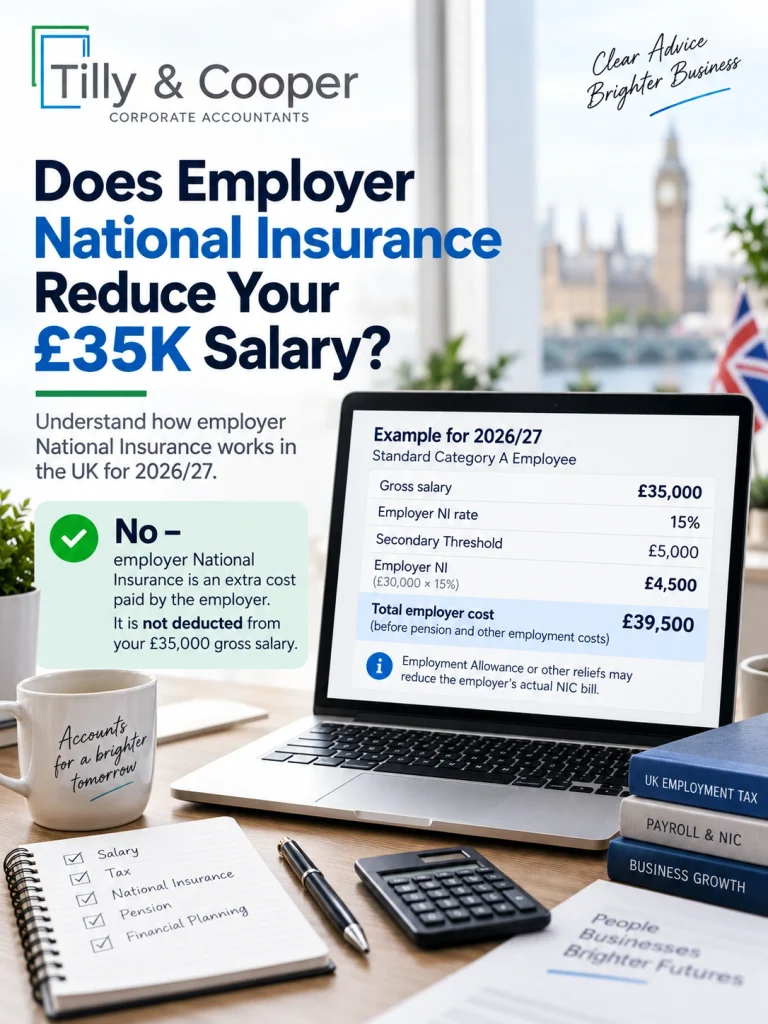
Employer National Insurance does not come out of your £35,000 contractual gross salary.It is an additional employment cost paid by the employer.For 2026/27, the standard employer National Insurance rate is 15%. The annual Secondary Threshold is £5,000.A standard Category A employee earning £35,000 can therefore create £4,500 of employer National Insurance.
The calculation is:
£35,000 − £5,000 = £30,000
£30,000 × 15% = £4,500
Special National Insurance categories can produce different results.Eligible employers may also reduce their overall liability through Employment Allowance.Employer National Insurance affects employment cost. It does not reduce the employee’s £28,719.60 standard net-pay estimate.
Which Other Payroll Deductions Can Reduce £35K Net Pay?
Several deductions can reduce £35k take-home pay beyond Income Tax and National Insurance.A workplace pension is one common example. Student and Postgraduate Loans can create another deduction. Salary sacrifice can reduce contractual cash earnings. Examples can include pension arrangements and qualifying workplace benefits. Court orders can also affect net pay. These include attachment of earnings orders and certain child maintenance deductions.
Some employees make charitable donations through Payroll Giving. Taxable benefits can affect Income Tax through payroll or a PAYE tax code.Company cars and private medical benefits are common examples.Not every deduction applies to every employee. Your payslip should identify amounts actually taken from your gross pay.
Can You Reduce Unnecessary Tax Deductions on £35K?
You can avoid unnecessary deductions by checking your tax code and claiming tax relief only where HMRC permits it. Start by checking your PAYE tax code against your circumstances. An incorrect code can produce too much or too little Income Tax. Eligible professional fees and subscriptions can qualify for employment expense tax relief. The membership must satisfy HMRC’s conditions. Employees can also claim qualifying business travel costs that their employer has not fully reimbursed.
HMRC allows tax relief for eligible business mileage. Ordinary commuting normally does not qualify. The approved mileage rate for cars and vans increased to 55p for the first 10,000 business miles from 6 April 2026. Working-from-home tax relief changed from 2026/27.
HMRC states that employees cannot claim this relief for the current 2026/27 tax year. Earlier eligible years can still remain claimable. Do not claim a tax expense simply because it relates loosely to your employment. HMRC conditions determine whether relief applies.
Is £35,000 Above or Below Average UK Full-Time Pay?
A £35,000 salary is below the latest published UK median annual earnings figure for full-time employees.ONS reported median gross annual earnings of £39,039 in April 2025. That figure covered full-time employees employed for at least one year. The ONS also reported median full-time weekly earnings of £766.60 in April 2025. A £35,000 salary equals approximately £673.08 gross per week.
However, a national median does not determine whether £35,000 meets your needs. Housing costs vary significantly between regions. Household size, childcare, transport, debts, and savings goals also affect affordability.
A person with low housing costs can retain more disposable income than someone with the same salary elsewhere. Compare net income with your actual monthly commitments, not gross salary alone.
What Should You Check When Reviewing a £35K Payslip?
Check your gross pay, tax code, Income Tax, National Insurance, pension, loans, and other deductions. Start with the gross-pay figure. Confirm it matches your contractual salary and any variable earnings. Next, check your PAYE tax code. A standard example often shows 1257L. Your correct code can differ because of your individual tax position. Review Income Tax and National Insurance separately. National Insurance should not simply match your Income Tax figure. Each deduction uses different rules and thresholds. Then check pension and student loan entries. Compare deductions with your pension scheme and student loan plan.
Finally, check your year-to-date totals. These figures help identify unexpected changes across several pay periods. Contact your payroll team when the gross pay or payroll deduction appears incorrect. Contact HMRC when the concern relates to your PAYE tax code or tax calculation.
What Is the Final £35K After-Tax Figure for 2026/27?
£35,000 after tax provides approximately £28,719.60 yearly or £2,393.30 monthly under standard 2026/27 assumptions.The calculation includes £4,486 of Income Tax and approximately £1,794.40 of employee National Insurance. It assumes tax code 1257L and one employment outside Scotland. Pension contributions, student loans, salary sacrifice, benefits, and different tax codes can change the result. Scottish Income Tax also produces a slightly different calculation. Use your actual payslip information when you need an exact personal figure.
Tilly & Cooper can help employees and businesses understand PAYE, payroll deductions, tax codes, and UK salary calculations.