

Statutory Accounting vs GAAP: What Are the Differences, Examples, and Financial Reporting Rules?
Financial reporting is not the same for every business. Different industries follow different accounting frameworks because they have different reporting objectives. Statutory Accounting and Generally Accepted Accounting Principles (GAAP) are two of the most important accounting frameworks in the United States, but they serve different purposes.
Statutory Accounting protects policyholders by measuring an insurance company’s financial strength and solvency, while GAAP provides investors, lenders, and other stakeholders with a fair and consistent view of a company’s financial performance. Although both frameworks produce financial statements, they recognise assets, liabilities, income, and expenses differently.
Insurance companies often prepare statutory financial statements for state regulators and GAAP financial statements for shareholders and creditors. Understanding these differences helps accountants, business owners, investors, and insurance professionals interpret financial reports accurately and maintain regulatory compliance.
This guide explains statutory accounting, GAAP, their major differences, practical examples, financial statements, admitted and non-admitted assets, and the role of the National Association of Insurance Commissioners (NAIC) and the Financial Accounting Standards Board (FASB) in developing accounting standards.
What Is Statutory Accounting and How Does It Work?
Statutory Accounting is a specialised accounting framework that insurance companies use to demonstrate financial solvency and protect policyholders. Unlike traditional financial reporting, statutory accounting focuses on whether an insurer has sufficient financial resources to pay present and future insurance claims. Profitability remains important, but policyholder protection always comes first.
In the United States, statutory accounting follows Statutory Accounting Principles (SAP) developed by the National Association of Insurance Commissioners (NAIC). Most state insurance regulators adopt these principles when supervising licensed insurance companies.
The NAIC publishes the Accounting Practices and Procedures Manual, which contains the Statements of Statutory Accounting Principles (SSAPs). These standards establish how insurers should recognise assets, liabilities, investments, premiums, reserves, and policyholder obligations. Statutory accounting follows a conservative approach because regulators must identify financial weakness before it threatens policyholders.
The main objectives of statutory accounting are:
- Protect policyholders
- Monitor insurer solvency
- Measure regulatory capital
- Support state insurance regulation
- Promote consistent financial reporting
Rather than asking, “How profitable is the company?”, statutory accounting asks:
“Can this insurer continue paying policyholder claims during normal operations and unexpected financial events?”
That single question shapes every accounting rule within the statutory framework.
What Is GAAP (Generally Accepted Accounting Principles) and How Does It Work?
GAAP is a comprehensive accounting framework that provides investors, lenders, regulators, and management with a consistent view of a company’s financial performance and financial position.GAAP stands for Generally Accepted Accounting Principles. It applies to most industries throughout the United States, including manufacturing, technology, healthcare, retail, construction, and financial services.
The Financial Accounting Standards Board (FASB) develops and updates GAAP through the Accounting Standards Codification (ASC), which serves as the primary source of authoritative accounting guidance in the United States. Unlike statutory accounting, GAAP focuses on presenting financial information that helps stakeholders make economic decisions.
Its objectives include:
- Improving financial transparency
- Increasing comparability between businesses
- Supporting investment decisions
- Providing consistent financial reporting
- Presenting economic performance fairly
GAAP contains accounting guidance for numerous topics, including:
- Revenue recognition
- Fair value measurement
- Lease accounting
- Inventory valuation
- Business combinations
- Financial instruments
- Income taxes
- Share-based payments
Public companies listed in the United States generally prepare GAAP financial statements for investors and file them with the U.S. Securities and Exchange Commission (SEC).
How Do Statutory Accounting and GAAP Compare?
There are six major differences between statutory accounting and GAAP: reporting objective, primary users, asset recognition, liability measurement, financial statement presentation, and regulatory focus.
Although both frameworks prepare financial statements, they answer different business questions. Statutory accounting asks whether an insurance company remains financially strong enough to protect policyholders.GAAP asks whether a company’s financial statements fairly represent its financial performance and position.
Statutory Accounting vs GAAP Comparison
| Feature | Statutory Accounting | GAAP |
| Primary objective | Protect policyholders | Inform investors and creditors |
| Standard setter | NAIC | FASB |
| Main users | Insurance regulators | Investors, lenders, management |
| Primary focus | Solvency | Profitability and financial performance |
| Asset treatment | Admitted and non-admitted assets | Assets recognised under GAAP standards |
| Capital measurement | Policyholders’ surplus | Shareholders’ equity |
One of the most significant differences involves asset recognition. Statutory accounting removes certain assets from regulatory capital because they cannot easily generate cash during financial distress.
GAAP recognises many of these assets because they continue providing economic benefits to the business. Another major difference involves accounting conservatism. Statutory accounting records potential financial risks earlier to strengthen policyholder protection.GAAP focuses on presenting financial information that reflects the company’s economic reality over a reporting period.
How Does Statutory Accounting Work in the Real World?
A statutory accounting example is excluding office furniture from admitted assets because it cannot be converted into cash quickly enough to pay insurance claims.
Consider an insurance company with the following assets.
| Asset | Value |
| Cash | $40 million |
| U.S. Treasury securities | $120 million |
| Corporate bonds | $55 million |
| Office furniture | $4 million |
| Prepaid advertising | $800,000 |
Under statutory accounting:
- Cash remains an admitted asset.
- Treasury securities remain admitted assets.
- High-quality corporate bonds generally remain admitted assets.
- Office furniture becomes a non-admitted asset.
- Prepaid advertising becomes a non-admitted asset.
Although office furniture still belongs to the insurer, regulators exclude it because selling desks and computers would not provide immediate funds during a large volume of insurance claims. This conservative approach prevents insurers from overstating their financial strength. Removing illiquid assets allows regulators to calculate policyholders’ surplus, which measures the financial cushion available after liabilities are deducted from admitted assets.
State regulators also review:
- Claims reserves
- Loss reserves
- Investment portfolios
- Risk-Based Capital (RBC)
- Liquidity
- Capital adequacy
Together, these measures help determine whether an insurer can continue meeting its contractual obligations.GAAP Explained with a Practical Example
What Is a Real-World Example of GAAP?
A GAAP example is recognising revenue as performance obligations are satisfied while reporting assets according to the FASB’s accounting standards. Imagine a software company sells an annual subscription for $1,200.Although the customer pays the full amount on the first day, GAAP does not recognise all the revenue immediately.
Instead, the company records $100 of revenue each month because it continues providing services throughout the twelve-month contract. This approach follows the revenue recognition principle contained in ASC 606, which requires revenue to reflect the transfer of promised goods or services.GAAP also recognises assets that continue generating future economic benefits.
Examples include:
- Property and equipment
- Inventory
- Accounts receivable
- Intangible assets
- Investments
- Deferred tax assets
Many assets appear on a GAAP balance sheet even though they would not qualify as admitted assets under statutory accounting. This difference explains why an insurance company often reports different asset values under each accounting framework.
How Are Financial Statements Prepared Under Statutory Accounting and GAAP?
Statutory accounting and GAAP prepare the same core financial statements, but they apply different recognition, measurement, and presentation rules.
Both frameworks generally prepare:
- Balance Sheet
- Income Statement
- Statement of Cash Flows
- Notes to the Financial Statements
Insurance companies also prepare an Annual Statement for regulators using statutory accounting requirements established by the NAIC. Although many report titles remain the same, the reported amounts often differ because each framework recognises assets, liabilities, expenses, investments, and reserves differently.
For example:
- Statutory accounting removes non-admitted assets.
- GAAP continues recognising qualifying assets.
- Statutory accounting often recognises expenses sooner.
- GAAP matches expenses with related revenue.
- Statutory accounting emphasises solvency.
- GAAP emphasises financial performance.
As a result, the same insurance company may produce two compliant financial statements with different reported equity and net income.
How Do Financial Statements Differ Under Statutory Accounting and GAAP?
Yes. Financial statements can change significantly because statutory accounting and GAAP measure financial performance using different accounting principles.
The largest differences usually appear in:
- Asset valuation
- Claims reserves
- Deferred acquisition costs (DAC)
- Deferred taxes
- Investment valuation
- Policyholders’ surplus
- Shareholders’ equity
- Expense recognition
These differences do not necessarily indicate accounting errors. Instead, they reflect the different objectives of each accounting framework.
Who Uses Statutory Accounting and GAAP?
Insurance companies primarily use statutory accounting, while most businesses in the United States use GAAP. Each framework serves different users because their reporting objectives differ.
Organisations that commonly use statutory accounting include:
- Property and casualty insurance companies
- Life insurance companies
- Health insurance companies
- State insurance regulators
- The National Association of Insurance Commissioners (NAIC)
These organisations use statutory financial statements to assess an insurer’s solvency, liquidity, and regulatory capital.
Organisations that commonly use GAAP include:
- Publicly traded companies
- Private businesses
- Banks
- Manufacturing companies
- Technology companies
- Healthcare organisations
- Retail businesses
GAAP financial statements help investors, lenders, analysts, and management evaluate profitability, financial position, and future growth. Although insurance companies must prepare statutory financial statements for regulatory purposes, many also prepare GAAP financial statements for shareholders, lenders, and external stakeholders. Preparing reports under both frameworks ensures the business meets regulatory obligations while providing transparent financial information to investors.
What Role Does the NAIC Play in Statutory Accounting Standards?

The National Association of Insurance Commissioners (NAIC) influences statutory accounting by developing accounting guidance that promotes consistent insurance regulation across the United States. The NAIC does not regulate insurance companies directly. Instead, it supports state insurance departments by developing model regulations and accounting standards. The NAIC’s Accounting Practices and Procedures Manual contains the Statements of Statutory Accounting Principles (SSAPs), which establish how insurers should:
- Recognise assets
- Measure liabilities
- Value investments
- Record insurance reserves
- Prepare statutory financial statements
The NAIC also establishes a SAP hierarchy, which helps insurers determine which accounting guidance takes precedence when multiple standards apply. In addition to accounting standards, the NAIC oversees important regulatory tools, including:
- Risk-Based Capital (RBC) requirements
- Annual Statement reporting
- Financial ratio analysis
- Solvency monitoring
- Insurance company examinations
These requirements help regulators identify financial weakness early and reduce the risk of insurer failure.
What Role Does the FASB Play in Establishing GAAP Standards?
The Financial Accounting Standards Board (FASB) influences GAAP by creating accounting standards that improve the quality and consistency of financial reporting. The FASB is an independent standard-setting organisation recognised by the SEC. Its standards are published within the Accounting Standards Codification (ASC), which serves as the authoritative source of U.S. GAAP.
The FASB regularly updates accounting guidance for topics such as:
- Revenue recognition (ASC 606)
- Fair value measurement (ASC 820)
- Lease accounting (ASC 842)
- Credit losses
- Business combinations
- Financial instruments
- Income taxes
These standards help businesses prepare comparable financial statements that investors and lenders can rely on when making financial decisions. Unlike statutory accounting, GAAP focuses on representing a company’s economic performance rather than its regulatory solvency.
Why Do Insurance Companies Use Statutory Accounting Rather Than GAAP?
Insurance companies use statutory accounting because regulators need to measure an insurer’s ability to pay policyholder claims, not simply its profitability. Insurance policies create long-term financial obligations. Some claims remain unpaid for many years after a policy is issued. For that reason, regulators require insurers to maintain sufficient liquid assets and capital to satisfy future claims.
Statutory accounting supports this objective by:
- Recognising insurance liabilities conservatively
- Excluding illiquid non-admitted assets
- Monitoring policyholders’ surplus
- Measuring capital adequacy
- Assessing Risk-Based Capital (RBC)
- Supporting regulatory supervision
For example, an insurer may report strong profits under GAAP while experiencing declining statutory surplus because some assets do not qualify as admitted assets. Regulators focus on statutory surplus because it better reflects the insurer’s capacity to meet policyholder obligations. This conservative approach helps protect consumers and promotes confidence in the insurance industry.
How Do Admitted Assets Differ from Non-Admitted Assets in Statutory Accounting?
Admitted assets are assets that regulators recognise when measuring an insurer’s financial strength, while non-admitted assets are excluded because they cannot readily support policyholder claims. Liquidity is the key difference between these asset categories.
Admitted Assets vs Non-Admitted Assets
| Asset Type | Admitted Assets | Non-Admitted Assets |
| Cash | ✔ | ✘ |
| U.S. Treasury securities | ✔ | ✘ |
| High-quality corporate bonds | ✔ | ✘ |
| Premium receivables | ✔ | ✘ |
| Office furniture | ✘ | ✔ |
| Prepaid expenses | ✘ | ✔ |
| Certain intangible assets | ✘ | ✔ |
| Overdue receivables | ✘ | ✔ |
Insurance regulators exclude non-admitted assets because they cannot normally be converted into cash quickly enough during periods of heavy claim activity.For example, office furniture may have resale value. However, selling desks and computers would not provide immediate liquidity after a natural disaster or other catastrophic event. Removing these assets produces a more conservative measure of an insurer’s financial strength.
Why Is Statutory Accounting More Conservative Than GAAP?
Statutory accounting is more conservative than GAAP because it prioritises solvency and policyholder protection over reported profitability.
The differences become clear when comparing key accounting treatments.
| Area | Statutory Accounting | GAAP |
| Primary objective | Protect policyholders | Present financial performance |
| Asset recognition | Removes non-admitted assets | Recognises qualifying assets |
| Expense recognition | Often accelerated | Matched with related revenue |
| Capital measure | Policyholders’ surplus | Shareholders’ equity |
| Regulatory focus | Solvency | Financial reporting |
This conservative approach reduces the likelihood that insurers overstate their financial strength.
GAAP, by comparison, aims to present a fair representation of business performance while maintaining consistency across industries.
What Are the Key Differences Between Statutory Accounting, GAAP, and IFRS?
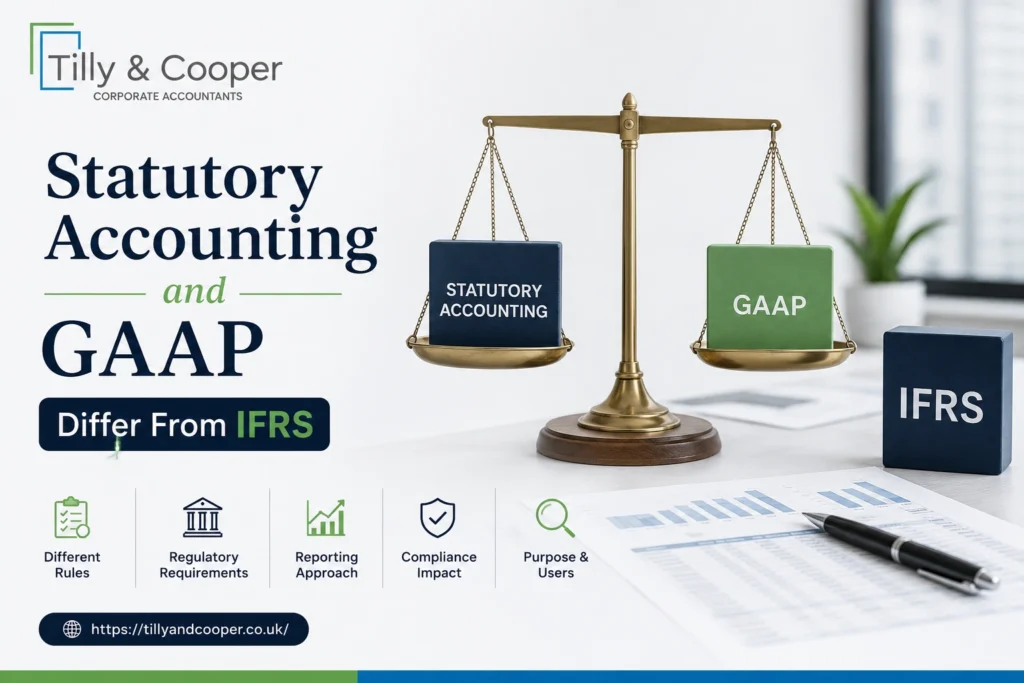
Statutory accounting, GAAP, and International Financial Reporting Standards (IFRS) differ because each framework serves a distinct reporting objective and is governed by a different body.
How Do Statutory Accounting, GAAP, and IFRS Compare?
| Framework | Primary Purpose | Standard Setter | Typical Users |
| Statutory Accounting | Insurance regulation and solvency | NAIC | Insurance companies |
| GAAP | U.S. financial reporting | FASB | U.S. businesses |
| IFRS | International financial reporting | IASB | Global organisations |
IFRS is issued by the International Accounting Standards Board (IASB) and is widely used outside the United States. Although GAAP and IFRS share many accounting principles, they differ in areas such as revenue recognition, lease accounting, impairment, and financial instrument reporting. Statutory accounting remains unique because it focuses specifically on protecting insurance policyholders rather than supporting investment decisions.
What Common Mistakes Should Businesses Avoid When Choosing Between Statutory Accounting and GAAP?
The most common mistake is applying the wrong accounting framework to the reporting objective. Businesses and finance professionals should understand the purpose of each framework before preparing financial statements.
Common mistakes include:
- Applying GAAP rules to statutory filings
- Misclassifying admitted and non-admitted assets
- Ignoring state insurance regulations
- Miscalculating policyholders’ surplus
- Incorrectly reporting deferred acquisition costs
- Overlooking Risk-Based Capital requirements
- Failing to reconcile GAAP and statutory financial statements
- Using outdated accounting guidance
Selecting the correct framework improves compliance, reporting accuracy, and financial transparency.
Can Professional Accounting Services Handle Both Statutory Accounting and GAAP?
Yes. Experienced accounting professionals can prepare financial statements under both statutory accounting and GAAP while ensuring compliance with applicable standards.
Professional accounting services often assist with:
- Financial statement preparation
- Regulatory reporting
- GAAP conversions
- Statutory reporting
- Audit support
- Accounting policy implementation
- Internal controls
- Compliance reviews
- Financial analysis
Businesses operating in regulated industries often benefit from accountants who understand both frameworks because they can identify reporting differences before financial statements are issued.
How Do Tax Services Support Statutory Accounting and GAAP Compliance?
Tax services support statutory accounting and GAAP by helping businesses manage tax reporting differences while maintaining accounting compliance.
Tax professionals commonly assist with:
- Deferred tax calculations
- Current tax provisions
- Corporate tax planning
- Federal tax compliance
- State tax reporting
- Tax reconciliations
- Accounting adjustments
- Regulatory reporting support
Insurance companies frequently report different taxable income, statutory income, and GAAP income because each framework recognises assets, liabilities, and expenses differently. Professional tax advisers help reconcile these differences while ensuring compliance with tax legislation and accounting standards.

