

How to Issue Shares in a UK Limited Company
To issue shares, check directors’ authority and existing shareholders’ rights. Agree the share class, quantity, and subscription price. Approve the allotment and update the register of members. File SH01 within one month of the allotment. Prepare the applicable share certificates within two months. Issuing shares can raise funding, attract investors, or support employee ownership. It can also reduce existing shareholders’ ownership percentages. Review voting rights, dividend entitlements and control before agreeing terms. This guide covers private companies limited by shares. Public companies face additional requirements for certain allotments.
What Steps Does a UK Share Issue Involve?
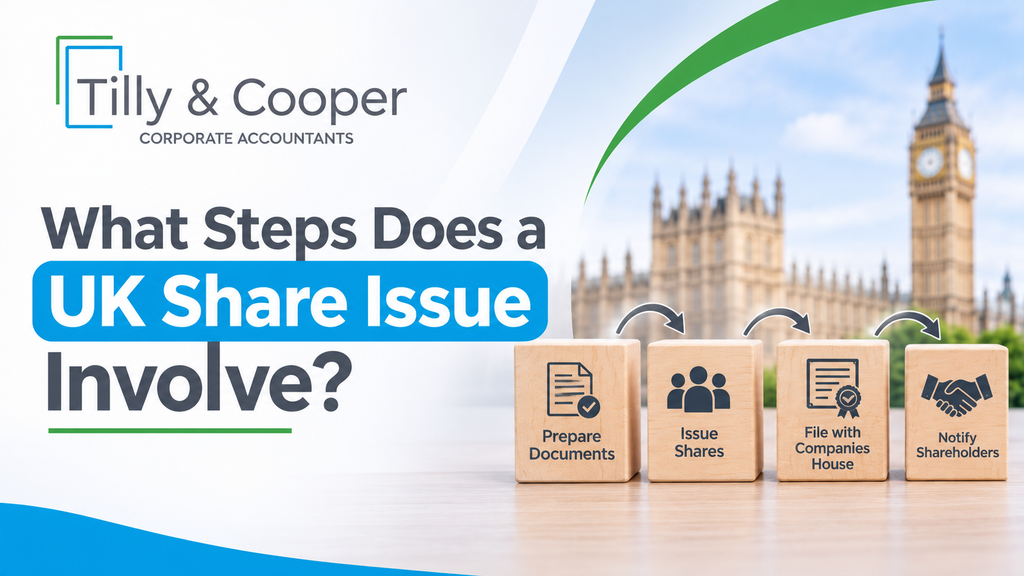
To issue shares, check the articles and directors’ allotment authority. Address existing shareholders’ pre-emption rights before agreeing the subscription terms. Confirm the investor, share class, quantity, price and payment conditions. The board then approves the allotment and records its effective date. Update the register of members, file SH01 and prepare share certificates. The table below identifies each step’s main document.
| Step | What the company does | Main document |
| 1. Check the constitution | Review the articles and any shareholders’ agreement. | Current company constitution |
| 2. Confirm directors’ authority | Check existing powers and obtain any required authorisation. | Articles or shareholder resolution |
| 3. Address pre-emption rights | Make the required offer or establish a valid alternative. | Offer documents, waivers or resolutions |
| 4. Agree subscription terms | Confirm the investor, rights, price, and payment conditions. | Subscription agreement or application |
| 5. Approve the allotment | Record the board decision and actual allotment date. | Board minutes or written board resolution |
| 6. Complete records and filings | Update the register, file SH01 and prepare certificates. | Company records and return of allotment |
Keep the approvals, subscription terms and payment evidence together. Check any conditions before deciding when allotment takes effect.
What Happens When a Company Issues New Shares?
The company creates additional shares for an investor or existing shareholder. A cash subscription brings money into the company. Each share carries the rights attached to its class. Those rights can cover votes, dividends, and capital distributions.
How Does Allotment Differ From the Issue of Shares?
Allotment gives someone an unconditional right to join the register. Section 558 defines this point for company law. Registration then establishes the holder’s membership. Track these stages when preparing the board records and filing timetable.
How Does Issuing Shares Differ From Selling Existing Shares?
| Transaction | Who receives the money? | Effect on the share count |
| Subscription for new shares | Company | Increases the number of issued shares |
| Purchase of existing shares | Selling shareholder | Leaves the issued share count unchanged |
An investor can subscribe, buy existing shares, or agree to both. Confirm the transaction before choosing its documents and reporting route.
What Should You Check Before Issuing Shares?

Check the articles, shareholders’ agreement and current shareholdings. Confirm the intended class, rights and subscription price. Calculate ownership and voting power after the proposed allotment. Check whether the investor wants director appointment rights or other protections. A company can issue ordinary, preference or alphabet shares. Redeemable shares require additional terms and statutory checks. Describe the rights before approving the issue. A class label alone provides little information about its entitlements.
Can Directors Allot Shares Without a New Shareholder Resolution?
Yes, where the directors already hold sufficient authority. Section 550 can cover a private company’s sole existing class. Check the articles for restrictions before relying on that power. Companies incorporated under earlier legislation may need transitional checks. Review previous shareholder resolutions alongside the incorporation date. Other allotments generally require authority under section 551. The articles or an ordinary shareholder resolution can provide it. The authority must state the maximum allotment amount. It must also specify an expiry date. That date generally falls within five years of authorisation.
What Pre-emption Rights Apply to a New Share Issue?
Pre-emption rights give existing shareholders priority over certain new allotments. Section 561 generally covers cash allotments of equity securities. These include ordinary shares and certain subscription or conversion rights. The statutory definition considers participation rights, rather than class labels alone. The company must normally offer eligible holders their proportion first. Use the same or more favourable terms. Section 562 generally requires at least 14 days for acceptance. Follow its delivery rules when calculating the acceptance period.
| Situation | What to establish before allotment |
| Statutory rights apply | Make the compliant offer and observe its acceptance period. |
| A statutory exception applies | Record the exception and why the allotment qualifies. |
| The articles exclude statutory rights | Check the exclusion’s wording and scope. |
| Shareholders disapply statutory rights | Use the applicable statutory procedure and required approval. |
| Contractual rights also apply | Address those rights under the shareholders’ agreement. |
Sections 569–571 provide different disapplication routes. The applicable route depends on the company and allotment authority. A special resolution can provide the required approval. Check contractual rights separately before finalising the allotment.
How Many Shares Should a New Company Issue?
A private company limited by shares can start with one share. Choose a count that suits the founders’ ownership split. Consider future investment before setting the initial structure. For example, 100 equal shares make percentages straightforward. A founder holding 60 owns 60% by share count. Another founder holding 40 owns 40%. Class terms determine their voting and payment rights.
How Do You Agree on the Subscription Price and Payment?
Agree on the number, class, and price before approving the allotment. Record who will subscribe and how they will pay. Specify any conditions that must precede allotment. A subscription agreement can document these terms. Each share has a fixed nominal value. The investor can pay a higher subscription price. The company generally records the excess as share premium. It cannot allot shares below nominal value.
Allotting 25 Shares to an Investor
This hypothetical company has 100 fully paid ordinary shares. Each share has £1 nominal value and identical rights. An investor subscribes for 25 new shares at £100 each. Assume the investor pays the full £2,500 before allotment.
| Item | Calculation | Result |
| Subscription proceeds | 25 × £100 | £2,500 |
| Increase in nominal share capital | 25 × £1 | £25 |
| Share premium | £2,500 − £25 | £2,475 |
| Total shares after allotment | 100 + 25 | 125 |
| Investor’s holding | 25 ÷ 125 | 20% |
| Existing shareholders’ combined holding | 100 ÷ 125 | 80% |
Existing holders keep their original number of shares. Their combined ownership falls from 100% to 80%. This reduction in ownership percentage is dilution.
What Must Directors Record When Approving the Allotment?

Record the authority, subscription terms, and pre-emption position. Identify the recipient, class, quantity, and actual allotment date. Keep any shareholder resolutions with the board records. Confirm that the company has met the applicable subscription conditions. For cash subscriptions, retain payment evidence. For non-cash consideration, retain the agreement and supporting valuation records. Record how much the company treats as paid.
What Extra Approvals Apply to a New Share Class?
Use an ordinary resolution if the articles allow it. Pass a special resolution if you need to amend the articles. If the proposal changes existing class rights, follow the applicable class consent procedure. Define the new class’s voting, dividend, capital and redemption rights. Article 22 of the model articles allows shareholders to set rights by ordinary resolution. That power remains subject to the articles and existing share rights. Before allotting shares, confirm the directors have authority under section 551.
What Must You File With Companies House?
| Event | What to file | Deadline |
| Shareholders pass a special resolution | Copy of the resolution | Within 15 days of passing it |
| Amended articles take effect | Copy of the amended articles | Within 15 days of taking effect |
| The company assigns or changes a class designation | Form SH08 | Within one month of the assignment or change |
| The company varies existing share rights | Form SH10 | Within one month of the variation |
Each filing deadline runs from its own event.
When Must You File Form SH01?
File SH01 within one calendar month of allotment. Section 555 sets the deadline. Count from when the investor acquires the unconditional registration right. The certificate date does not determine that deadline. Use SH01 for allotments after incorporation. Initial subscribers’ shares appear in the incorporation application. Companies House lists online SH01 filing with no fee. Professional preparation and advice may carry separate charges.
What Does SH01 Require?
SH01 requires company details, allotment dates, and information about new shares. State their class, quantity, currency, nominal value, and payment details. Describe any non-cash consideration the company receives. Include a statement of capital showing all shares after allotment. Explain each class’s voting, dividend, capital and redemption rights. An eligible filer must sign the form or authenticate the submission online.
| Information | What to prepare |
| Company identification | Registered name and company number |
| Allotment date | Actual allotment date or applicable date range |
| New shares | Class, currency, quantity and nominal value |
| Payment | Amount paid or unpaid, including premium where requested |
| Non-cash consideration | Description of what the company received |
| Statement of capital | The company’s entire issued capital after allotment |
| Prescribed particulars | Voting, dividend, capital and redemption rights |
| Authentication | Signature or online authentication from an eligible filer |
Use the current form and follow each field’s instructions. Keep the share descriptions consistent across the documents.
How Does the Worked Example Appear on SH01?
| Field | Example figure |
| New ordinary shares | 25 |
| Currency | GBP |
| Nominal value per new share | £1 |
| Amount paid per new share, including premium | £100 |
| Amount unpaid per new share | £0 |
| Total ordinary shares after allotment | 125 |
| Aggregate nominal value after allotment | £125 |
| Total amount unpaid after allotment | £0 |
The statement of capital summarises the entire issued share capital. Include all existing classes alongside the new allotment. For each class, describe the prescribed particulars accurately. Include voting rights that arise only in specified circumstances.
Which Records Need Updating After the Share Issue?
Update the register of members as soon as practicable. Section 554 sets an outer limit of two months. Prepare the applicable share certificates for delivery within two months. Section 769 generally sets the certificate deadline. Record the subscription proceeds and capital allocation in the accounts. Report relevant shareholder information through the confirmation statement. Check separately for changes in significant control.
Does the Confirmation Statement Replace SH01?
No. A confirmation statement does not replace Form SH01. A UK limited company uses SH01 to report a share allotment. File it with Companies House within one month of allotment. Include the company’s updated statement of capital. The confirmation statement (CS01) confirms your company details are current. Use it to update shareholder information and share capital where needed. File SH01 by its own deadline, even if CS01 is due sooner.
Frequently Asked Questions
A subscription for newly issued shares normally attracts no Stamp Duty. HMRC also excludes new issues from the usual SDRT charge. A separate purchase of existing shares follows different tax rules.
Submit the outstanding return promptly using the actual allotment date. Section 557 makes failure to deliver the return an offence. The company and officers in default can face fines. Check the remaining records for outstanding actions.
Get Help Issuing Shares in Your Limited Company
Send Tilly & Cooper your company number and current share structure. Tell us the proposed investor, quantity, class, and subscription price. Include your articles and any shareholders’ agreement. We can help prepare allotment documents and update company records.