
Company Registration Number UK: How to Find, Check and Use a CRN
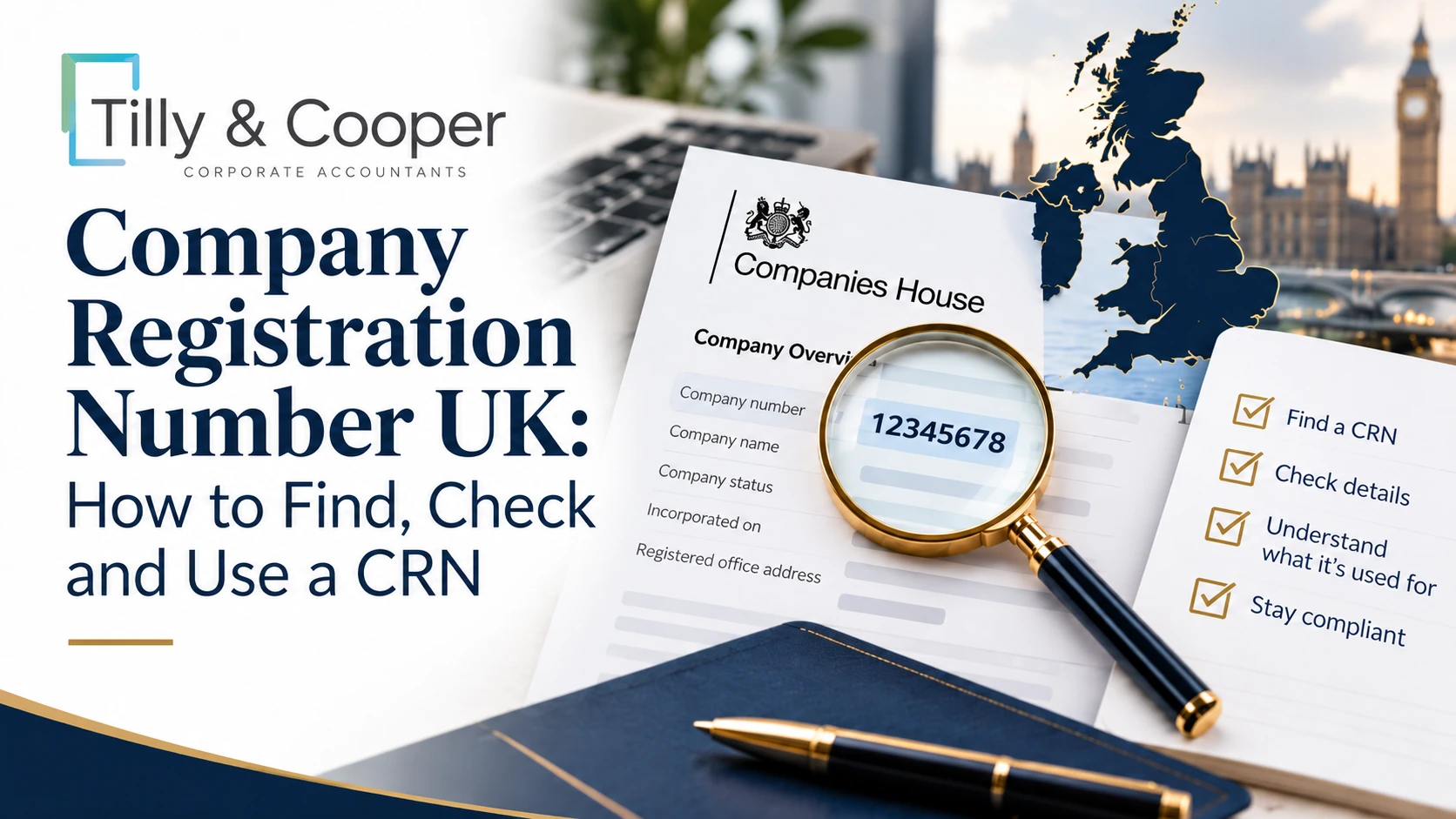
A Company Registration Number (CRN) is the unique identifier Companies House assigns to a UK company when it is incorporated. The number appears on the certificate of incorporation and identifies the company throughout its registered history.
Most UK company numbers contain eight characters. Companies registered in England and Wales commonly use eight digits, while Scottish and Northern Ireland companies use SC and NI prefixes. A company registration number does not change when a company appoints new directors, transfers shares, changes its name or moves its registered office.
What Are the Key Facts About a UK Company Registration Number?

A UK Company Registration Number (CRN) is a unique reference issued by Companies House when a company is incorporated. It remains the same throughout the company’s existence, even if its name changes. The number helps identify a business on official records, verify its registration details, and distinguish it from other companies. The table below outlines the key facts about CRNs.
| CRN attribute | Answer |
| Issuing authority | Companies House |
| When issued | Following successful incorporation |
| Typical length | Eight characters |
| England and Wales format | Eight digits |
| Scottish format | SC followed by six digits |
| Northern Ireland format | NI followed by six digits |
| Publicly searchable | Yes |
| Changes with company name | No |
| Same as Corporation Tax UTR | No |
| Found on | Certificate of incorporation and Companies House register |
A CRN identifies a registered legal entity. It does not establish that the company is trading, financially solvent or registered for VAT.
How Does Companies House Use a CRN to Identify a Limited Company?
Companies House uses the CRN to connect a company’s incorporation, officers, registered office and statutory filings to one public record.
The number has three important attributes:
- Uniqueness: Each registered entity has its own identifier.
- Continuity: The identifier normally remains unchanged throughout the company’s registered history.
- Traceability: The number connects filings and changes to the same legal entity.
For example, Greenfield Trading Limited may change its registered name to Greenfield Holdings Limited. Companies House records the name change, but the company’s CRN remains the same. The company registration number identifies the legal company, not its trading name or brand.
Which UK Organisations Receive Companies House Registration Numbers?
Companies House assigns registration numbers to limited companies, limited liability partnerships and other qualifying registered entities.However, not every registered organisation is legally a limited company.
| Entity type | Companies House identifier | Registration position |
| Private limited company | Company number | Assigned at incorporation |
| Public limited company | Company number | Assigned at incorporation |
| Company limited by guarantee | Company number | Assigned at incorporation |
| Limited liability partnership | LLP registration number | Uses its own registration category |
| Overseas company with UK registration | Overseas company number | Uses an entity-specific prefix |
| Sole trader | No Companies House CRN | Operates without company incorporation |
| Ordinary partnership | Generally no company CRN | Not incorporated as a limited company |
| Charitable company | Company number | Registered with Companies House |
| Charitable incorporated organisation | Charity registration identifier | Generally registered through the relevant charity regulator |
Why Do Sole Traders Not Have a Companies House Number?
A sole trader does not receive a CRN just by starting a business because they have not incorporated a separate limited company.
The trader may receive a personal Unique Taxpayer Reference from HMRC for Self Assessment.If the individual subsequently incorporates a limited company, that company receives its own CRN and Corporation Tax UTR.
What Does the Format of a UK Company Number Show?
A UK company number follows a particular format depending on where the business is registered and its legal structure. Companies registered in England and Wales usually have eight digits, while those in Scotland and Northern Ireland have a two-letter prefix. Limited liability partnerships (LLPs) also use different prefixes. The table below explains the most common formats and examples.
| Registration category | Typical format | Illustrative example |
| England and Wales company | Eight digits | 01234567 |
| Scottish company | SC + six digits | SC123456 |
| Northern Ireland company | NI + six digits | NI123456 |
| England and Wales LLP | OC + six digits | OC123456 |
| Scottish LLP | SO + six digits | SO123456 |
| Northern Ireland LLP | NC + six digits | NC123456 |
These are format examples, not verified company identifiers.
What Do SC, NI and OC Mean?
SC identifies a company registered in Scotland. NI identifies a company registered in Northern Ireland. OC identifies a limited liability partnership registered in England and Wales. These prefixes identify registration categories. They do not prove where an entity conducts its business activities.
Why Do Some CRNs Start With Zero?
Companies House may display leading zeroes to make an older numeric company number eight characters long.For example, a historic number represented as 12345 may be entered as 00012345. Copy the complete number exactly as Companies House displays it.
How Do You Obtain a Company Number When Registering a Business?

Companies House automatically issues a CRN when it accepts an application to incorporate a limited company. There is no separate application to obtain only a registration number.
Which Details Are Needed for Limited Company Incorporation?
Before registering a private limited company in the UK, you will need to gather a few important details about the business, its directors and shareholders. Companies House requires this information to complete the incorporation process and maintain accurate public records. You will also need a suitable registered office address, share structure, and governing documents. Preparing everything in advance can help avoid delays or rejected applications.
- Proposed company name.
- Appropriate UK registered office address.
- Registered email address.
- Director names and required personal information.
- Director identity-verification personal codes.
- Shareholder information and initial shareholdings.
- People with Significant Control (PSC) details.
- Statement of capital.
- Memorandum and articles of association.
The registered office must be in the same UK jurisdiction as the company’s registration. For example, a Scottish company must have a registered office in Scotland.
For assistance with incorporation documents and ongoing filings, see Tilly & Cooper’s company services.
How Do Directors and PSCs Verify Their Identity?
Directors must complete Companies House identity verification and provide the required personal codes for incorporation or appointment. Verification is available through the GOV website One Login or an Authorised Corporate Service Provider. Once verified, an individual receives an 11-character Companies House personal code. A person who is both a director and a PSC must provide the personal code separately for each role.
For a new director, the code is supplied through the incorporation or appointment filing. Existing directors generally provide it through the company’s confirmation statement. PSCs use the separate Provide identity verification details for a PSC service.
For an existing individual who is both a director and PSC, the PSC’s 14-day submission period normally begins the day after the company’s confirmation statement date. Other PSC categories follow different deadlines. The personal code belongs to the individual, not the company. It must not be confused with the CRN or the company’s authentication code.
What Are the Companies House Incorporation Fees in 2026?
As of October 2026, Companies House charges £100 for standard online incorporation, £124 for paper incorporation and £156 for eligible same-day software incorporation.
| Incorporation method | Statutory fee | Typical processing |
| Standard online | £100 | Usually within 24 hours |
| Paper form IN01 | £124 | Usually 8–10 days |
| Same-day software incorporation | £156 | Eligible applications submitted before the applicable deadline |
The same-day software service normally requires submission before 3 pm on a working day. These amounts are Companies House charges. Accountancy or formation-agent fees are separate.
Companies House issues the certificate of incorporation only after accepting the application. The certificate confirms the registered company number, incorporation date, and other prescribed details.
Where Can You Find and Verify a Company Registration Number?
You can find a UK company’s registration number (CRN) free of charge through the official Companies House website. The public register provides essential company details, including its registration number, registered office address, and current status. You can search using the company’s name and check the results to identify the correct business. The CRN also appears on several official company documents.
How Do You Search for a Company Number?
- Open the Companies House company information service.
- Enter the registered company name or known registration number.
- Select the matching company.
- Check its registered office, incorporation date, and company status.
- Copy the company number from its public profile.
Searching by name can produce several similar companies. Compare their records before using the number in a contract or statutory filing.
Which Documents Show the CRN?
The company number can appear on:
- Certificate of incorporation.
- Companies House filing history.
- Annual accounts.
- Confirmation statements.
- Companies House correspondence.
- Company websites and business letters.
- Order forms and commercial documents.
The certificate of incorporation and public Companies House record are the best sources for confirming the number.
When Does HMRC Issue a Corporation Tax UTR?
HMRC issues a ten-digit Corporation Tax Unique Taxpayer Reference (UTR) separately from the Companies House registration number. The CRN is issued at incorporation. HMRC usually sends the company’s UTR by post to its Companies House registered office after registration. The UTR normally arrives around 15 days after registration. GOV.UK advises requesting it online if it has not arrived within 15 working days.
The company uses the CRN to identify it with Companies House and its Corporation Tax UTR for tax administration. Companies can use their UTR when accessing Corporation Tax services, preparing returns and communicating with HMRC.
How Is a CRN Different From VAT, PAYE and Other Business References?
A UK company may have several reference numbers, each serving a different purpose. The Company Registration Number (CRN) identifies the business on the Companies House register, while HMRC issues separate references for Corporation Tax, VAT and PAYE. These numbers are not interchangeable, and businesses may not need all of them. The table below explains their main differences.
| Identifier | Issued by | Main purpose | Typical format |
| CRN | Companies House | Registered company identity | Eight characters |
| Corporation Tax UTR | HMRC | Corporation Tax administration | Ten digits |
| VAT registration number | HMRC | VAT registration | Usually nine digits |
| Employer PAYE reference | HMRC | Employer PAYE scheme | Tax-office number and employer reference |
| Accounts Office reference | HMRC | PAYE payment administration | 13 characters |
Does Every Limited Company Have a VAT Number?
No. Companies House incorporation does not automatically register the business for VAT. HMRC issues a VAT number only when the business is registered for VAT. A limited company can therefore have a CRN and Corporation Tax UTR without having a VAT registration number.
Where Must a Limited Company Display Its Registration Number?
A UK limited company must display its registered number, registered office address, registration jurisdiction and limited-company status on its business letters, order forms and websites.
The company must also display its registered name as required by the applicable trading disclosure rules. For a company registered in England and Wales, the website should identify that registration jurisdiction rather than simply describing its trading location.
Does Every Limited Company Invoice Need a CRN?
A limited company invoice must include the full registered company name and the other required invoice details.The company registration number, registered office address and registration jurisdiction are specifically required on business letters, order forms and websites. Where an invoice also functions as one of those documents, the corresponding disclosure requirements apply.VAT invoices must meet additional HMRC requirements, including relevant VAT registration information.
What Information Can You Check Using a Company Number?
A Company Registration Number (CRN) helps you find and check a company’s official details on the Companies House public register. By entering the number, you can view its legal status, registered address, directors and filing history. This information can help you confirm that you are dealing with the correct business. The table below shows what information is publicly available.
| Company record attribute | Information available |
| Company status | Active, dissolved or another recorded status |
| Incorporation date | Date the legal entity was registered |
| Registered office | Official registered address |
| Officers | Current and former registered directors |
| Filing history | Accounts, statements and company changes |
| PSC details | Registered significant control information |
| Previous names | Historical changes of registered name |
| Charges | Security interests registered against the company |
A company number confirms which legal entity the record concerns. It does not prove the company is profitable, solvent or creditworthy.
Tilly & Cooper’s annual accounts preparation service supports companies with their financial reporting and Companies House filing obligations.
Does a Company’s CRN Change After Its Registered Details Change?
No. The CRN normally stays the same after a company changes its name, directors, shareholders, or registered office. Companies House records the changes against the existing legal entity.
Does a Dormant Company Keep Its Registration Number?
Yes. Dormancy does not terminate incorporation. A dormant company retains its CRN and must continue meeting the statutory filing requirements that apply to it. These usually include annual accounts and a confirmation statement.
What Happens to a CRN After Dissolution or Restoration?
The CRN remains associated with the company’s historical public record after dissolution.If the company is later restored through the appropriate legal procedure, it returns with its original registration number. Restoration reinstates the existing company rather than incorporating a new entity.
Frequently Asked Questions
No. Each Companies House registration number identifies a particular registered entity. Similar company names do not mean the companies share an identifier.
Yes. The number appears on the public Companies House register, which can be searched without paying a basic search fee.
Yes. UK companies can have overseas directors and shareholders. The company must still satisfy incorporation, registered office and identity-verification requirements.
No. The CRN is a public company identifier. The authentication code is a confidential credential used for certain Companies House filings.
Yes. A newly incorporated or dormant company retains its CRN even when it has not started trading. Applicable filing obligations continue.
The number is issued when Companies House accepts incorporation. Standard online applications are usually processed within 24 hours; paper applications commonly take 8–10 days.
Get Professional Help With Company Registration and Compliance
Tilly & Cooper Corporate Accountants supports UK business owners with company incorporation, statutory accounts, confirmation statements and Corporation Tax compliance. Our team can help prepare company registration information, review director and shareholder details and identify the statutory filings required after incorporation. For existing limited companies, we assist with financial reporting and Companies House compliance. Need help registering a UK limited company or correcting its statutory records? Contact Tilly & Cooper to discuss your requirements, government charges, and professional service costs.

