

How to File a Confirmation Statement (CS01) in the UK
Every UK limited company must file a confirmation statement with Companies House at least once a year. This includes dormant and non-trading companies. Form CS01 confirms that Companies House holds accurate information about your company. It covers directors, shareholders, business activities, and other statutory details.
You must submit your confirmation statement within 14 days after your review period ends. Filing costs £50 online or £110 by post. Before submitting CS01, you must check your company information and complete the required director identity verification. This guide explains how to file a confirmation statement, calculate deadlines, update company details and avoid filing problems.
What Is a Confirmation Statement (CS01)?
A confirmation statement is a statutory filing that confirms your company’s registered information is accurate. Companies House uses Form CS01 to maintain the UK public company register. Under Section 853A of the Companies Act 2006, companies must deliver confirmation statements at least once every 12 months. You must file CS01 even when your company information has not changed.
The confirmation statement covers information such as:
- Registered office address
- Directors and company secretaries
- People with Significant Control (PSCs)
- Standard Industrial Classification (SIC) codes
- Shareholder information
- Statement of capital, where applicable
Some information requires separate updates before you submit CS01.
What Is the Difference Between CS01 and an Annual Return?
The confirmation statement replaced the annual return, Form AR01, on 30 June 2016. Both filings relate to company information held by Companies House. However, CS01 confirms existing information and reports certain permitted changes. The confirmation statement does not replace annual accounts or Corporation Tax returns.
| Filing | Main purpose | Filing frequency |
| CS01 | Confirms company information | At least annually |
| Annual accounts | Reports company financial information | Usually annually |
| Company Tax Return | Reports Corporation Tax information to HMRC | According to HMRC requirements |
| AR01 | Former annual return | Replaced in 2016 |
Companies must meet each applicable filing obligation separately.
Who Must File a Confirmation Statement?
Every registered UK limited company must file a confirmation statement, regardless of its trading status. The requirement applies to private limited companies, public limited companies and companies limited by guarantee. Community Interest Companies must also comply. Limited Liability Partnerships use their own confirmation statement process.
Do Dormant Companies Need to File CS01?
Yes. Dormant companies must file a confirmation statement every year. Companies House does not exempt a limited company because it has stopped trading. For example, a company may hold no assets and have no business transactions. It must still file CS01 while it remains registered. Dormant accounts and confirmation statements are separate filings.
When Is Your Confirmation Statement Due?
You must file your confirmation statement within 14 days after the review period ends. The normal review period lasts 12 months. Your first review period begins on the incorporation date. Later periods follow your previous confirmation date. Companies House displays your next confirmation statement deadline on the public register.
How Does the 12-Month Review Period Work?
The review period determines the information your confirmation statement must cover. For a new company, the first period begins on incorporation. For existing companies, the next period usually begins the day after the previous confirmation date.
Example: First confirmation statement
Suppose Companies House incorporates a company on 1 October 2025.
| Event | Date |
| Incorporation | 1 October 2025 |
| First review period begins | 1 October 2025 |
| Review period ends | 30 September 2026 |
| CS01 filing deadline | 14 October 2026 |
The company must submit its first CS01 by 14 October 202 6. This example assumes the company has not filed an early confirmation statement. Always check your actual filing deadline on Companies House.
Can You File a Confirmation Statement Early?
Yes. Companies House allows early confirmation statement filing. However, filing early changes your future review period.For example, a company may have a confirmation date of 30 September 2026. If it chooses an earlier confirmation date of 31 July 2026, the next review period begins on 1 August 2026. Its next normal confirmation date becomes 31 July 2027. The annual fee payment period does not change.
How Can You Check Your CS01 Deadline?
Open the Companies House company information service. Search for your company using its registered name or company number. The company overview displays the next confirmation statement date and filing deadline. You can also register for Companies House email reminders.
What Information Must You Check Before Filing CS01?
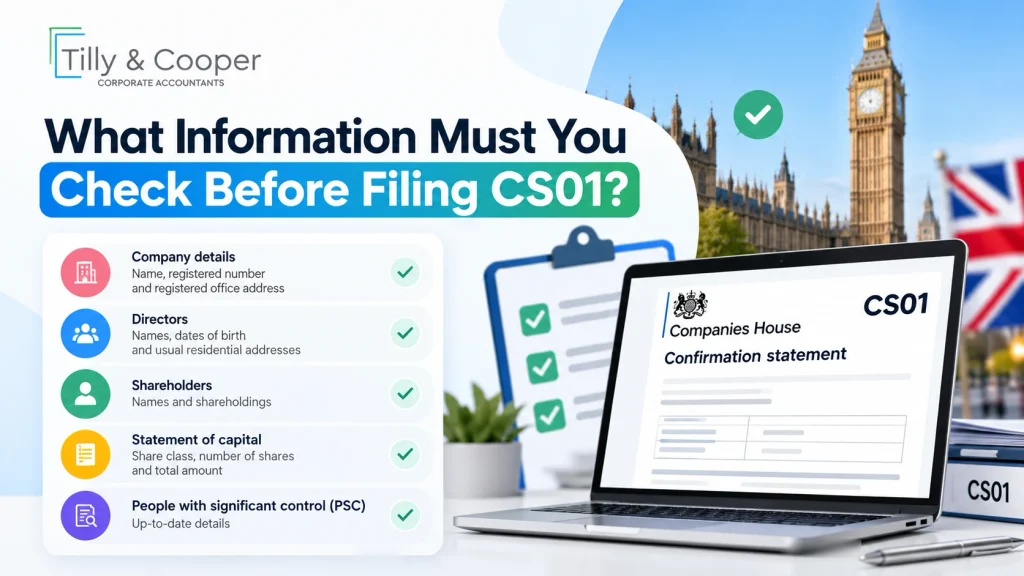
Before filing a confirmation statement, review the company details held by Companies House. Do not assume your records are correct because the previous CS01 was accepted. Check six important areas.
1. Registered Office Address
The registered office must be an appropriate address within the company’s UK jurisdiction. It must be possible for documents sent there to reach someone acting for the company. If the address has changed, submit Form AD01 before filing CS01. You cannot update the registered office address through the confirmation statement itself.
2. Directors and Company Secretaries
Check that Companies House lists the correct directors and secretary, where applicable. Report appointments, resignations and changes through separate filings.
| Company change | Relevant form |
| Appoint an individual director | AP01 |
| Appoint an individual secretary | AP03 |
| Change an individual director’s details | CH01 |
| Change an individual secretary’s details | CH03 |
| Terminate a director appointment | TM01 |
| Terminate a secretary appointment | TM02 |
For example, if a director resigned in August, submit TM01.Do not wait until the next confirmation statement to report the change.
3. People with Significant Control (PSC)
A PSC is someone who meets the legal conditions for significant company ownership or control. This often includes holding more than 25% of shares or voting rights. Other statutory conditions can also create PSC status. Check the company’s PSC information on the public register. Report changes through the appropriate Companies House process.
4. Standard Industrial Classification (SIC) Codes
SIC codes identify your company’s principal business activities. For example, SIC code 69201 covers accounting and auditing activities. If your company changes its main activity, review the registered SIC codes. You can update SIC codes through the confirmation statement process.
5. Statement of Capital
A company limited by shares must check its issued share capital information. This includes share classes, issued shares and relevant capital details. If the company issues new shares, it must meet the separate share allotment reporting requirements.
For example, Form SH01 normally reports an allotment of shares. Updating the statement of capital through CS01 does not replace SH01.
6. Shareholder Information
Check the company’s shareholder information. Review shareholdings and any relevant changes during the confirmation period. You can report permitted shareholder information changes through CS01. Make sure the information corresponds with the company’s statutory records.
What Are the Companies House Identity Verification Requirements?
The Economic Crime and Corporate Transparency Act 2023 introduced mandatory identity verification for company directors and other specified individuals.Mandatory verification began on 18 November 2025. Existing directors must provide their Companies House personal codes through the relevant confirmation statement process. New directors must provide the required verification information when appointed. Companies House may prevent a CS01 submission until the directors’ verification requirements have been met.
How Do Directors Verify Their Identity?
DirectorsDirectors can verify their identity for free through GOV.UK One Login or through an Authorised Corporate Service Provider (ACSP). An ACSP, such as an authorised accountant or solicitor, may charge a fee. The required documents depend on the verification route.
After verification, each director receives a Companies House personal code. Existing directors must provide this code with their company’s next confirmation statement. New directors provide it when incorporating a company or filing their appointment. can verify their identity for free through GOV.UK One Login or through an Authorised Corporate Service Provider (ACSP).
What Is a Companies House Personal Code?
The Companies House personal code is an 11-character identifier. It confirms that an individual has completed identity verification. A person usually needs to verify their identity only once.
For example, a director who manages three companies can use the same personal code for each directorshi p. However, the director must connect their verified identity to every relevant company role.
Personal code versus authentication code
| Feature | Personal code | Authentication code |
| Identifies | An individual | A company |
| Length | 11 characters | 6 characters |
| Purpose | Confirms verified identity | Authorises company filings |
| Used for | Director and PSC verification requirements | Companies House online submissions |
Do not confuse these codes.
Your company’s authentication code cannot replace a director’s personal code.
Do People with Significant Control Need Identity Verification?
Yes. PSCs must verify their identities and provide their personal codes. However, their deadlines depend on their roles and registration dates. A PSC who is also a director must provide the personal code separately for both roles.
For existing director-PSCs, the PSC submission window generally starts the day after the company’s confirmation date. A PSC who is not a director generally provides their personal code during the first 14 days of their birth month. A person becoming a PSC after 18 November 2025 must provide the code when registered or within 14 days. Existing director-PSCs follow a window linked to the company’s confirmation date.
What Is the Lawful Purpose Declaration?
Companies must confirm that their intended future activities are lawful. This declaration forms part of the confirmation statement process. It applies to trading and dormant companies.
Why Is a Registered Email Address Required?
Companies House requires every UK limited company to maintain a registered email address under the Economic Crime and Corporate Transparency Act 2023. The email address allows Companies House to send important notices, compliance updates, and company-related correspondence. It also helps directors receive information about their statutory filing obligations. Companies must provide an active email address that someone acting on their behalf regularly checks. Companies House does not publish this address on the public register.
If a company has not previously registered an email address, it must provide one when filing Form CS01.To change an existing registered email address, use Form EM01 or the relevant online service. CS01 cannot replace an email address already registered with Companies House.
How to File a Confirmation Statement Online: Step-by-Step
You can file a confirmation statement through Companies House’s online services. However, not every company can use the same online service. Choose the correct filing route before starting.
Step 1: Choose the Correct Companies House Filing Service
Companies House provides a dedicated confirmation statement service for eligible private companies limited by shares.
This service has specific eligibility conditions.
| Company condition | Dedicated confirmation statement service |
| Private company limited by shares | Eligible company type |
| One shareholder | Required |
| Between one and five officers | Required |
| Five or fewer PSCs | Required |
| Director personal codes already provided | Required |
| Company information needs updating | Updates must be completed separately |
Companies that do not meet these conditions should use WebFiling.For example, a private company with three shareholders cannot use the dedicated service. It must use WebFiling.The dedicated service cannot update company information. Correct relevant records before submitting.
Step 2: Prepare Your Filing Information
Before signing in, prepare your company number and authentication code. You will also need access to the relevant Companies House account. Check that each director has provided the required personal code. Review the company information shown on the public register. Correct any outstanding changes that require separate filings.
Step 3: Sign In and Review Company Details
Open the appropriate Companies House filing service. Sign in using the required account credentials. Enter your company number and authentication code when requeste d.Review the company’s confirmation date and recorded information. Check the registered office, directors, PSCs, SIC codes, share capital, and shareholders. If a correction requires a separate form, complete that filing first.
Step 4: Complete the Required Declarations
Confirm that the company information is accurate. Provide any required director identity verification information not already recorded. Supply the registered email address if necessary. Confirm that the company’s intended future activities are lawful. Review every answer before submission.
Step 5: Pay the Companies House Fee
The online filing fee is £50. This is the statutory annual charge for the first confirmation statement within the payment period. The dedicated service accepts payment by debit or credit card. An accountant or agent may charge a separate professional fee.
Step 6: Submit CS01 and Check Acceptance
Submit the confirmation statement through the selected service. Keep your acknowledgement and payment reference. Check the submission status. After Companies House accepts the filing, review the company’s filing history. The register should show the new confirmation statement entry. Do not treat a submitted but rejected filing as complete.
Which Company Details Can You Update Using CS01?
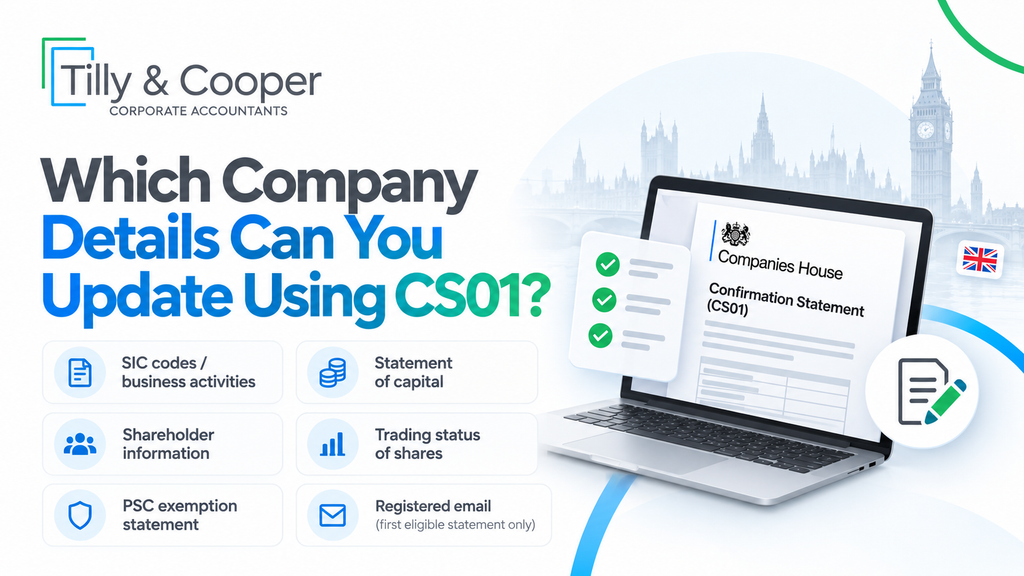
Form CS01 allows certain changes, but other updates require separate filings.
| Company information | Update through CS01? | Correct approach |
| SIC codes | Yes | Update with confirmation statement |
| Statement of capital | Yes | Complete relevant CS01 details |
| Shareholder information | Yes | Report applicable changes |
| Trading status of shares | Yes | Complete relevant CS01 section |
| Relevant PSC reporting exemption | Yes | Use relevant CS01 section |
| Registered office address | No | File AD01 |
| Director appointment | No | File AP01 where applicable |
| Director resignation | No | File TM01 |
| Director personal details | No | File CH01 |
| New share allotment | No | File SH01 where applicable |
| PSC personal details or control changes | No | Use the relevant PSC update process |
Example
A company appoints a new director and changes its business activity. The company must submit the director appointment through the appropriate form. It can then report the updated SIC code through its confirmation statement. If using the dedicated filing service, update the SIC code separately beforehand. This distinction helps prevent rejected or inaccurate filings.
How Much Does a Confirmation Statement Cost?
Companies House charges £50 to file a confirmation statement online. Paper filing costs £110. These fees took effect on 1 February 2026.
| Filing method | Statutory fee | Difference |
| Online CS01 | £50 | — |
| Paper CS01 | £110 | £60 more |
| Agent filing | £50 online statutory fee | Professional fee may apply separately |
Companies House charges the annual fee with the first confirmation statement in the relevant 12-month payment period.
What Is the Difference Between a Review Period and a Payment Period?
The review period determines when you must file CS01. The payment period determines when the annual fee becomes payable. Both normally cover 12 months, but they serve different purposes.
| Feature | Review period | Payment period |
| Purpose | Sets confirmation statement timing | Sets annual fee timing |
| Duration | Normally 12 months | 12 months |
| Can early filing change it? | Yes | No |
| Determines | Filing deadline | When another annual fee is due |
Do You Pay for Every Confirmation Statement?
No. Companies House charges the annual fee once during the relevant 12-month payment period . You can file additional confirmation statements without paying another annual fee during that period.
Example
Assume a company’s existing 12-month payment period runs from 1 January to 31 December 2026. These dates are illustrative. Each company’s payment period depends on its filing history.
| Filing date | Fee payable | Reason |
| 15 March 2026 | £50 | First online filing in payment period |
| 20 September 2026 | £0 | Additional filing during same payment period |
| 15 January 2027 | £50 | First online filing in new payment period |
The dates and online filing assumptions are illustrative. The payment period cannot be changed by filing early.
What Happens If You File a Confirmation Statement Late?
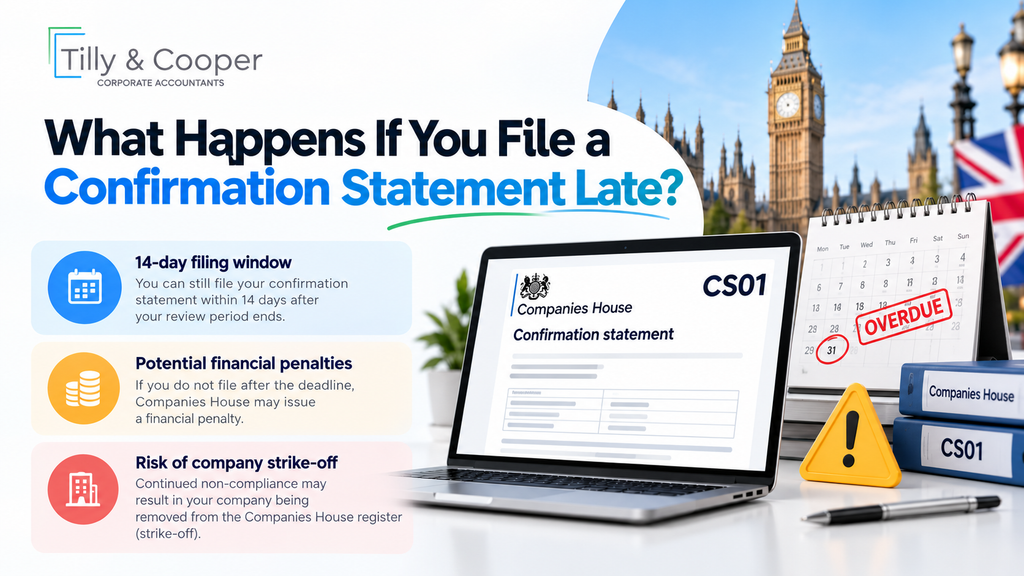
Companies House can take enforcement action if a company misses its CS01 deadline. Consequences may include financial penalties, prosecution and company strike-off.
Is Late Confirmation Statement Filing a Criminal Offence?
Failure to deliver a confirmation statement within 14 days after the review period is a criminal offence under Section 853L of the Companies Act 2006. The company and officers in default may face prosecution. Companies House may also issue financial penalties or begin strike-off proceedings. Companies House guidance states that fines can reach £5,000. Companies House may also issue a financial penalty. The company and responsible officers may face enforcement action under the applicable rules.
Can Companies House Strike Off a Company for Not Filing CS01?
Yes. Continued failure to file can lead to compulsory strike-off proceedings. The Registrar may begin the statutory strike-off process. Relevant notices can appear in The Gazette. If the company is dissolved, its bank accounts may be frozen. Certain company property may also pass to the Crown as bona vacantia.
How Do You File an Overdue Confirmation Statement?
First, check the company’s outstanding filing position. Confirm the correct historical confirmation date. Review the company records and identity verification requirements. Then submit the outstanding statement through the appropriate Companies House filing route.
If Companies House has started strike-off proceedings, check the company’s current status. Submitting an overdue CS01 does not automatically cancel every penalty or enforcement consequence.
How Do Filing Requirements Differ by Company Type?
Most UK registered companies must submit an annual confirmation statement. However, the required information and forms depend on the legal structure.
| Business structure | Form | Important distinction |
| Private limited company | CS01 | May include share capital and shareholders |
| Public limited company | CS01 | Must report applicable public company information |
| Company limited by guarantee | CS01 | Generally has no share capital |
| Dormant limited company | CS01 | Still files annually |
| Community Interest Company | CS01 | CIC annual report remains separate |
| Limited Liability Partnership | LL CS01 | Reports LLP information instead of company share capital |
| Scottish Limited Partnership | SLP CS01 | Uses its partnership-specific form |
Check the relevant form instructions if your organisation is not a standard private limited company.
How Do You File CS01 During Company Restoration?
A dissolved company may need outstanding confirmation statements before Companies House can restore it. Administrative restoration requires outstanding filings with RT01; court restoration follows the court-order procedure.
Is CS01 Required for Administrative Restoration?
Administrative restoration normally requires the company to deliver outstanding statutory documents. These can include accounts and confirmation statements. The application also uses Form RT01. The Companies House administrative restoration application fee is £341. This fee is separate from outstanding CS01 filing fees and other restoration costs.
How Do You Complete CS01 for a Dissolved Company?
To complete Form CS01 for a dissolved company, you must use the paper confirmation statement form and submit it to Companies House as part of the company restoration process. You cannot file the CS01 online while the company remains dissolved.
Follow these steps:
- Check the company records. Find the company’s registration number, last confirmation statement, and outstanding filing dates on the Companies House register.
- Download Form CS01. Use the latest paper form
- Enter the company details. Provide the registered company name and number.
- Use the correct confirmation date. Enter the outstanding confirmation date due before the company was struck off. Do not automatically use the current date.
- Check company information. Review the SIC code, share capital, shareholders, and other required details. Complete the relevant continuation pages when necessary.
- Complete the required declarations. Confirm the company’s lawful purpose and provide the required director identity verification details.
- Prepare outstanding statements. Complete any additional CS01 forms required to bring the company’s filing record up to date.
- Submit the restoration documents. Include the completed CS01 forms, applicable filing fees, Form RT01, outstanding accounts and other required restoration documents.
How Much Does CS01 Cost for a Dissolved Company?
The current Companies House paper CS01 filing fee is £110 per chargeable annual payment period. The administrative restoration application fee is £341. Other restoration expenses may apply. Companies House requires the paper CS01 form during restoration, even though online filing is normally available for active companies
Yes. You must file a confirmation statement (CS01) with Companies House at least once every 12 months, even if your company details remain unchanged. This requirement also applies to dormant and non-trading companies.
You generally need your company’s six-character authentication code to file CS01 online. If you have lost it, request a reminder through Companies House. You can also use the paper filing method without an online authentication code.
Yes. Companies House can reject a confirmation statement containing incorrect information, missing details or incomplete declarations. Unmet director identity verification requirements can also prevent filing. Correct the issues and resubmit CS01 before the deadline.
No. You cannot change your company’s registered office address through Form CS01. Submit Form AD01 or use the Companies House online address update service. Complete the address change before filing your confirmation statement.
No. Form CS01 confirms your company’s registered information, while annual accounts report its financial position and performance. Companies must file both documents separately. Dormant companies must also meet their applicable accounts and confirmation statement requirements.
Yes. You can file multiple confirmation statements within 12 months. Companies House charges £50 online or £110 by post for the first filing in each 12-month payment period. Additional confirmation statements within that payment period do not incur another annual filing fee.
Conclusion
You must file a confirmation statement with Companies House at least once every 12 months. Before submitting CS01, check your company details, filing deadline and director identity verification requirements. Use the correct online filing service and complete any necessary company updates first.Online filing costs £50. Paper filing costs £110. Meeting the filing deadline helps your company comply with the Companies Act 2006 and reduces enforcement risks.
Need help filing your CS01 confirmation statement? Contact Tilly & Cooper at enquiries@tillyandcooper.co.uk for help checking your company details and submitting your filing.

