

Restoring a Dissolved Company UK | Costs, RT01 & Timescales
Companies House can remove a company from the register for several reasons. Some business owners close their companies voluntarily because they no longer need them, while Companies House strikes off others when they miss statutory filing obligations such as annual accounts or confirmation statements.
Once Companies House dissolves a company, the company no longer exists as a legal entity.It cannot trade, hold assets, enter into contracts, issue invoices, recover company funds, or take legal action in its own name. In many cases, the only way to regain control of the company and its assets is by restoring the dissolved company to the Companies House register.
Restoring a dissolved company can be possible through administrative restoration or court restoration, depending on how the company was dissolved and whether it meets the legal requirements. This guide explains the company restoration process in the UK, including the documents required, Companies House fees, Bona Vacantia issues, late filing penalties, expected timescales, and director responsibilities after reinstatement.
What Does Dissolving a Company Mean?
Companies House removes a company from its register when it dissolves. Once dissolution takes effect, the company ceases to exist as a separate legal entity under the Companies Act 2006.
This means the company cannot:
- Continue trading
- Enter into new contracts
- Own or sell assets
- Issue invoices
- Receive payments in its own name
- Employ staff
- Start or defend legal proceedings
- Use its company bank account
Before dissolving a company, Companies House usually publishes a notice in the Gazette. This allows directors, shareholders, creditors, and other interested parties to object before Companies House removes the company from the register.If the company owned assets at the date of dissolution, those assets may pass to the Crown under the Bona Vacantia rules. This can include money in bank accounts, property, land, shares, intellectual property or other company-owned assets.
Dissolved Company vs Struck Off Company: What Is the Difference?
People often use the terms struck off and dissolved together, but they do not mean the same thing. Companies House strikes off a company when it removes the company, or starts the process of removing it, from the Companies House register. The strike-off process normally starts when Companies House publishes a Gazette notice. A company becomes dissolved once Companies House has removed it from the register. At that point, the company no longer legally exists.
In simple terms:
| Struck Off Company | Dissolved Company |
| The removal process has started | The company has already been removed |
| A Gazette notice may have been published | The company no longer exists legally |
| Strike off may still be stopped | Restoration is required |
| Directors may still be able to act quickly | Directors lose authority after dissolution |
If your company has only received a strike-off notice, you may still be able to stop the process by filing overdue documents, paying outstanding fees or objecting to the strike-off. You must follow the legal company restoration process to restore the company to the register once it has been dissolved.
Can a Dissolved Company Be Restored?
Yes, you can often restore a dissolved company, but the correct route depends on the circumstances.
There are two main ways to restore a dissolved company in the UK:
- Administrative restoration
- Court restoration by court order
Administrative restoration is usually the simpler and faster route, but it is only available in specific cases. If the company does not qualify, a court may require an order.
The restoration route depends on:
- How did the company dissolve?
- Did Companies House strike off the company, or did the directors close it voluntarily
- Who is applying for restoration
- Whether the application is within the relevant time limit
- Whether the company was trading at the time of dissolution
- Whether any company assets passed to the Crown
- Whether there are legal claims, creditor issues or HMRC matters
Professional advice is useful because choosing the wrong route can delay the application and increase costs.
Administrative Restoration vs Court Restoration
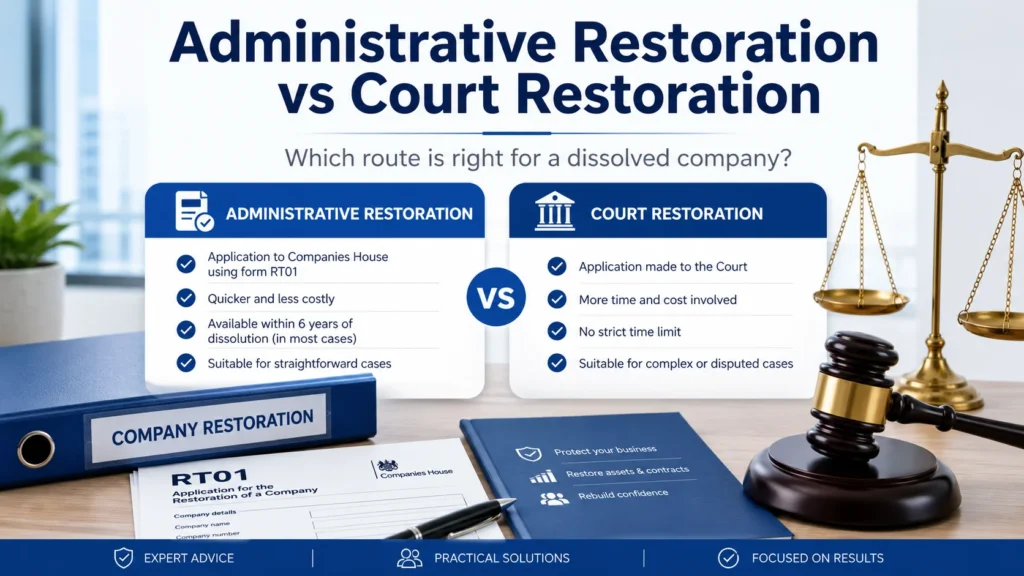
Administrative Restoration
You can use administrative restoration when the Registrar of Companies struck off the company and Companies House dissolved it. Companies usually use this process when Companies House removed them for failing to file accounts, confirmation statements, or other statutory documents.
Administrative restoration may be available if:
- The applicant was a director or shareholder of the company
- The Registrar of Companies struck the company off.
- The company dissolved within the last 6 years.
- The company was carrying on business or trading at the time of dissolution.
- You can bring all overdue Companies House documents up to date.
- You can pay any required fees and late filing penalties.
- You can obtain any required Bona Vacantia waiver letter.
This route uses form RT01 and does not normally require court proceedings.
Court Restoration
You need court restoration when administrative restoration is not available. This commonly applies where:
- The directors voluntarily dissolved the company.
- The applicant is not eligible for administrative restoration
- The company was not trading at the time of dissolution
- The case involves more complex legal issues.
- A creditor, former shareholder or another interested party wants the company restored
- The company needs restoration for litigation, asset recovery, or other legal reasons.
Court restoration usually takes longer and may involve solicitor support, court documents and a formal court order.
Step-by-Step Process to Restore a Dissolved Company
The company restoration process depends on whether administrative restoration or court restoration applies. However, the general steps are usually as follows:
- Check the company record at Companies House
Review the company status, dissolution date, filing history, overdue accounts, missing confirmation statements and reason for strike-off. - Confirm the correct restoration route
Decide whether the company qualifies for administrative restoration or whether a court order is required. - Prepare overdue annual accounts
Any outstanding accounts that should have been filed before dissolution normally need to be prepared and submitted. - Prepare overdue confirmation statements
Missing confirmation statements must usually be completed, with the correct filing fees paid. - Check Corporation Tax and HMRC requirements
HMRC may require outstanding Corporation Tax returns, tax payments or correspondence to be resolved. - Review Bona Vacantia issues
If the company had assets when it was dissolved, you may need a Bona Vacantia waiver letter or further consent from the relevant Crown representative. - Complete the restoration application
For administrative restoration, this is normally form RT01. For court restoration, court documents and supporting evidence will be required. - Pay the required fees and penalties
This may include the RT01 fee, confirmation statement fees, late filing penalties, court fees, professional fees and HMRC liabilities. - Submit the application
Send the complete restoration package to Companies House or follow the court process where applicable. - Wait for approval and restoration
Once approved, Companies House restores the company to the register and updates its status.
After restoration, the company is treated as though it had continued in existence, subject to any court order or legal restrictions that may apply.
What Documents Are Needed to Restore a Dissolved Company?
The exact documents depend on the company’s history and the restoration route, but most applications require careful preparation.
Common documents include:
- Completed RT01 form for administrative restoration
- Overdue annual accounts
- Outstanding confirmation statements
- Confirmation statement filing fees
- Companies House application fee
- Late filing penalty payments, where applicable
- Bona Vacantia waiver letter, if required
- HMRC Corporation Tax filings, where requested
- Supporting identity or applicant information
- Court order and legal documents, where court restoration applies
For administrative restoration, Companies House normally expects all outstanding company documents to be submitted with the application. If anything is missing, the application may be rejected or delayed.
What Is Form RT01?
Form RT01 is the official Companies House form used to apply for administrative restoration of a dissolved company.
It is used when an eligible former director or shareholder wants to restore a company without going through the court process.
The RT01 form usually includes:
- Company name
- Company number
- Date of dissolution
- Applicant details
- Confirmation of eligibility
- Details of outstanding filings
- Declaration by the applicant
The current Companies House administrative restoration fee is £341. This fee should be checked before submission because government fees can change.A completed RT01 form should normally be submitted with all overdue accounts, confirmation statements, filing fees, late filing penalties and any required Bona Vacantia waiver letter.
How Much Does It Cost to Restore a Dissolved Company?
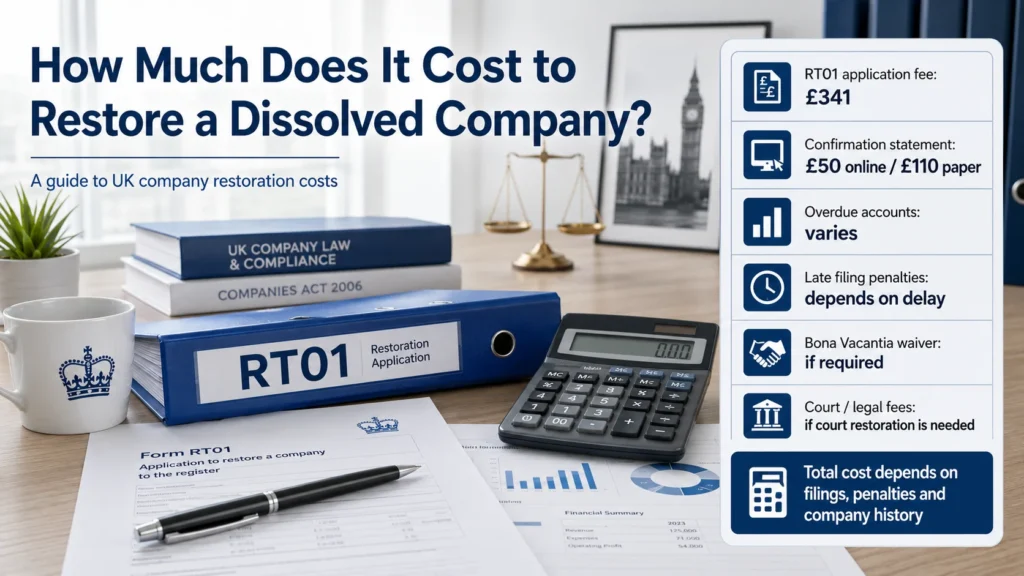
The cost of restoring a dissolved company depends on the route used and the company’s compliance history.
Typical restoration costs may include:
| Cost Type | Typical Requirement |
| RT01 administrative restoration fee | £341 |
| Confirmation statement fee | £50 online/software or £110 paper |
| Overdue annual accounts | Depends on number of years and complexity |
| Late filing penalties | Depends on how late the accounts were |
| Bona Vacantia waiver letter | Depends on authority and case |
| Court fees | Required for court restoration |
| Solicitor fees | Usually required for court restoration |
| Accountancy fees | For accounts, tax returns and filings |
| HMRC liabilities | Depends on Corporation Tax position |
The final cost can increase if several years of accounts are overdue, if HMRC filings are outstanding, or if the company had assets that passed under Bona Vacantia.Before starting the restoration, it is important to review the company’s full Companies House and HMRC position so the expected costs are clear.
Are There Penalties When Restoring a Dissolved Company?
Restoration itself is not a penalty. However, companies often have to deal with penalties and overdue compliance issues before they can be restored.
Common costs may include:
- Late filing penalties for annual accounts
- Outstanding confirmation statement filing fees
- HMRC interest or penalties
- Corporation Tax liabilities
- Professional restoration fees
- Court fees, where applicable
Late filing penalties normally apply to overdue annual accounts. A restored company may need to pay penalties that were already due before dissolution or penalties linked to accounts that were overdue when the company was dissolved.This is why it is important to check the company’s filing history before applying for restoration.
How Long Does It Take to Restore a Dissolved Company?
The timescale depends on the restoration method, the company’s filing history and how quickly the documents are prepared.
Administrative Restoration Timescale
Administrative restoration is usually the fastest route. Once all documents are complete, Companies House may process the application within a few weeks.
However, delays can happen if:
- The RT01 form is incomplete
- Annual accounts are missing
- Confirmation statements are outstanding
- Fees have not been paid
- Late filing penalties remain unpaid
- A Bona Vacantia waiver letter is required
- Companies House asks for further information
Preparing a complete application before submission is the best way to reduce delays.
Court Restoration Timescale
Court restoration usually takes longer because it involves legal proceedings. The timescale depends on:
- Court availability
- Complexity of the case
- Whether legal evidence is required
- Whether assets passed to the Crown
- Whether HMRC or creditors are involved
- How quickly the court order is issued and filed with Companies House
Court restoration can take several weeks or longer, depending on the case.
What Is Bona Vacantia and Why Does It Matter?
Bona Vacantia means “ownerless goods”. When a company is dissolved, any remaining assets owned by the company may automatically pass to the Crown.
This can include:
- Cash in company bank accounts
- Property or land
- Shares and investments
- Intellectual property
- Mortgages or other legal rights
- Other company-owned assets
If the company had assets at the date of dissolution, you may need written consent from the relevant Crown representative before the company can be restored. This is often called a Bona Vacantia waiver letter. After the company is restored, it may be possible to recover assets that passed to the Crown, but the process depends on the asset type and the relevant authority. Bona Vacantia is one of the most important issues in company restoration because missing the waiver requirement can delay the application.
What Happens After a Company Is Restored?
Once the company is restored, it is placed back on the Companies House register. In most cases, it is treated as though it had continued to exist during the period of dissolution.
After restoration:
- The company status is reinstated
- Directors regain authority to act
- Company assets may become recoverable
- Bank accounts may be reopened or recovered
- Legal rights and obligations may resume
- Compliance duties restart
- Future Companies House deadlines continue
- HMRC obligations may need to be brought up to date
The company must continue filing annual accounts, confirmation statements and Corporation Tax returns after restoration. If it fails to remain compliant, it may face future strike-off action.
Can a Dissolved Company Keep Trading?
No. A dissolved company cannot legally continue trading because it no longer exists as a legal entity.
A dissolved company cannot:
- Issue invoices
- Receive payments in its own name
- Sign contracts
- Employ staff
- Use its company bank account
- Own assets
- Start or defend legal proceedings
If business activity continues after dissolution, the individuals involved may create personal legal and financial risks. If the company needs to trade again, it should be restored to the register before continuing business activity.
Can You Stop a Strike Off Before the Company Is Dissolved?
Yes. If the company has only received a strike-off notice and has not yet been dissolved, you may still be able to stop the process.
You may stop strike off by:
- Filing overdue annual accounts
- Filing overdue confirmation statements
- Paying required filing fees
- Responding to Companies House correspondence
- Objecting to the strike off where there is a valid reason
- Resolving compliance issues quickly
Acting before dissolution is usually easier, faster and cheaper than restoring the company after it has been removed from the register.
Can a Dissolved Company Be Restored After 6 Years?
Administrative restoration is generally only available if the company was dissolved within the last 6 years.Court restoration may also be subject to time limits, depending on the reason for restoration. Some applications may still be possible in specific circumstances, such as certain legal claims, but this depends on the facts of the case.If your company was dissolved more than 6 years ago, you should get professional advice before starting the restoration process.
Why Do Companies Get Dissolved?
Companies can be dissolved for several reasons. Some are closed intentionally, while others are removed because of missed legal obligations.
Common reasons include:
- Voluntary closure by directors
- Failure to file annual accounts
- Failure to submit confirmation statements
- Ignoring Companies House letters
- Ceasing to trade
- Failure to maintain company records
- Compulsory strike off by Companies House
- Administrative oversight by directors or accountants
Understanding why the company was dissolved is important because it affects the restoration route.
Voluntary Dissolution vs Compulsory Dissolution
The main difference is who starts the process.
Voluntary Dissolution
Voluntary dissolution happens when directors apply to close the company. This is usually done when the company is solvent, has stopped trading and is no longer needed.Directors normally apply for voluntary strike off when there are no outstanding liabilities and the company has completed its affairs.
Compulsory Dissolution
Compulsory dissolution happens when Companies House strikes off the company. This often occurs because the company has failed to meet statutory filing obligations.
Common reasons include:
- Late annual accounts
- Missing confirmation statements
- Failure to respond to Companies House notices
- Persistent non-compliance
A company dissolved through compulsory strike-off may qualify for administrative restoration if it meets the eligibility conditions.
Dissolution vs Liquidation: What Is the Difference?
Dissolution and liquidation are different legal processes. Dissolution removes the company from the Companies House register and ends its legal existence. Liquidation is a formal insolvency process used to close a company, sell its assets and deal with creditors.
Dissolution is usually suitable where the company is no longer trading and has no outstanding liabilities. Liquidation is usually more appropriate where the company is insolvent or cannot pay its debts. Using strike off or dissolution when liquidation is required can create serious legal issues for directors.
What Happens to Company Debts After Dissolution?
Dissolution does not always make company debts disappear permanently. If the company is restored, creditors may still be able to pursue valid claims.
Outstanding liabilities may include:
- HMRC tax debts
- Supplier invoices
- Bank loans
- Employee claims
- Legal claims
- Contractual obligations
If the company is insolvent, restoration may not be the best option unless it is required for a specific legal or asset recovery reason.Each case should be reviewed carefully before deciding whether to restore the company.
Can a Director Be Responsible After a Company Is Dissolved?
After dissolution, directors lose their legal authority to act for the company.
A former director should not:
- Trade in the company’s name
- Enter contracts for the company
- Use the company bank account
- Sell company assets
- Represent the company as active
If the company is restored, directors generally regain authority, but they must ensure the company remains compliant going forward.Directors should also keep proper records and deal with any outstanding Companies House and HMRC obligations after restoration.
Is a Solicitor Required to Restore a Dissolved Company?
A solicitor is not always required.
For many administrative restoration cases, an accountant experienced in company restoration can assist with:
- Checking eligibility
- Preparing overdue annual accounts
- Filing confirmation statements
- Completing RT01
- Reviewing Companies House penalties
- Dealing with HMRC filings
- Guiding on Bona Vacantia requirements
A solicitor is more likely to be needed where court restoration is required, legal proceedings are involved, or there are disputes between shareholders, creditors or other parties.
Common Mistakes When Restoring a Dissolved Company
Many restoration applications are delayed because of avoidable errors.
Common mistakes include:
- Applying through the wrong restoration route
- Submitting an incomplete RT01 form
- Missing overdue annual accounts
- Forgetting confirmation statements
- Not paying the correct Companies House fee
- Ignoring late filing penalties
- Missing the Bona Vacantia waiver requirement
- Providing incorrect company details
- Failing to deal with HMRC obligations
- Waiting too long before applying
- Continuing to trade before restoration
Preparing the application properly at the start can save time, cost and frustration.
Why Choose Tilly & Cooper Corporate Accountants for Company Restoration?
Restoring a dissolved company involves more than completing a form. In many cases, the company must deal with overdue accounts, confirmation statements, Corporation Tax matters, Companies House penalties and Bona Vacantia issues before it can return to the register.At Tilly & Cooper Corporate Accountants, we help businesses and directors understand the correct restoration route and prepare the required documents for Companies House.
Our company restoration support may include:
- Reviewing the Companies House record
- Checking administrative restoration eligibility
- Advising whether court restoration may be required
- Preparing overdue annual accounts
- Preparing confirmation statements
- Completing RT01 form support
- Reviewing Companies House fees and penalties
- Assisting with Corporation Tax return preparation
- Guiding on Bona Vacantia waiver requirements
- Supporting communication with Companies House and HMRC
- Helping with ongoing compliance after restoration
Our aim is to make the company restoration process clear, practical and efficient, while helping you meet your legal filing obligations.
Need Help Restoring a Dissolved Company?
If your company has been dissolved, early action can make the process easier. Whether you need to recover company funds, regain control of assets, deal with overdue filings or return the company to active status, professional support can help avoid delays.Tilly & Cooper Corporate Accountants can review your company position, explain your restoration options and help prepare the documents needed to restore your dissolved company.
FAQs
What is the fastest way to restore a dissolved company?
Administrative restoration is usually the fastest route, provided the company meets the eligibility requirements and all documents are ready.
How long does administrative restoration take?
Administrative restoration often takes a few weeks after a complete application is submitted. The overall timescale depends on how quickly overdue filings, fees and any Bona Vacantia requirements are dealt with.
How much is the RT01 fee?
The current Companies House fee for administrative restoration using form RT01 is £341. This fee should be verified before submission, as official fees may change.
Do I need a court order to restore a company?
You need a court order if the company does not qualify for administrative restoration. This is common where the company was voluntarily dissolved or where the applicant is not eligible to use the RT01 route.
Will the company bank account reopen after restoration?
In many cases, the bank may allow the account to be reopened or recovered once the company is restored. However, each bank has its own process, and some accounts may require additional checks.